
























![Kingdom Hearts Collection [I-III] Review](https://gazettely.com/wp-content/uploads/2026/10/Kingdom-Hearts-Collection-I-III-1-360x180.webp "Kingdom Hearts Collection [I-III] Review: KHII Holds Steady as Newer Entries Fluctuate 37")



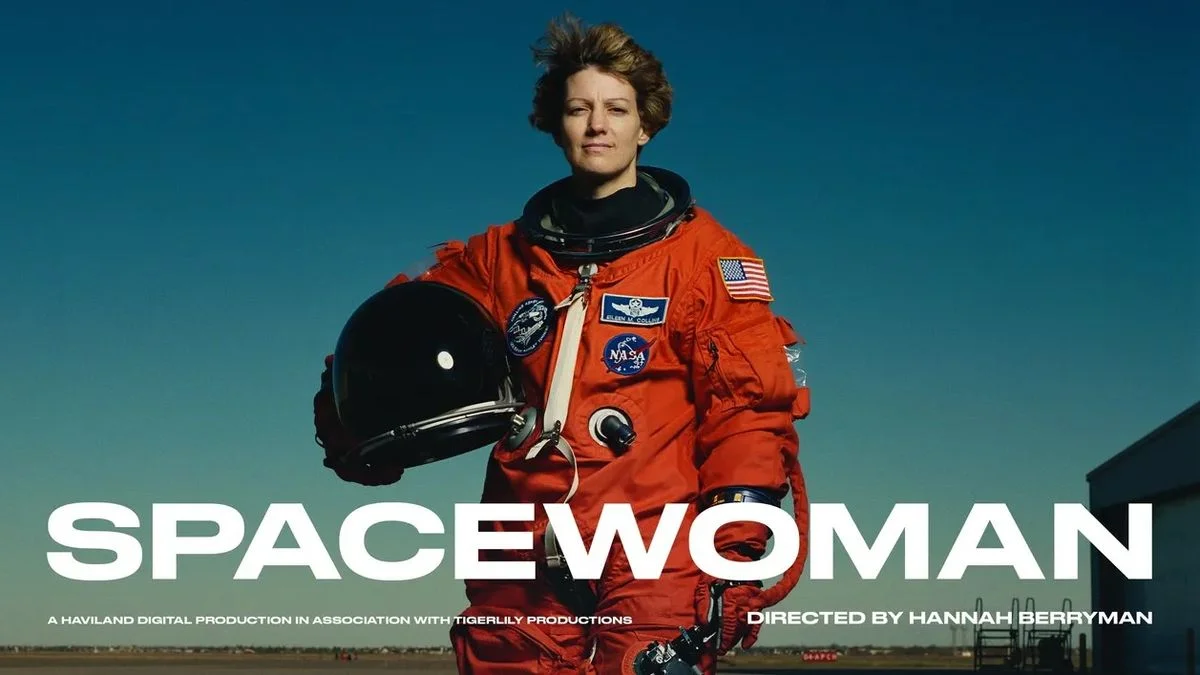

Eileen Collins answers Hannah Berryman’s opening question about good astronauts with the precision of someone who has spent a career converting danger into procedure. A good astronaut does not panic, she says. Problems become challenges, sometimes even exciting ones. Spacewoman spends the rest of its running time testing that principle against a life in which composure was demanded long before NASA entered the picture.
Berryman’s documentary traces Collins from a working-class childhood in Elmira, New York, through the Air Force and into the Space Shuttle program, where she became the first woman to pilot a shuttle in 1995 and the first to command one in 1999. Those milestones could easily support a polished story of exceptionalism. The film is sharper when it asks what institutions require from the exceptional women they celebrate afterward.
Family photographs, home movies, NASA recordings and present-day interviews keep Collins from hardening into an emblem. She speaks with the same measured control seen in archival footage, yet the material around her gradually reveals how much effort that control has required.
Training for a World Built by Men
Collins learned responsibility in circumstances far removed from launchpads. Her father drank heavily and could become angry, while her mother Rose struggled to keep four children secure. One of the film’s quietest and harshest memories has Collins sitting beside her sister Margy, recalling the day she drove behind an ambulance carrying their mother after Hurricane Agnes struck Elmira.
Flying offered a different kind of order. Collins, painfully shy and struggling with a severe stutter as a child, discovered confidence in the cockpit. At 19 she worked several jobs to finance lessons, then entered the Air Force through ROTC at a moment when the military was still testing its willingness to place women in demanding aviation roles.
The archival interviews expose the absurd arithmetic women faced. Collins understood that a female pilot could perform at the same level as a male colleague and still be regarded as less capable. Equality required surplus proof.
Berryman avoids turning every sexist encounter into an applause cue. The sharper scenes simply show Collins adapting. Her remark that growing up with her father taught her something about how men think carries a weary practicality. She learned how male authority operated because her ambitions depended on surviving inside it.
Her route to NASA was equally calculated. Collins wanted to command missions, knew shuttle commanders usually came through the pilot corps, and pursued the test-pilot experience needed to reach that seat. The childhood wish to become Captain Kirk sounds playful. The career that followed was anything but accidental.
The Mission That Mattered Most
The famous landmarks arrive in chronological order. In 1995 Collins pilots Discovery during the first Space Shuttle rendezvous with Russia’s Mir station. Four years later, she commands a shuttle mission, carrying the extra burden assigned to every woman who becomes a first: personal failure risks being treated as evidence about an entire sex. Yet Spacewoman finds its most revealing chapter after Collins has already made history.
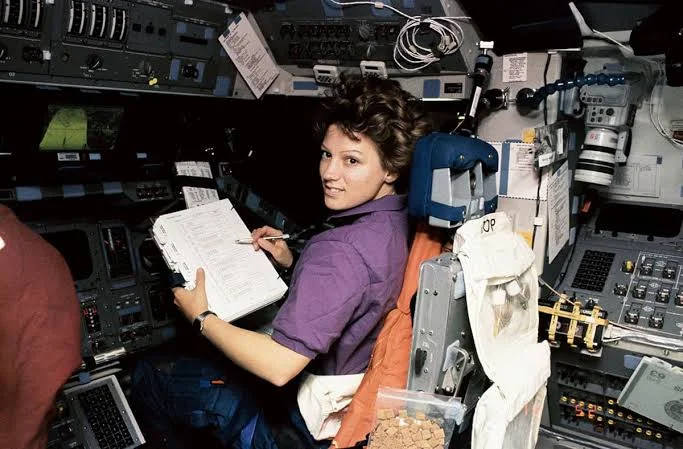
STS-114, flown in 2005, was NASA’s Return to Flight mission following the Columbia disaster. Berryman draws on astronauts, engineers and flight personnel including Charlie Camarda, Cady Coleman, Mike Foale, Wayne Hale and Paul Hill to explain the risks facing Discovery after damage raised fears about the shuttle’s safe return.
The technical discussion stays unusually clear. Diagrams and archival mission footage establish what could go wrong, while the editing steadily narrows attention toward Collins and her crew. Marcelo Zarvos’s score applies pressure without turning the sequence into manufactured spectacle. The outcome is known, yet the film restores uncertainty to events history has already settled.
That sequence also corrects the easiest reading of Collins’s career. Her importance cannot be contained by the phrase “first female commander.” During a mission carrying enormous symbolic weight for NASA after Columbia, she had to exercise judgment while the possibility of another catastrophe remained painfully imaginable. The institution had given her history. Now it needed competence.
The People Watching the Sky
The film becomes most culturally revealing when Berryman turns from the cockpit toward the family waiting below it. Collins’s husband, Pat Youngs, understood aviation firsthand and reorganized family life around her career. Their daughter Bridget experienced something harder to rationalize. Challenger had already made spaceflight’s danger part of American memory, and Collins had to explain that disaster to a child who knew her own mother intended to board a shuttle. Then Columbia broke apart.
Bridget’s interviews resist the comfortable language usually attached to pioneering women. A mother can make history while her daughter fears she will die doing it. Professional achievement does not erase resentment, missed time or the emotional bargain imposed on children who never volunteered for NASA’s risks.
One revealing anecdote concerns astronaut families being moved to a secluded beach house after disaster, partly to shield them from reporters. For the children it could resemble an unusual holiday. For the adults it was institutional crisis management shaped around the possibility that their spouses might never return.
The final book-signing footage finds Collins speaking with a young girl dressed in a junior flight suit. It would be easy to read the scene as inspirational punctuation. Berryman has already complicated that reading. The child can imagine herself inside that uniform because women such as Collins entered institutions that questioned their presence, performed under heightened scrutiny, and carried those demands home to their families. The glass ceiling may break with a satisfying sound. Someone still has to stand underneath it.
Spacewoman premiered on digital platforms like Prime Video. The documentary explores the extraordinary life and career of Eileen Collins, the first woman to pilot and command an American space shuttle.
Where to Watch Spacewoman (2024) Online




Full Credits
Title: Spacewoman
Distributor: Dogwoof, Prime Video
Release date: June 2, 2025 (North American Digital Release)
Rating: 16+
Running time: 1 hour 41 minutes
Director: Hannah Berryman
Writers: Hannah Berryman (based on the memoir by Eileen Collins and Jonathan H. Ward)
Producers and Executive Producers: Natasha Dack Ojumu, Keith Haviland
Cast: Eileen Collins, Cady Coleman, Pat Youngs, Bridget Youngs, Paul Hill, Marcia Dunn, Mike Foale
Director of Photography (Cinematographer): James Gold
Editors: Ian Salvage
Composer: Marcelo Zarvos
The Review
Spacewoman
Spacewoman treats Eileen Collins’s historic career without reducing her to a ceremonial “first.” Hannah Berryman finds greater meaning in the structures Collins had to survive: childhood instability, military sexism, NASA’s culture of risk, and a profession that asked her family to live beside catastrophe. The STS-114 material gives the film genuine suspense, while Bridget Youngs’s perspective prevents achievement from becoming uncomplicated triumph. Collins emerges as disciplined, extraordinarily capable, and painfully human, which makes the documentary’s final encounter with a young aspiring pilot feel earned rather than manufactured.
PROS
- Rich NASA archival material
- Strong family perspectives
- Excellent STS-114 tension
- Clear treatment of institutional sexism
- Collins’s candid interviews
CONS
- Conventional chronological structure
- Limited scrutiny of NASA itself
- Some inspirational framing feels familiar







