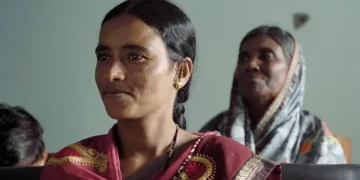

























Grief has no private room in Sanjivani Bhure’s life. It follows her into the fields, sits beside the laundry, waits near the cooking fire, and travels with her whenever she leaves the house under the suspicious gaze of relatives. Eight years after her husband died by suicide, she is still living inside the consequences of a death produced partly by forces much larger than either of them.
Kinshuk Surjan places those forces near the beginning of Marching in the Dark. At an agricultural auction in Maharashtra, farmers watch their produce valued at prices that barely acknowledge the labour required to grow it. An elderly farmer complains that cultivators never receive what they deserve. The film then cuts toward the human cost of that arithmetic. Sanjivani has two children to raise and little space in which to imagine a different life. Her husband’s debts did not disappear with him. Neither did the farm, the crops or the social expectations waiting for his widow.
Surjan could have turned this material into an examination of agricultural policy, debt and the staggering number of farmer suicides recorded across India over the past two decades. Instead, he stays close to one household. Statistics describe the scale of catastrophe. Sanjivani shows what catastrophe looks like the morning after everyone else has stopped counting.
Labour Without Silence
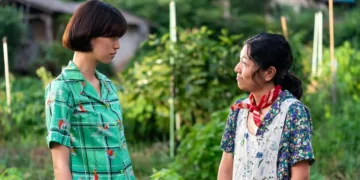
The camera rarely catches Sanjivani doing nothing. She harvests crops. She cooks. She cleans. She washes clothes. She cares for her children and contributes labour to her brother-in-law’s household while trying to establish some economic independence through education and work outside farming. Each task seems ordinary when considered alone. Accumulated across a day, they become a life built almost entirely from obligation.
Surjan’s patience allows small injuries to carry unusual force. Sanjivani’s daughter watches others receive gifts while she is excluded. Sanjivani herself faces questioning whenever she leaves the family home. To attend meetings with other widows, she sometimes needs to invent explanations for her absence. There are no chains here. There do not need to be.
The restrictions attached to widowhood operate through custom, expectation and shame. Women in the film describe being kept away from celebrations because their presence is considered unlucky. Death has already taken their husbands, yet society seems determined to make the widows carry its symbolism too.
Against this, one scene of Sanjivani lying beside her children feels almost startling in its softness. She plays along with their games, and for a few minutes motherhood is allowed to exist outside exhaustion. The camera sits close without forcing sentiment from the moment. Her face does enough.
Women Speaking Into the Dark
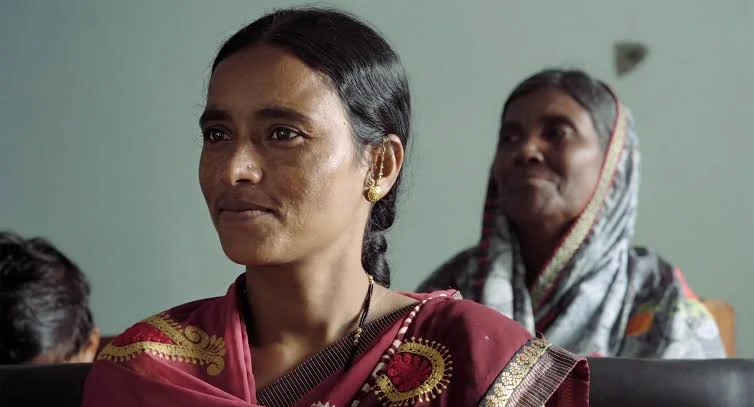
The film changes whenever Sanjivani enters the widow support group. At first she seems hesitant, listening while other women speak about lives marked by bereavement and restriction. Their stories gradually widen the film beyond one family. One woman talks about having been a child bride.
Another openly discusses her decision to remarry, an act still treated as socially unacceptable within her village. Others describe loneliness, anger, money problems and the strange condition of becoming visible as a symbol of bad fortune while becoming invisible as a person.
A counsellor tells them to make their sandals strike the ground loudly and keep walking. It is a wonderfully physical instruction. Sound becomes permission. Sanjivani begins to speak too. Her change is gradual enough to feel earned. She continues her education, searches for work beyond agriculture and starts claiming time that once belonged entirely to other people. The meetings do not erase grief. They alter its shape. Private suffering becomes something shared, named and therefore slightly less absolute.
Surjan leaves the organisation behind these sessions frustratingly indistinct. We see what the meetings accomplish among the women but learn little about how the programme operates or how far its reach extends. The omission matters because this room is one of the few places in Sanjivani’s world built expressly for women like her.
Flames in a Carefully Composed Night
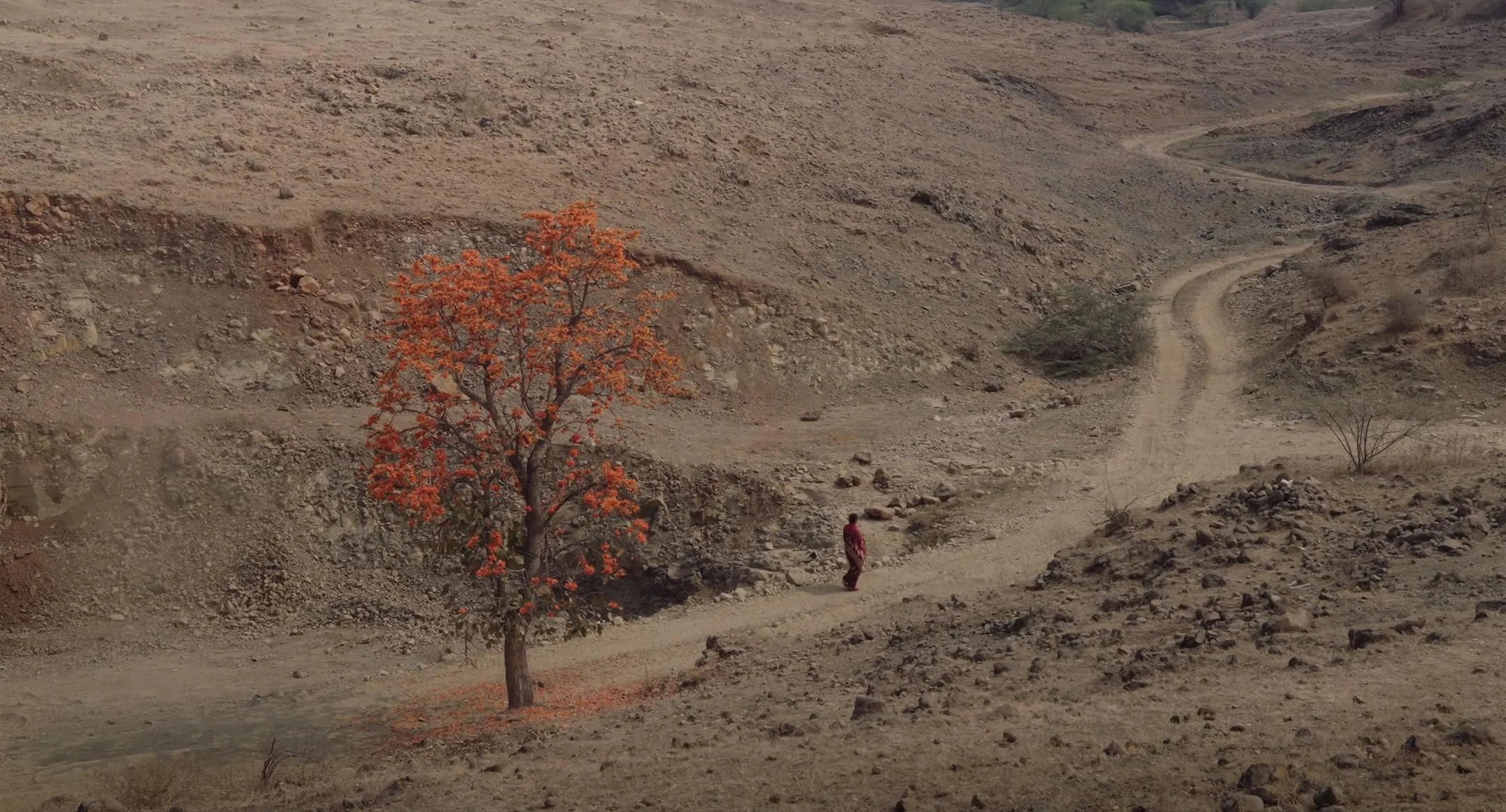
Cinematographers Leena Patoli, Carl Rottiers and Vishal Vittal frequently position the camera near floor, chair or bed height. Sanjivani is rarely photographed as an object of pity observed from afar. The lens works beside her. Long takes give ordinary actions time to acquire emotional weight.
The muted grading, sometimes resembling colourised black-and-white photography, turns fields and interiors into spaces caught between memory and the present. It is beautiful, though the beauty occasionally raises an uncomfortable question about how carefully this supposedly observational reality has been shaped.
Some scenes possess the tidy precision of fiction. The hushed conversations, restrained tears and carefully balanced compositions can make spontaneous life feel prearranged. Surjan’s control gives the documentary coherence, yet it occasionally places glass between the viewer and the people being filmed. Sanjivani keeps breaking that glass.
Near the sewing machine, she hesitates. Her composure slips for a moment. She almost breaks down, then gathers herself and continues. Nothing dramatic changes around her. The machine remains there. The work remains. Tomorrow remains.
The Marathi title, Andharatlya Mashali, translates closer to “Flames in the Darkness.” That phrase belongs to these women with painful precision. They are surrounded by a night they did not choose, striking their sandals against the earth loudly enough to prove they are still here.
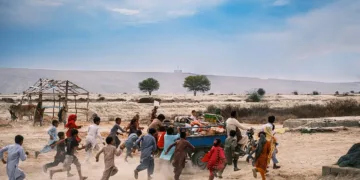
Marching in the Dark had its international premiere at the CPH:DOX film festival in March 2024, later expanding to international festivals and streaming on platforms like MUBI. The powerful documentary follows resilient women farmers in rural Maharashtra, India, as they cope with the devastating loss of their husbands to suicide and unite to forge a path toward independence and healing.
Where to Watch Marching in the Dark (2024) Online

Full Credits
Title: Marching in the Dark
Distributor: Clin d’Oeil Films, MUBI
Release date: March 2024 (CPH:DOX)
Running time: 1 hour 50 minutes
Director: Kinshuk Surjan
Writers: Kinshuk Surjan
Producers and Executive Producers: Evelien De Graef, Hanne Phlypo
Cast: Sanjeevani Bhure
Director of Photography (Cinematographer): Leena Patoli, Carl Rottiers, Vishal Vittal
Editors: Joëlle Alexis
The Review
Marching in the Dark
Marching in the Dark finds its deepest sorrow in what happens after a death, when debt, labour and inherited customs continue pressing against the living. Sanjivani’s quiet persistence gives the film its pulse, especially when the camera simply watches her work, study, care for her children, or gather herself at the sewing machine. Surjan’s carefully sculpted images occasionally make lived experience feel arranged, and the support organisation remains frustratingly indistinct. Yet the widows’ meetings create something rare: grief spoken aloud until isolation begins to loosen its grip.
PROS
- Sanjivani’s quietly powerful presence
- Intimate, patient cinematography
- Exceptional widow support-group scenes
- Strong focus on grief after suicide
- Restrained emotional approach
CONS
- Occasionally over-controlled presentation
- Stylised grading can feel artificial
- Support organisation lacks detail