


























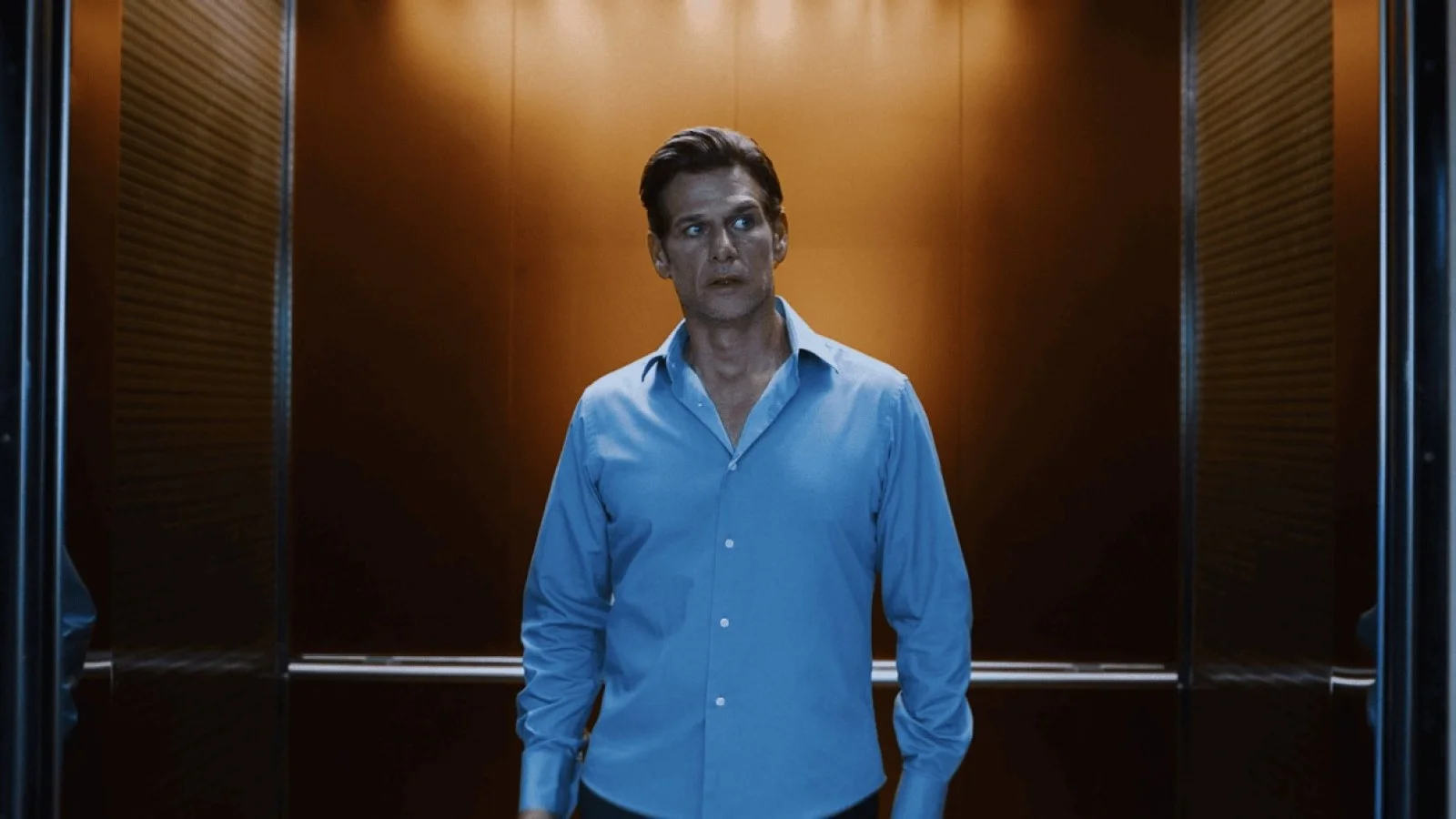

Payton Burnham cannot stop looking at himself through other people’s eyes. Early in PH-1, the Illinois senator lies awake scrolling through social-media praise after a successful event promoting his water-safety initiative. The habit feels harmless at first, almost embarrassingly relatable. Soon, it becomes the mechanism through which his entire life is dismantled.
Mark Kassen directs, co-writes with Cheryl Guerriero, and plays Payton, a politician whose polished public image already has hairline cracks. His aide Becca (Dina Shihabi) calls about squeezing another media appearance from the previous night’s momentum. His wife Catherine (Rebecca Amzallag), shepherding their children through the morning, presses him about staying out late. Payton handles both conversations with the smooth calibration of somebody accustomed to adjusting his personality for the room. Then the family leaves.
A mysterious caller named Buddy contacts Payton and demonstrates control over the penthouse’s phones, cameras, internet connection, doors, and electrical systems. Photographs implying an affair between Payton and Becca appear online. The senator’s relaxing day off becomes a hostage situation in which the weapon is public opinion.
Politics by Push Notification
The strongest stretches of PH-1 understand that watching a reputation collapse can create its own kind of suspense. Buddy does not need to burst through the door. He can publish something, wait several seconds, then let Payton’s phone tell him how much damage it caused.
That rhythm gives the film its best scenes. A leak appears. Payton checks his feed. Cable host Monica Hall (Vinessa Shaw) discusses the developing scandal. Another accusation lands before Payton has worked out how to contain the previous one. The news broadcasts and social-media inserts let Kassen widen the story beyond the apartment without abandoning the restricted location.
Payton’s addiction to approval makes the setup sting. Those glowing reactions from the opening have trained him to treat the internet like a scoreboard, so watching the numbers turn against him feels less like observing bad publicity and closer to watching somebody suffocate while staring at an oxygen meter.
The film belongs to the same family as Phone Booth, with a little of The Game in Buddy’s seemingly impossible ability to predict his victim. That familiarity helps because Kassen and Guerriero keep the first two acts moving quickly. Payton tests allies, questions the motives of people around him, and tries to identify who could possess this much access to his private life.
Some of Buddy’s tricks are shakier in 2026. Audio supposedly proving that a loved one is in danger carries less certainty in an age of convincing synthetic voices. A caller demonstrating surveillance by describing Payton’s clothing is hardly supernatural either. PH-1 occasionally asks modern viewers to fear technology that has already taught them to distrust the evidence it produces.
Locked In With Mark Kassen
Kassen has to carry long stretches alone, often with nothing except a phone conversation and Payton’s changing calculations. The performance is most convincing when the senator is still trying to manage people rather than survive Buddy.
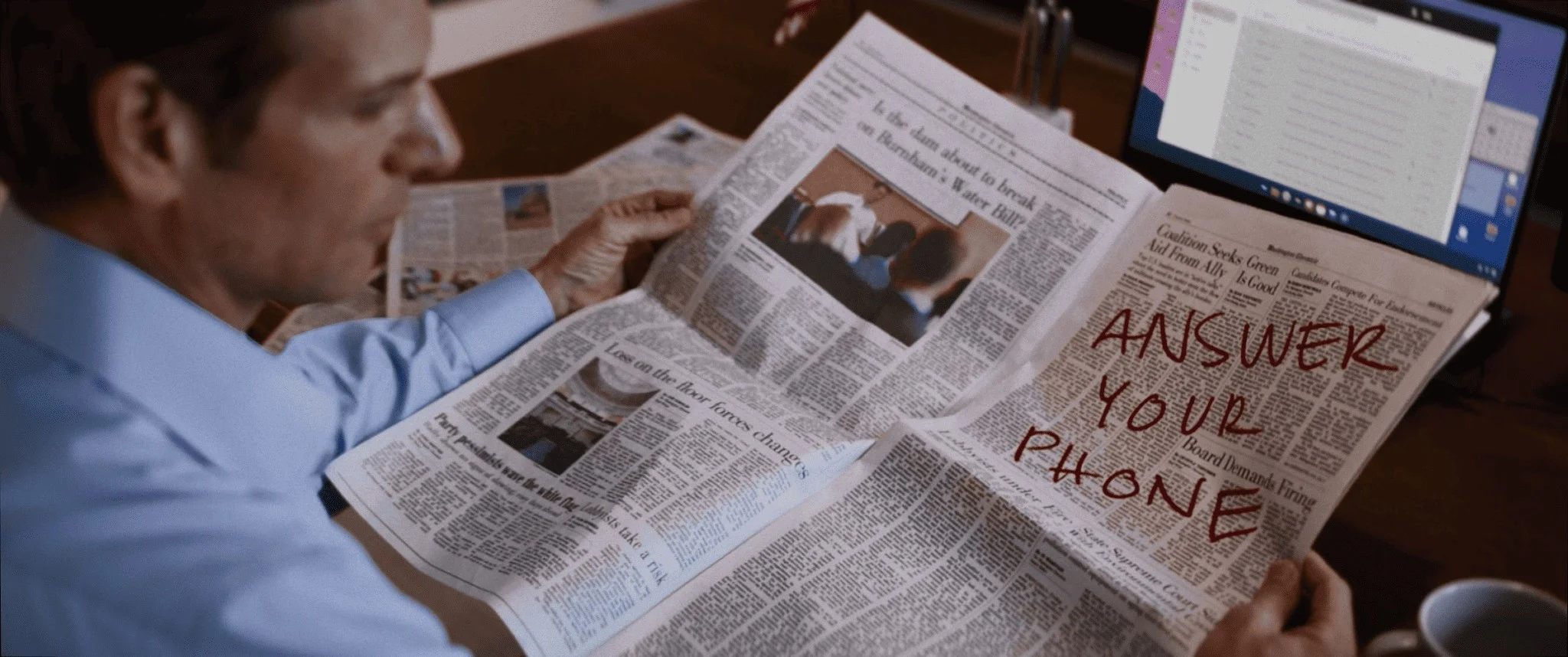
Watch how Payton speaks to Becca compared with Catherine. His warmth changes by degrees. Neither version feels entirely false, yet both feel practiced. When scandal hits, the same instinct remains. His first response is often to work out what story will play, who can be persuaded, and which relationship can still be useful.
That slipperiness keeps him interesting. PH-1 never gives us enough certainty early on to decide that Payton deserves rescue or punishment. A cleaner hero would actually hurt the film, since Buddy’s accusations gain tension from the possibility that some of them may be true.
The apartment itself is less effective. Restricted-location thrillers usually turn geography into pressure. Here, Payton moves through bedrooms, hallways, living areas, and his office without the layout becoming clear enough for us to feel trapped alongside him. Security-camera shots should make every room feel watched. Their repetition sometimes produces the opposite sensation, flattening different spaces into similar high-angle images.
Eye-level, waist-up compositions dominate many conversations too, which places extra weight on Kassen’s reactions. Some threats involving his family need a sharper physical response than he gives them. When the screenplay raises the emotional temperature, his performance occasionally stays stuck in political-crisis mode. The phones, monitors, feeds, and television reports carry much of the visual energy instead. The penthouse may not tighten around Payton, but the screens do.
When the Phone Explains Itself
Buddy is most frightening before PH-1 tells us too much about him. The caller’s icy confidence creates an enjoyable imbalance: Payton keeps scrambling for information while Buddy seems to have already read the next page.
That imbalance also invites the audience to start solving the film. Who has access? Which grievance connects to Payton? Which apparent ally could be participating? The mystery grows because every new piece of information can be read several ways.
The final revelations struggle against the theories created by that setup. Once motives and collaborators become clearer, moral ambiguity gives way to a tidier explanation. Buddy also makes choices late in the film that reduce some of the controlled menace established through his earlier calls.
Monica Hall’s role in the later developments is more interesting because it extends the movie’s central anxiety. Politicians need media exposure, broadcasters need conflict, audiences need fresh outrage, and digital platforms reward anything capable of accelerating all three. Payton spends much of PH-1 trying to determine which accusations are true, yet truth gradually becomes only one variable in a system driven by circulation. That is where the film leaves its strongest impression. A notification does not have to be accurate to hurt Payton. It only has to arrive first.
PH-1 was released in theaters and on digital platforms in April 2026 by Buffalo 8, and is available to stream on video-on-demand platforms. The political thriller follows a rising politician who is held hostage inside his luxury penthouse by an unseen captor and forced to watch his life and reputation be destroyed in real time through manipulated media feeds.
Where to Watch PH-1 (2026) Online









Full Credits
Title: PH-1
Distributor: Buffalo 8
Release date: April 17, 2026
Rating: TV-MA
Running time: 1 hour 25 minutes
Director: Mark Kassen
Writers: Cheryl Guerriero, Mark Kassen
Producers and Executive Producers: Mark Kassen, Iliana Nikolic
Cast: Mark Kassen, Abubakar Salim, Dina Shihabi, Jesse L. Martin, Vinessa Shaw, Sarah Adina, Rebecca Amzallag
Director of Photography (Cinematographer): Sven Estos
Editors: Martin Pensa
Composer: Adam Peters
The Review
PH-1
PH-1 works best when every notification feels like another lock snapping shut around Payton Burnham. The real tension comes from watching a man who lives through public perception lose control of the image he built, and Mark Kassen keeps that pressure moving at a brisk clip. The penthouse never becomes as claustrophobic as it should, while Buddy’s reach eventually stretches credibility and the final revelations flatten some of the earlier ambiguity. Still, the social-media siege gives this compact thriller enough bite to hold attention.
PROS
- Fast, escalating social-media pressure
- Payton’s slippery moral ambiguity
- Effective news and phone inserts
- Strong first two acts
- Compact 85-minute runtime
CONS
- Underused penthouse geography
- Repetitive visual framing
- Buddy’s abilities strain credibility
- Final reveal weakens the mystery