









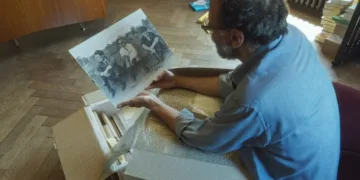








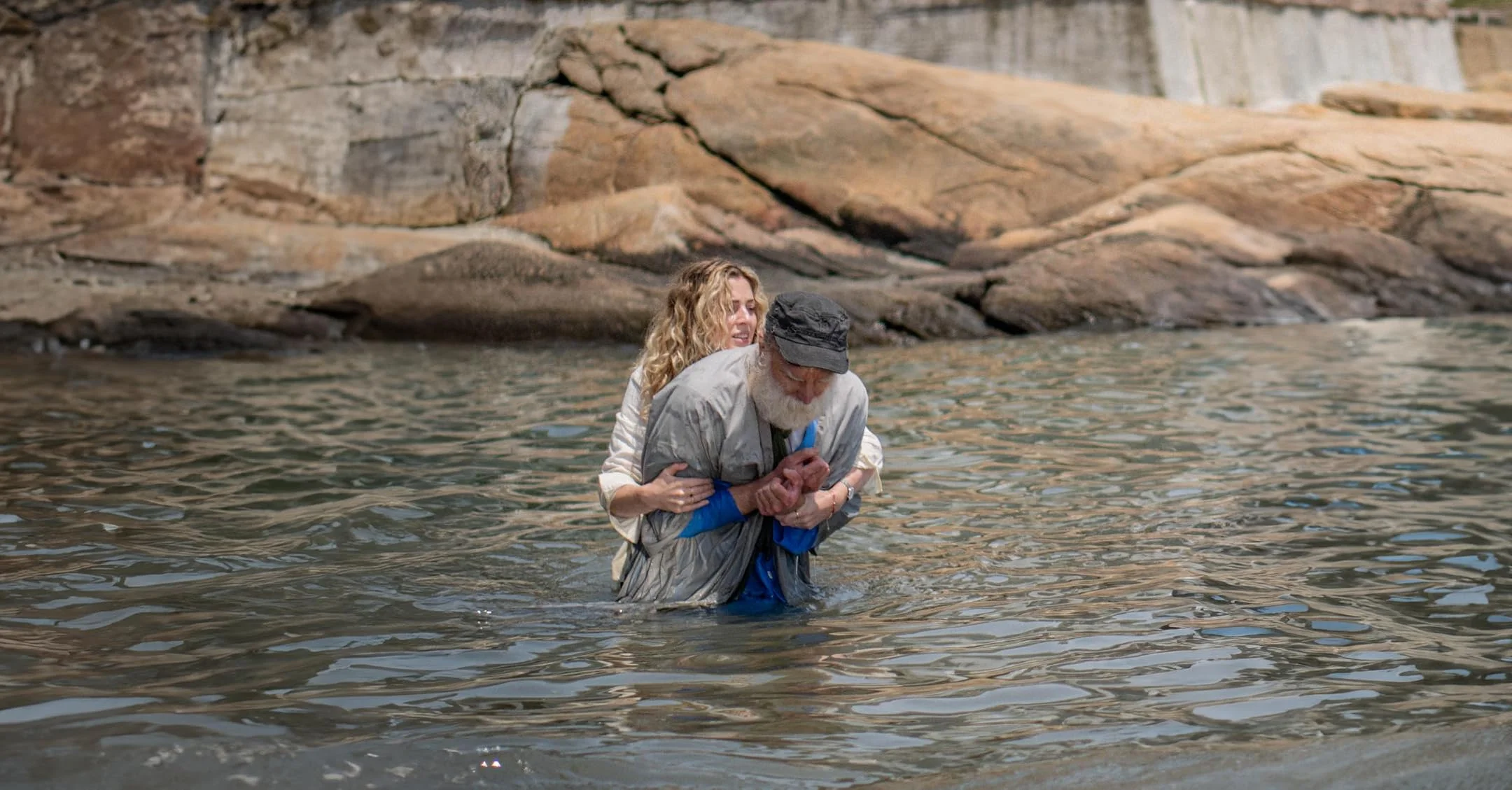

Robert Pearson spent his youth inside one of America’s most exportable fantasies: the Hollywood leading man. Decades later, the posters remain on the walls of his Connecticut home while Robert himself can barely move through it without help. Dillon Bentlage builds Watching Mr. Pearson around that cruel discrepancy, using a vanished movie culture to ask what survives once the image has outlived the person who created it.
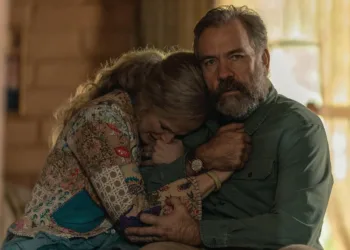
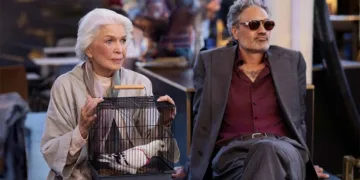
Pearson, played by Hugo Armstrong, has dementia and relies on two caregivers working opposite shifts. Caroline (Dominika Zawada), a Polish immigrant, encourages him to revisit scenes from his old films. Miguel (Luis Rizo), a first-generation American working nights, considers the practice dangerous because Robert already struggles to separate memory from his surroundings.
Bentlage and co-writer Simon Kienitz Kincade keep the story concentrated inside that triangle. Fame, immigration, labor, and aging all enter through the ways these three people understand a successful life. Robert once embodied the American Dream at its most photogenic. Caroline still treats possibility as something worth protecting. Miguel has learned to distrust easy optimism. Their differences give a modest chamber drama a distinctly American tension.
When Cinema Becomes Memory
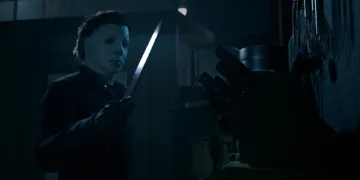
The film’s smartest device is casting Sam Bullington as Robert in his younger years rather than leaving the past trapped on posters and television screens. Bentlage recreates noir, melodrama, and other classical Hollywood forms with enough care that the opening black-and-white footage could briefly be mistaken for an older production. Those fragments establish young Robert as somebody accustomed to occupying a room before Armstrong shows us the physical cost of time.
Caroline discovers that Robert becomes sharper when he performs. During ordinary routines he may withdraw or resist her, yet familiar dialogue brings rhythm back into his voice. She begins reading scripts with him and stepping into his remembered movies. Her method is professionally questionable, though Zawada makes the emotional logic easy to understand. She sees participation where others might see symptoms.
The defining sequence places old Robert across a pool table from his younger self. Bullington carries the cockiness of a star playing a pool shark, while Armstrong answers him with the irritation of someone who knows exactly where that confidence leads. They trade shots and lines as if decades were simply another opponent waiting for a turn.
It works because the scene draws on a recognizably American movie mythology. The handsome rebel, the pool hall, the cool stare, the belief that youth can bargain with consequence. Robert confronts the exported image of American masculinity he once helped manufacture. The older man cannot defeat it because the younger one has already won. His face is still on the wall.
Care Across Generations
Caroline and Miguel approach Robert from opposite directions, and the film refuses to reduce either method to an easy moral lesson. Caroline enters Robert’s imagined reality because doing so produces visible moments of happiness and alertness. Miguel sees what follows after her shift ends: fatigue, confusion, and a man whose grasp on his surroundings can become increasingly fragile.

Rizo plays Miguel with an exhaustion that gradually clarifies his strictness. He is practical because care has become labor before it can become sentiment. Zawada gives Caroline an infectious playfulness, particularly during the recreated movie scenes, yet her affection sometimes pulls her past the distance her job requires.
Their backgrounds quietly sharpen the disagreement. Both characters exist adjacent to the mythology Robert once represented. Caroline’s optimism still carries faith in reinvention. Miguel’s perspective feels shaped by responsibility and repetition. Through them, Bentlage turns elder care into another angle on American aspiration, one where immigrants and their children sustain people who once represented the culture’s glamorous public face.
Armstrong keeps Robert from becoming an object around which these debates occur. Watch his eyes when a familiar line returns, or the change in his posture when he briefly occupies one of his former roles. His anger during moments of coddling carries the sting of someone aware, at least intermittently, that other people have begun treating him as a child.
Two Americas on the Same Screen
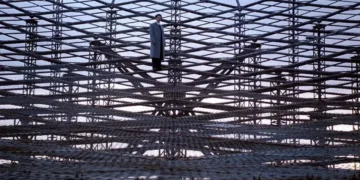
Peter Nogueira’s cinematography avoids turning dementia into permanent visual darkness. Robert’s home frequently receives soft natural light, while views of the Connecticut shoreline give the story space outside his increasingly restricted physical world. The choice makes the old film recreations stand apart through texture and composition rather than simply dividing past and present into light and shadow.
Jasper Van Dijk and Kyle Franklin use the score similarly. Older genre textures emerge around Robert’s cinematic memories, with trumpet accents restoring some of the grandeur attached to his screen identity. The music changes when Robert does. Performance briefly gives him access to an emotional vocabulary ordinary conversation can no longer reliably reach.
A later dance passage takes that idea further by allowing youth and old age to occupy the same imaginative space. The body Robert remembers moves with an ease the present one has lost. Bentlage occasionally makes these subjective transitions too vague, especially near the later stages of the film, yet the strongest ones use cinema itself as Robert’s remaining country.
That makes Watching Mr. Pearson unusually attentive to the cultural machinery behind nostalgia. Robert’s films preserved an American ideal of confidence, beauty, and permanence that audiences around the world learned to recognize instantly. His present life exposes what those images leave outside the frame: dependency, immigrant labor, deteriorating memory, and the ordinary human need to have someone nearby when the performance ends.
Watching Mr. Pearson launched its U.S. theatrical rollout on April 9, 2026, through RBL Films in partnership with KT Pictures and Hedy Films. The indie drama follows an aging, once-renowned actor living with dementia whose two distinct caregivers use imagination, performance, and classic movie memories to help him stay connected to reality.
Full Credits
Title: Watching Mr. Pearson
Distributor: RBL Films, KT Pictures, Hedy Films
Release date: April 9, 2026
Running time: 1 hour 22 minutes
Director: Dillon Bentlage
Writers: Dillon Bentlage, Simon Kienitz Kincade
Producers and Executive Producers: Dillon Bentlage, Simon Kienitz Kincade, Brian Reilly, Michael Skolnick, Samantha Rose Valletta
Cast: Hugo Armstrong, Dominika Zawada, Luis Rizo, Sam Bullington
Director of Photography (Cinematographer): Peter Nogueira
Editors: Jurriaan van Nimwegen
Composer: Kyle Franklin, Jasper van Dijk
The Review
Watching Mr. Pearson
Watching Mr. Pearson uses the grammar of classical Hollywood to examine what happens after the camera, fame, and physical certainty have disappeared. Dillon Bentlage’s sharpest choice is allowing Robert’s cinematic past to invade his present, especially during the superb pool-table encounter between Hugo Armstrong and Sam Bullington. Armstrong gives dementia dignity without smoothing away its anger or confusion, while Caroline and Miguel expose two credible philosophies of care. A few secondary themes receive limited room, yet the film’s intimate scale suits its concern with memory, identity, and the people who remain when public recognition fades.
PROS
- Hugo Armstrong’s restrained performance
- Excellent pool-table sequence
- Convincing old-Hollywood recreations
- Nuanced caregiver conflict
- Thoughtful visual treatment of dementia
CONS
- Some secondary themes feel compressed
- One late subjective sequence turns unnecessarily vague
- Supporting characters receive limited development