

























![Kingdom Hearts Collection [I-III] Review](https://gazettely.com/wp-content/uploads/2026/10/Kingdom-Hearts-Collection-I-III-1-360x180.webp "Kingdom Hearts Collection [I-III] Review: KHII Holds Steady as Newer Entries Fluctuate 37")





Judy Kaplan has built a career around identifying narcissists, which is precisely why her daughter’s engagement terrifies her. She teaches psychology at NYU, writes bestselling relationship books, and speaks with the authority of someone who has converted private damage into public expertise. Her marriage to Edward left that expertise with scar tissue. He persuaded her to abandon plans for Oxford, then left her raising their daughter Eva with enough resentment to turn romantic caution into a worldview.
So when 22-year-old Eva announces that she plans to marry Theo, a 29-year-old doctor she has known for six weeks, Judy does not hear wedding bells. She hears history clearing its throat.
That is the central intellectual tension in You’re Dating a Narcissist!: when does experience become wisdom, and when does it become projection? Director Ann Marie Allison and co-writer Jenna Milly have a genuinely useful question here. Judy knows the patterns she is looking for, yet knowing a pattern can become dangerous once every new person begins resembling the old one.
She flies to California with her friend Diane, who has just discovered that her own girlfriend has lied about separating from her wife. This should make Diane Exhibit A in Judy’s defense. Instead, the film turns both women loose inside something closer to screwball farce.
Professional Judgment, Amateur Surveillance
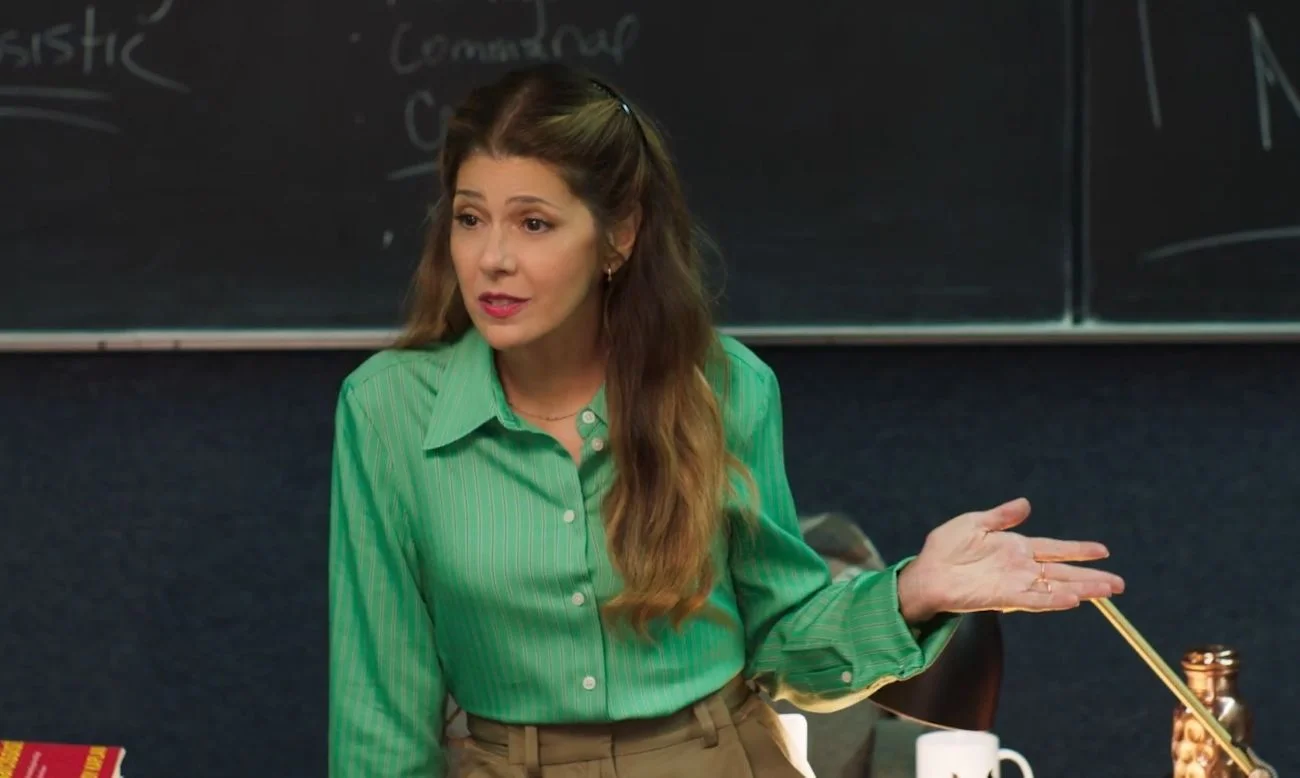
Judy’s investigation of Theo quickly becomes ridiculous. She follows him, records him from bushes, constructs improvised traps, and treats each ambiguous gesture like material for a graduate seminar. Marisa Tomei commits completely to this descent from composed professor to suburban spy, giving Judy a breathless physical energy that keeps scenes moving long after the screenplay has started repeating itself.
The trouble is conceptual. The movie wants us to question Judy’s certainty, yet it frequently accomplishes that by making her look foolish rather than making her reasoning genuinely difficult to assess. There is a difference. A woman crawling through shrubbery with her phone out is easy to dismiss.
A trained psychologist identifying several credible warning signs in a charming future son-in-law would force the audience into a far less comfortable position. Call this the Cassandra-with-a-ring-light problem. The script gives Judy knowledge, then packages that knowledge so theatrically that everyone around her can ignore it.
Theo helps sustain the uncertainty because Marco Pigossi plays him with an easy warmth. He is courteous to Judy, affectionate toward Eva, and composed when placed under scrutiny. Then his wealthy family enters the picture, with his domineering mother Mary abruptly announcing an accelerated wedding at the Keller home. Suspicion returns.
The film keeps nudging Judy toward vindication, then pulling her back toward paranoia. Secondary complications involving Theo’s former fiancée Simone and Eva’s ex-boyfriend Tyler should deepen that uncertainty. Tyler’s appearance is so brief that he feels less like a character than a screenplay notification.
Mothers, Daughters, and Unfinished Arguments
The sharper film is hiding inside Judy and Eva’s relationship. Judy sees intervention as maternal duty. Eva sees the same behavior as proof that her mother does not trust her adulthood. Neither interpretation is absurd. Their conflict becomes frustrating because the screenplay leaves too much of its emotional history unwritten.
Eva speaks of Judy with affection early on, yet once Judy reaches California she repeatedly tells her to leave and excludes her from major decisions. Edward, meanwhile, seems to retain a strange degree of access to Eva’s life after having failed both mother and daughter. The film needed a clearer account of how these loyalties formed.
Diane’s subplot exposes another weakness in the same structure. She has been deceived by Lauren, yet she still mocks Judy’s obsession with toxic relationships while relying on Judy when her own romance implodes. Sherry Cola gives those scenes speed and bite, particularly when Diane swings between sarcasm and humiliation, but the contradiction feels underexamined.
Eva repeats the pattern from another direction when she starts texting Tyler after suspecting Theo of cheating. Here the film briefly finds something much richer than romantic chaos. Three intelligent women each know enough to recognize bad behavior, yet knowledge does not prevent any of them from acting irrationally once attachment enters the room. Apparently the human brain did not read the syllabus.
The Romance Judy Wasn’t Looking For
Daniel, the widowed owner of La Luz Dorada Inn & Spa, gives Judy the one relationship in the film where nobody seems to be performing a psychological theory. Their first meeting is pure rom-com machinery. Judy assumes he is flirting and sharply rebukes him. He was merely returning the driver’s license she left at reception. The joke is obvious, but José María Yazpik plays Daniel with enough restraint that their later conversations become unexpectedly persuasive.
He listens without surrendering his judgment. He challenges Judy without reducing her to a hysterical mother. Most importantly, he seems to enjoy her company before asking her to change. That distinction matters because the rest of You’re Dating a Narcissist! repeatedly asks Judy to become easier for other people to tolerate. Daniel’s presence suggests something better: the problem may lie less in her intelligence or skepticism than in the way fear has colonized both.
The late revelation surrounding Judy’s recorded laptop message attempts to reframe everything that came before it. The idea is clever enough, but the setup is too thin for the reversal to feel inevitable in retrospect. It arrives like a psychological thesis suddenly attached to a romantic farce.
Judy’s move toward podcasting offers a final, telling irony. She finishes the story still analyzing relationships for an audience, still turning emotional disorder into professional material. Maybe she has changed. Maybe she has simply found a better microphone.
You’re Dating a Narcissist! premiered at the Austin Film Festival in October 2025 before receiving a nationwide theatrical release via Brainstorm Media on March 27, 2026. Written and directed by Ann Marie Allison, the comedy follows an outspoken psychology professor who flies to Los Angeles with her best friend to stage an intervention when her young daughter hastily gets engaged to a man she suspects is a manipulative narcissist.
Where to Watch You’re Dating a Narcissist! (2025) Online









Full Credits
Title: You’re Dating a Narcissist!
Distributor: Brainstorm Media
Release date: October 25, 2025 (Austin Film Festival), March 27, 2026 (United States)
Running time: 1 hour 31 minutes
Director: Ann Marie Allison
Writers: Ann Marie Allison, Jenna Milly
Producers and Executive Producers: Chris Abernathy, Ann Marie Allison, Robert Bauer, Brigid Brakefield, Jonathan Cogley, Eric B. Fleischman, Jorge Garcia Castro
Cast: Marisa Tomei, Sherry Cola, Ciara Bravo, Marco Pigossi, José María Yazpik, Jonah Platt, Lily Donoghue, Marcus Emanuel Mitchell
Director of Photography (Cinematographer): Martim Vian
Editors: Josie Azzam, Kristine McPherson
Composer: Maxton Waller
The Review
You’re Dating a Narcissist!
You’re Dating a Narcissist! has a smarter argument buried beneath its broadest comedy: expertise can become another form of control when fear supplies the evidence. Judy’s suspicion of Theo has understandable roots in Edward, yet the screenplay keeps turning her professional certainty into stalking gags until the ambiguity starts collapsing. Marisa Tomei keeps Judy human through the bushes, schemes, and lectures, while her quieter scenes with Daniel reveal the person the farce keeps obscuring. The late reversal is clever in concept, clumsy in preparation. Call it therapeutic slapstick with a diagnosis problem.
PROS
- Tomei’s committed comic performance
- Judy and Daniel’s quieter chemistry
- Sharp maternal-control premise
- Some credible narcissism observations
CONS
- Judy reduced to caricature
- Uneven mother-daughter conflict
- Underwritten supporting subplots
- Abrupt late-story reversal







