




























Renovation games usually reward the same instinct: measure twice, paint carefully, replace every broken fixture, then stand back and admire a room that looks suspiciously cleaner than anything most of us could manage at home. Low-Budget Repairs asks what happens if the player stops caring.
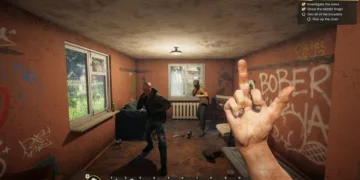
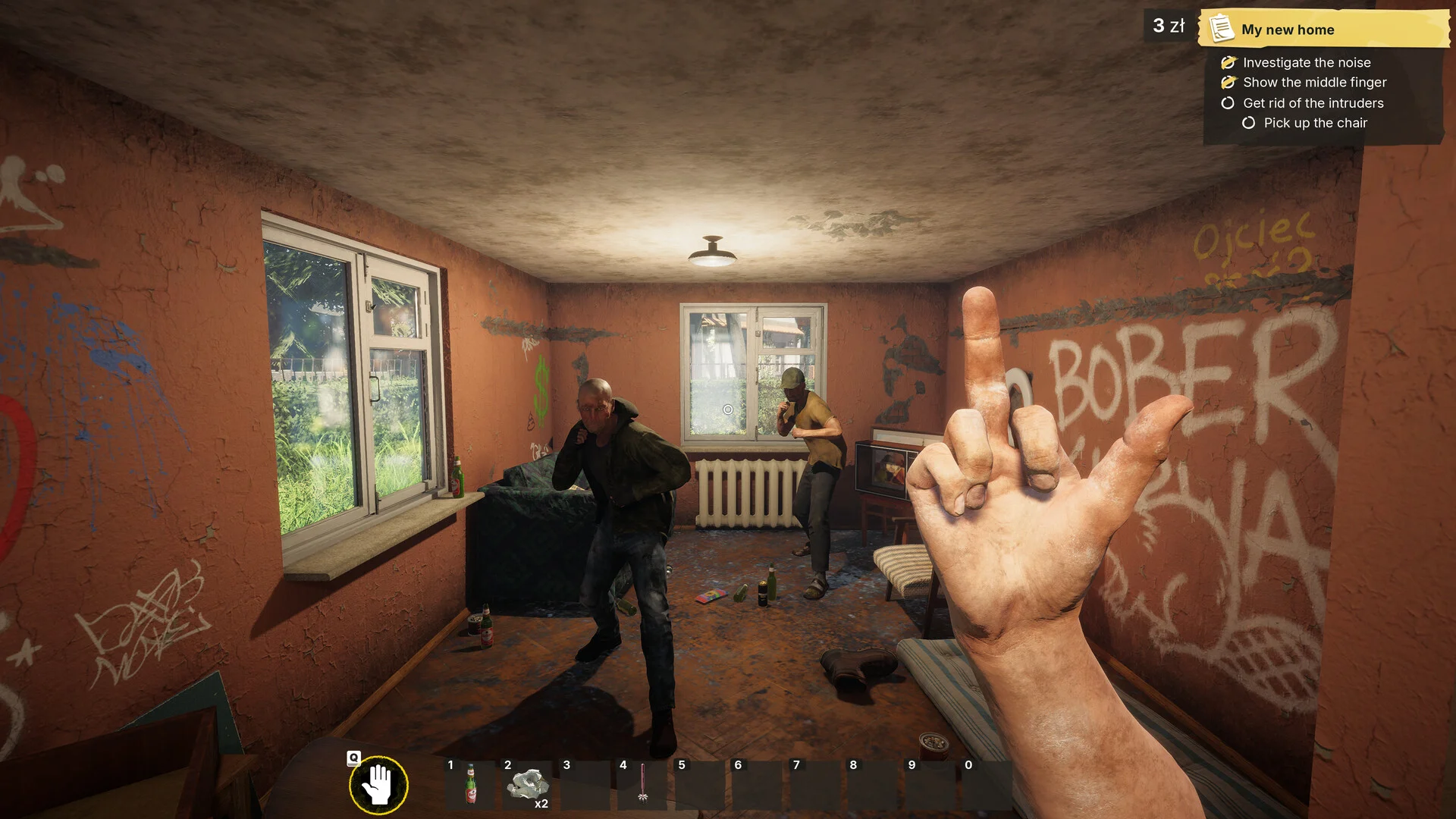
Maciek has inherited a shabby house from his American aunt, has little money to repair it, and soon falls under the questionable tutelage of local handyman Zbyszek. The lesson begins quickly. One of the earliest problems in Maciek’s new home involves squatters, and the solution involves throwing chairs at them. It is an efficient introduction to a game where professional standards are mostly theoretical.
Zbyszek soon dies in an accident, then returns as a ghost to continue Maciek’s education. His student begins taking renovation jobs, collecting materials and preparing for a local Super Handyman competition while working toward fixing his own house.
The premise gives Low-Budget Repairs something many renovation simulators lack: a campaign with actual characters, rivalries and comic escalation. The difference from games such as House Flipper becomes clear almost immediately. Those games transform repair work into a fantasy of precision. Here, precision may actively be a waste of your time.
Measure Once, Regret Nothing
Painting a wall badly is usually evidence that the player misunderstood a mechanic. Here it can be evidence that the player understood it perfectly. Maciek can drill in the wrong place, slap paint over unfinished surfaces, leave residue across the floor, break windows and steal unused supplies from clients.
A perfect job may earn a small bonus, yet spending extra time and materials for twenty additional dollars starts to look financially foolish. The game has taken the genre’s familiar scoring logic and replaced craftsmanship with cost-benefit calculation.
That joke works because it exists inside the systems. You are not watching Maciek behave like a terrible contractor during cutscenes and then becoming an immaculate tradesman once control returns. His philosophy follows you into the repair work.
There is surprising mechanical breadth behind it. Jobs can involve windows, doors, furniture, walls, tiles, electrical work and painting. Main missions ask you to consider what materials remain in your inventory, while side jobs tend to supply what is needed. Clients occasionally provide enough excess material to tempt you into taking some home. Given Maciek’s profession, “tempt” may be giving him too much credit.
Yet Low-Budget Repairs rarely develops every tool as far as its initial variety suggests. An early playground job exposes the problem. Building playground equipment sounds ideal for combining several repair mechanics, yet much of the work involves carrying components to highlighted positions.
No meaningful assembly process follows. A game that has already taught you to enjoy the physical mess of manual labor suddenly turns renovation into placing props in designated spots. Compared with the best task-driven simulators, there is a missing second stage here. Low-Budget Repairs has many verbs. It needs richer reasons to combine them.
Six Hours With the Worst Handyman in Poland
Its campaign structure helps compensate for that mechanical inconsistency. Rather than presenting a broad catalogue of houses and contracts from the beginning, the game moves Maciek through a mostly fixed sequence of jobs, gradually adding tools and activities.
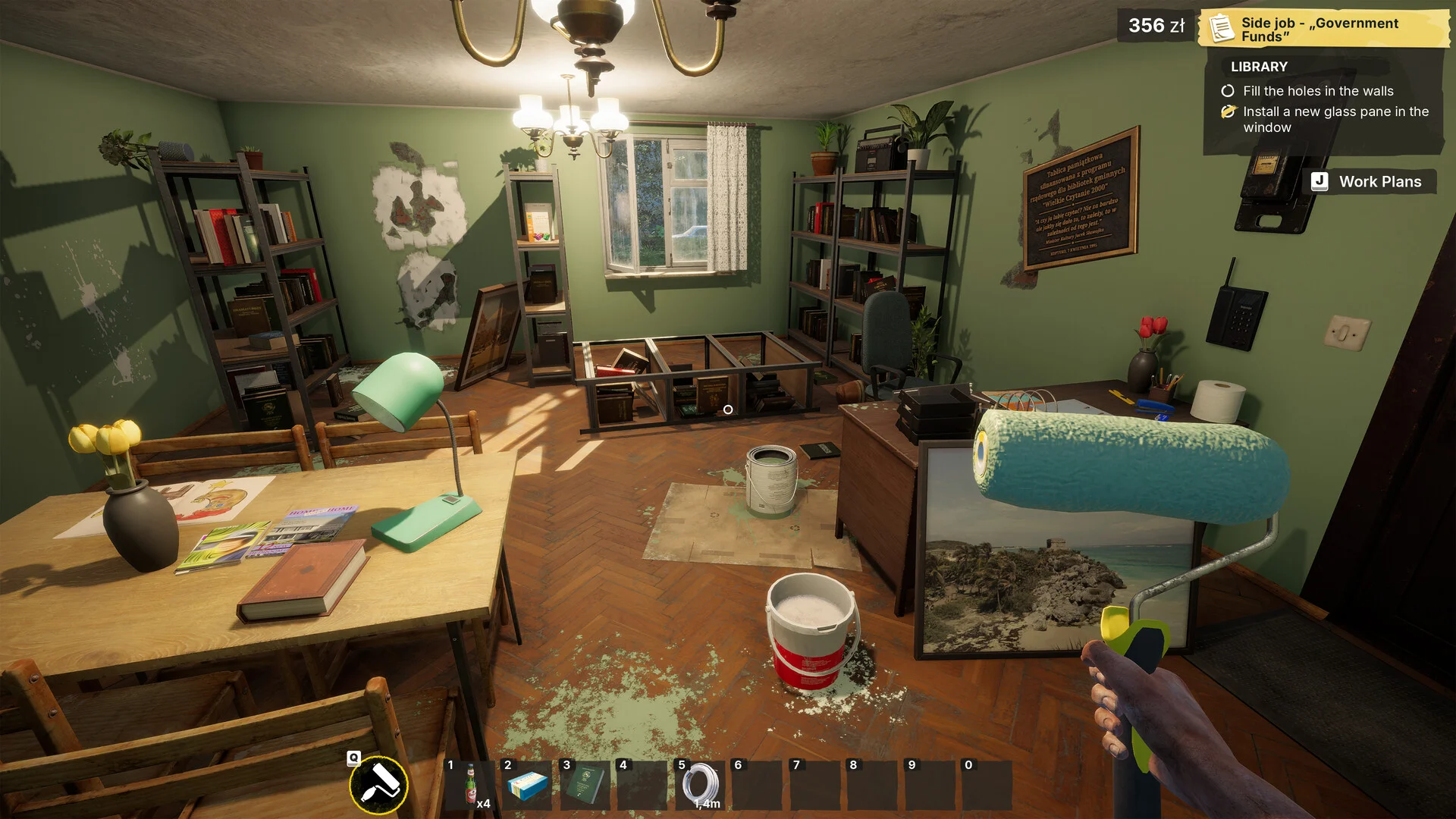
That makes the first hours easier to follow, particularly when each assignment introduces another part of the repair system. It can also make the game feel smaller than its toolset suggests. Players accustomed to choosing their own projects in renovation simulators may find themselves waiting for the campaign to grant permission to use the next toy.
Side jobs provide some relief, and Maciek’s inherited house gives the money and scavenged materials a longer-term purpose. Still, the strongest reason to continue is often the setting rather than progression.
The version of 1990s Poland presented here is intentionally grotesque: questionable craftsmen, alcohol, petty theft, neighborhood absurdity and a local competition treated with ridiculous seriousness. Zbyszek’s ghostly mentoring and Maciek’s rivalry with Janusz give the comedy recurring personalities instead of reducing the game to disconnected jokes.
Some references are clearly rooted in Polish popular culture and internet humor, so their impact will vary internationally. The broader joke travels easily. Anyone who has watched a contractor solve a problem with an alarming amount of improvisation can understand Maciek.
When Deliberate Jank Meets Real Jank
The central danger for a game about bad workmanship is obvious: players still need the game itself to work properly. Object handling can be awkward enough to blur that distinction. Furniture and boxes snag against crowded environments. Fragile objects can break after minor contact. Fresh tiles, windows and nearby fixtures may suffer because something clipped the wrong edge while being moved.
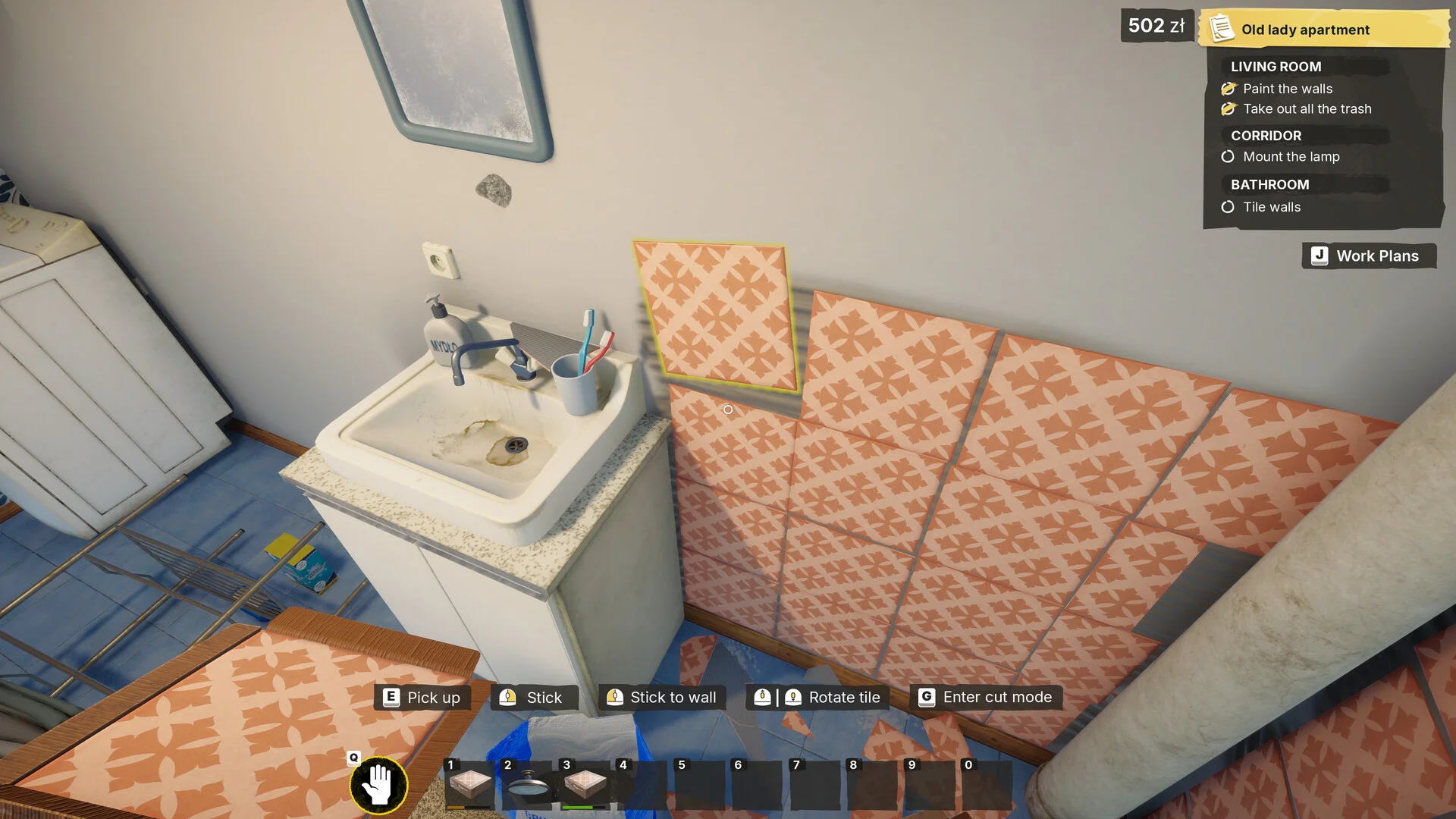
Interaction problems are harder to forgive. Objectives can fail to register after the required work appears complete, highlights may disappear, and doors or vehicles can become inaccessible. Side missions seem particularly vulnerable. Reloading is no guaranteed escape either, since saves can occasionally place Maciek outside the playable area and force another reload from an earlier point.
Performance has its own odd behavior, with dramatic frame-rate changes between small areas that do not appear substantially different in complexity. The dated visual presentation is easier to accept because the cheap, grimy look matches the material. Mechanical unreliability is another matter. Intentional ugliness can become style. An objective refusing to complete is simply an objective refusing to complete.
The game’s disclosed use of generative AI for some translations, music and visual assets creates a stranger mismatch. Its comedy celebrates human labor in all its incompetent, improvised glory, while some supporting creative work comes from generated material. The music is where that choice feels particularly noticeable, lacking the personality found in the amateurish but suitably rough voice performances.
Low-Budget Repairs has found a genuinely clever angle on a crowded simulator formula. Its best systems understand exactly why doing a terrible job can be fun. The frustration comes from seeing how close those systems are to supporting a sharper, freer game, then watching technical problems and underdeveloped missions leave part of that potential sitting unfinished on the worksite.
The Review
Low-Budget Repairs
Low-Budget Repairs finds a smart niche by turning the renovation simulator's obsession with perfect workmanship into a comedy about cutting corners. Stealing leftover materials, botching paintwork, and treating property damage as acceptable business practice give its repair loop an identity few genre rivals have. The trouble is that real bugs, awkward object handling, inconsistent mission design, and restrictive progression frequently blur the line between intentional incompetence and unfinished development. Its Polish 1990s setting and memorable characters carry stretches where the mechanics cannot.
PROS
- Clever renovation-genre parody
- Wide range of repair mechanics
- Distinctive Polish setting
- Memorable characters and dialogue
- Fun corner-cutting systems
CONS
- Imprecise object handling
- Numerous technical bugs
- Restrictive campaign structure
- Mechanics often underused
- Uneven AI-generated assets and music