









Father Joe can walk into a drug laboratory dressed like a priest, execute half the room, shoot a gangster in the foot, and still speak with the measured patience of a man hearing confession. That collision between clerical serenity and ballistic violence gives Barthélémy Grossmann’s action thriller its identity. Luc Besson’s screenplay treats the collision with complete sincerity, which is exactly why so much of it becomes funny.
Set in 1990s New York, the film casts Kiefer Sutherland as Joe, a former Special Forces soldier and Vietnam veteran who now runs a parish while conducting an armed campaign against the city’s drug trade. He has rules. Dealers may continue selling narcotics, provided their customers are at least 21. Survivors of Joe’s raids receive injections of a homemade poison, then must attend his church every Sunday to collect the temporary antidote. There are easier ways to increase Mass attendance.
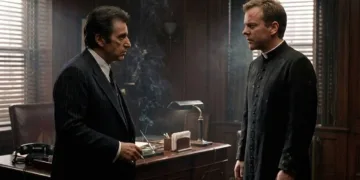
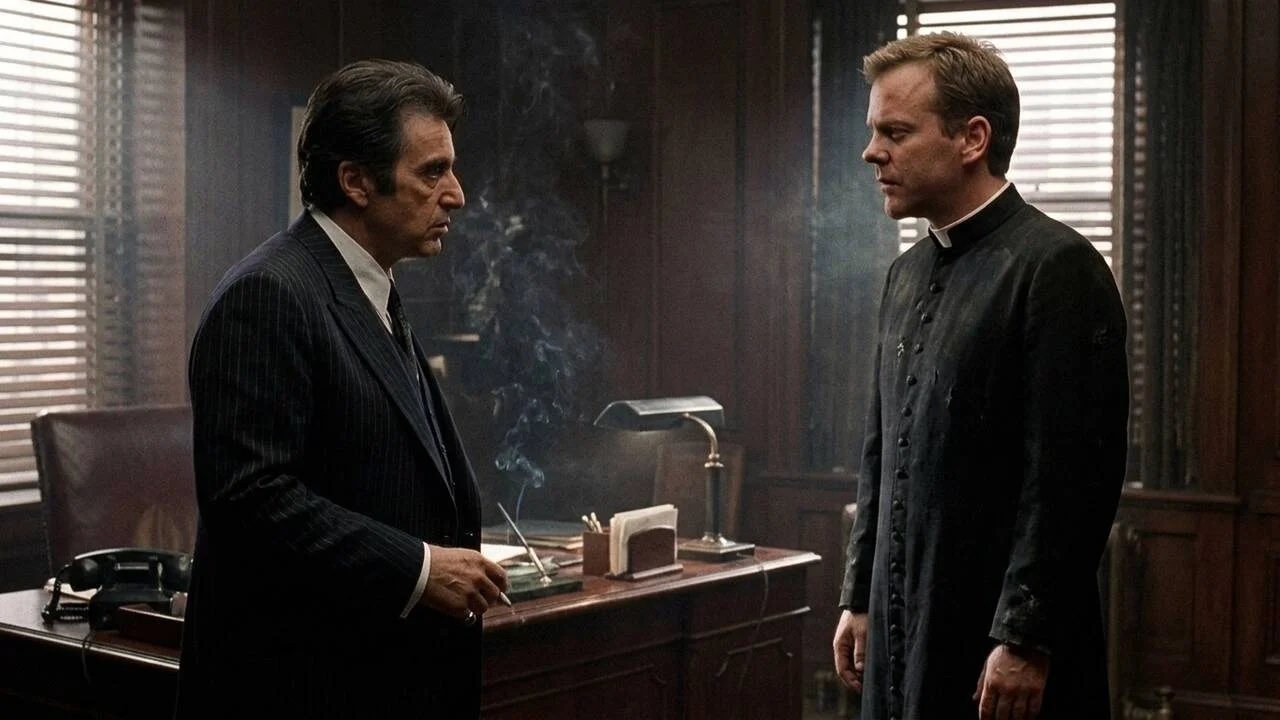
Al Pacino’s crime boss Giu eventually notices the damage being done to his operation, setting up what seems destined to become a clash between two men who offer desperate people different forms of salvation. Grossmann has a stronger film whenever he keeps those two men staring at each other across that moral fault line.
Confession at Gunpoint
Joe’s first assault on a mob drug lab establishes the visual grammar immediately. His long black coat and cappello romano turn the silhouette of a priest into that of a gunslinger. Men disappear from the frame, shots crack from unseen positions, and Joe gradually materializes as the architect of the carnage. Religious clothing becomes tactical camouflage.
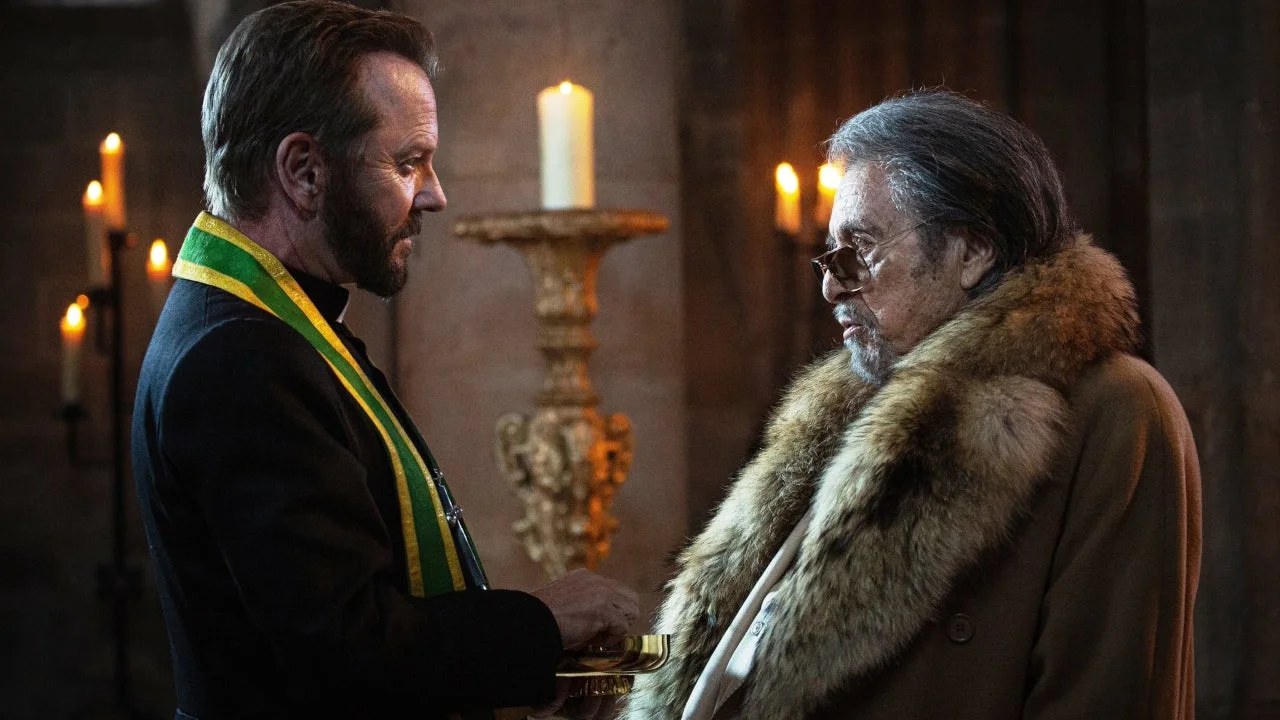
That transformation extends to his parish. Mobsters line up during Mass for small antidote pills while ordinary worshippers receive Communion. Weapons sit hidden inside sacred spaces. Fellow clergymen turn out to possess military skills of their own, while local Muslim and Jewish allies contribute to an improbably cheerful network of armed interfaith solidarity.
The imagery is playful, yet the screenplay gives Joe a history designed to explain the anger beneath it. He served in Vietnam, married an Asian woman, built a family, then lost his daughter to drugs. His crusade converts grief into procedure. Every raid becomes another attempt to impose order on a death he could not control.
Sutherland understands that Joe becomes far stranger if played without irony. He delivers sermons about grace with the same quiet certainty he brings to executions. His face barely changes when mercy gives way to murder. The moral dissonance stays visible because the performance refuses to resolve it for us.
Two Men Selling Salvation
Pacino gets his strongest material when Giu visits Joe and the pair face each other inside a confession booth. The enclosure matters. Grossmann compresses two large personalities into a narrow wooden box, separating them physically while allowing their philosophies to overlap.
Giu argues that he and Joe work the same market. Joe offers hope. Giu offers alcohol and narcotics. Both provide relief to people frightened by their own lives. It is the screenplay’s sharpest idea because it identifies the hypocrisy Joe usually carries without consequence. A priest who poisons men to force them into church has already surrendered some moral territory.
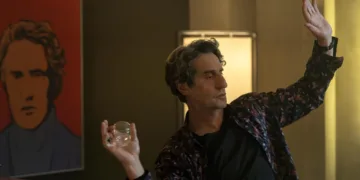
Pacino plays Giu as cultured vanity with a growl underneath. He reads Dante, speaks of his dead mother, and carries himself like a man insulted by the suggestion that ordinary gangsters belong to his species. The performance can tip into familiar Pacino volume, yet the confession sequence gives him a useful stillness. Then the film abandons much of that tension.
A separate storyline involving missing children, illegal organ harvesting, and a private hospital takes over the middle stretch. Joe’s feud with Giu fades into the background while the film behaves like an installment from some imaginary Father Joe television series. The detour contains violence, villains, and another righteous mission, yet it drains pressure from the relationship that had supplied the story with its clearest dramatic shape.
Ever Anderson’s Felicity enters through this material after an overdose and eventually joins Joe’s operation. Her presence should force him to confront the paternal grief driving his crusade. The script gives her importance without enough interior life, so the relationship remains an outline where an emotional wound should be.
Catholic Noir, Besson Ballistics
Grossmann recovers his footing whenever bodies start moving through space. An elevator fistfight works because the confined location removes the film’s tendency toward clutter. Every strike has a wall to land against. Every attacker has somewhere visible to fall. The geometry is simple, and simplicity helps.
The later church violence expands in the opposite direction. Gunfire tears through sacred architecture while Joe’s private theology of righteous killing becomes literal spectacle. Matteo Locasciulli’s score and Lucas “Kub” Fabiani’s editing push these sequences toward operatic excess, though some fights leave armed henchmen waiting implausibly long before using the guns already in their hands.
Period stock footage gives New York a texture that several interiors cannot match. The archival images have grain, density, weather. Cut back to certain smooth sets and dim rooms, and the production suddenly feels smaller. Noir can survive modest resources. Flatness is harder to forgive.
Still, Grossmann understands the value of a strong silhouette. Joe walking away from an explosion in slow motion is ridiculous the first time and practically doctrinal the second. The film keeps searching for spiritual depth in his grief, his guilt, and his resemblance to Giu. Its images have already found something stranger: a priest framed like a condemned gunslinger, carrying salvation in one hand and ammunition in the other.
Father Joe had its world premiere out of competition at the 83rd Venice International Film Festival on September 5, 2026. Set in 1990s Manhattan, the action thriller follows a priest who clashes head-on with a ruthless mob boss while a young woman gets caught in the crossfire.
Full Credits
Title: Father Joe
Distributor: EuropaCorp, Kinology
Release date: September 5, 2026 (Venice International Film Festival)
Running time: 1 hour 56 minutes
Director: Barthélémy Grossmann
Writers: Luc Besson
Producers and Executive Producers: Luc Besson, Kiefer Sutherland
Cast: Kiefer Sutherland, Al Pacino, Ever Anderson, Fred Melamed, Michael Lockerbie
Director of Photography (Cinematographer): Colin Wandersman, Matteo Locasciulli
Editors: Lucas “Kub” Fabiani
The Review
Father Joe
Father Joe has the moral geometry of a noir and the restraint of a rocket launcher. Kiefer Sutherland gives the priest’s contradictions enough gravity to keep the absurd premise standing, especially when Joe moves from sermon to execution without altering his calm expression. Barthélémy Grossmann fares best when the camera follows that contradiction into elevator fights, church gunfire, and slow-motion explosions. The organ-trafficking detour muddies the story’s strongest conflict, while Giu’s confession-booth argument hints at a richer duel the film never fully pursues. Still, few pulp thrillers commit this confidently to sacramental firepower.
PROS
- Sutherland’s controlled lead performance
- Confession-booth confrontation
- Energetic elevator fight
- Audacious religious action imagery
- Committed B-movie tone
CONS
- Distracting organ-trafficking subplot
- Underused Pacino
- Thin Felicity characterization
- Uneven action editing
- Shallow moral inquiry