


























Noel Gallagher stands in a rehearsal room beside an empty microphone, waiting for a brother who spent roughly fifteen years outside his life. The musicians are present. The equipment is ready. Liam is not. For a few minutes, Oasis: Don’t Look Back in Anger allows absence to become physical, giving that vacant space the weight of everything that happened after Oasis collapsed backstage at Rock en Seine in 2009. Then Liam arrives and complains about the drum baffles. They are “giving me the hump.” Of course they are.
Directed by Dylan Southern and Will Lovelace, with Steven Knight credited as creator and writer, the documentary follows Oasis through the rehearsals and global stadium tour that marked their extraordinary 2025 reunion. Archival footage compresses the old story quickly: Definitely Maybe, (What’s the Story) Morning Glory?, mass adoration, sibling warfare, Paris, silence. The story told about Oasis for years ended with two brothers who could fill stadiums yet apparently could not share a room.
The new film wants to replace that ending. Its difficulty is that reconciliation cannot be filmed as easily as a concert. You can photograph two people holding hands. The camera cannot photograph everything that had to happen before they reached for each other.
Brothers on Their Best Behaviour
The rehearsal footage carries a tension that later stadium sequences cannot reproduce. Everyone knows the reunion tour happened. Everyone knows Oasis survived it. Yet Southern and Lovelace edit these early sessions around tiny uncertainties: Noel looking toward Liam’s microphone, Liam appearing unusually focused, the brothers exchanging little eye contact, rehearsals ending with Liam sometimes leaving while the final notes are still hanging in the room. Nothing explodes. For this band, that qualifies as suspense.
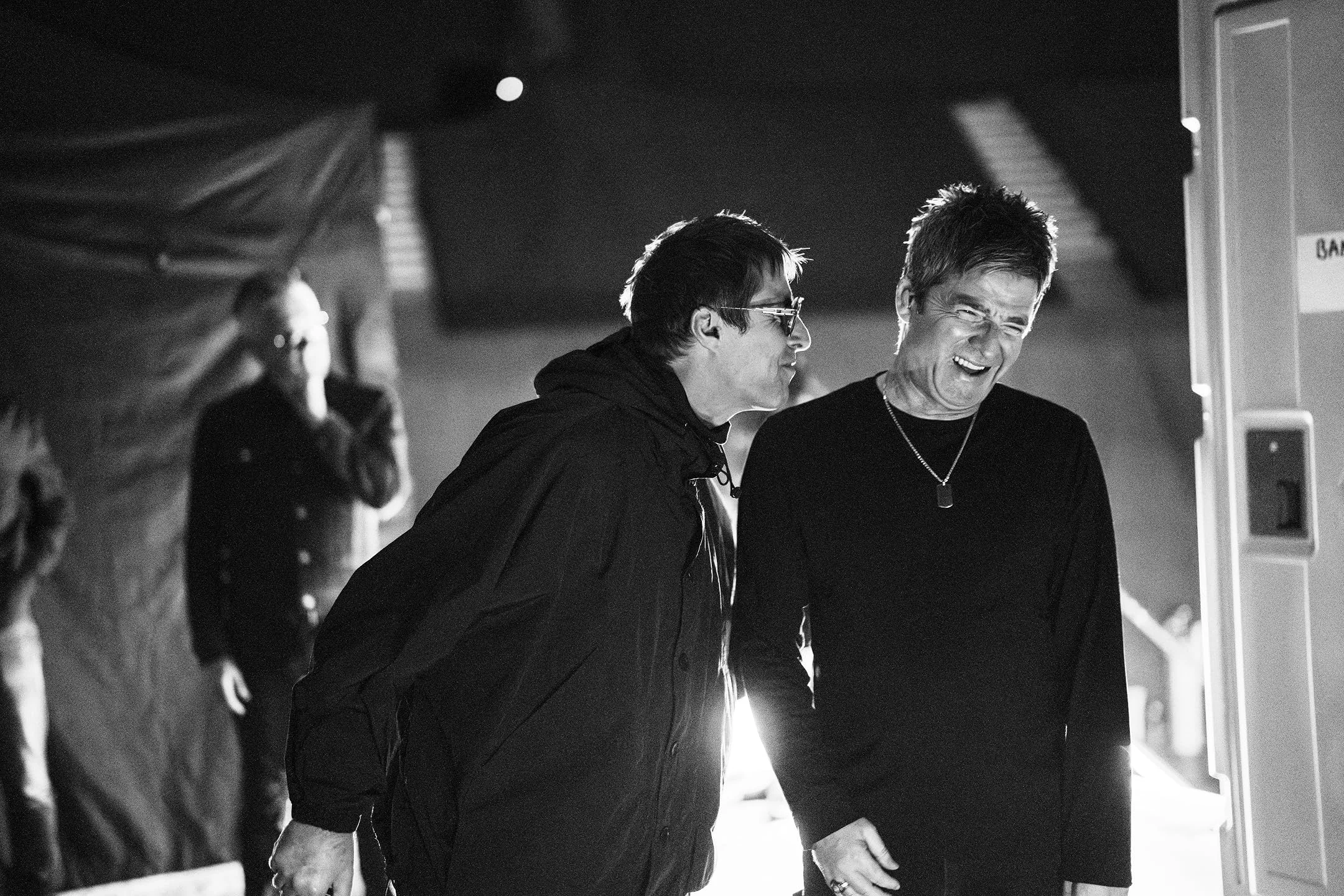
Liam discusses the estrangement with the wonderful trivializing instinct that has always made him funny. Noel behaves, he jokes, as if Liam had “stabbed one of his cats.” It was merely an argument, Liam suggests. Noel offers something colder. He describes himself as someone who struggles to forgive. The distance between those positions could contain an entire film.
Don’t Look Back in Anger rarely enters it. Noel and Liam mostly speak separately, and their interviews stay curiously protected from the uglier practical questions. What changed? Who called whom? Which wound became tolerable? What did each man have to admit? Were there financial arrangements, lawyers, family interventions, or simply age doing its slow, humiliating work? The documentary gives fragments instead. Perhaps fragments are all the brothers were willing to surrender.
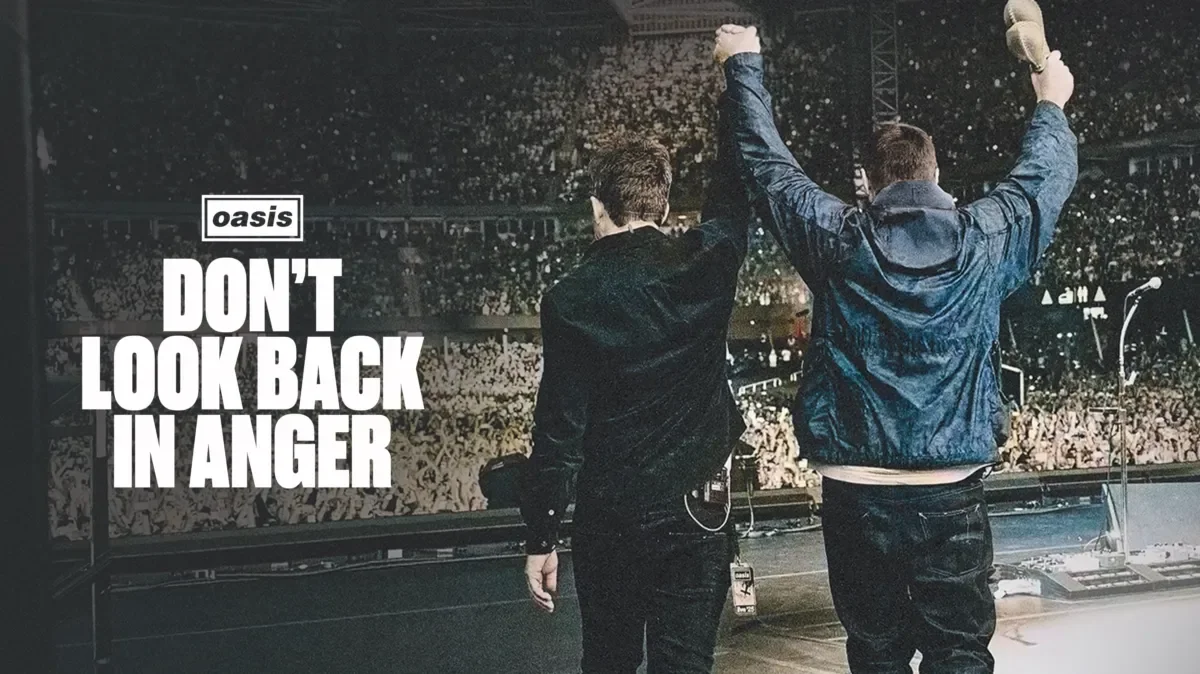
Their relationship becomes clearest through a repeated gesture. Before the opening Cardiff concert, Liam reaches for Noel’s hand and lifts it as they approach the stage. Noel seems to accept the display with the expression of a man being persuaded into a family photograph. Later, the gesture looks easier. By the time Noel describes Liam as “delightful,” a word he admits he once would never have used, something has shifted. It is tempting to call this healing. The film certainly does. A quieter possibility is that two men have learned how to inhabit the same wound without reopening it every night.
The Songs Do the Talking
Cardiff feels like the point where private anxiety becomes public weather. Fans look around the stadium with the expression people wear when an impossible thing has happened in front of them and they are still checking for the trick. “F*ckin’ in the Bushes” detonates through the speakers. The noise rises. Oasis walk out.
During “Hello,” Noel looks almost painfully tense. His face seems to be calculating everything that might still go wrong. Then he and Liam arrive together at “It’s good to be back,” and a flicker passes across him. Relief, pleasure, disbelief. Maybe all three. Liam has simpler medicine: put your “big boy pants on.”
The concert material is where the film stops searching for significance and simply encounters it. Cinematographer Haris Zambarloukos photographs stadium scale without making the band disappear inside it. Liam barely moves from his microphone. Noel remains planted behind the guitar. There are no athletic theatrics, no attempt to compete with younger performers through movement. The stillness becomes part of Oasis’ strange authority. They stand there. Everyone else moves for them.
Tarn Willers and James Mather’s sound work gives the guitars enormous physical presence. “Some Might Say” and “Cigarettes & Alcohol” arrive like weather systems. “Wonderwall,” endlessly reproduced and culturally worn smooth, regains force when thousands of voices push against Liam’s. “Live Forever,” dedicated to Gary “Mani” Mounfield of The Stone Roses, becomes something sadder. Death changes old songs. So does age.
Footage from Knebworth in 1996 makes the difference visible without requiring commentary. The young Gallaghers once seemed surrounded by infinite time. The men onstage in 2025 know better, and so does the audience. A song called “Live Forever” can only become stranger as everyone singing it grows older.
George Cragg and Martina Zamolo keep returning to faces in the crowd. People scream lyrics, wrap themselves around strangers, cry against partners’ shoulders. One person appears to pray. The band remains relatively motionless while thousands of bodies supply the choreography. For a documentary so preoccupied with explaining Oasis, these passages understand the simplest truth: sometimes volume is an argument.
The Congregation
The tour becomes a loose map of what the band means in different places. Cardiff carries the shock of return. Manchester brings Oasis back to the streets and class mythology that produced them. Dublin opens the Gallaghers’ Irish heritage. Brazil offers devotees whose affection has travelled across language and geography. A woman has named her dog after guitarist Paul “Bonehead” Arthurs. In South Korea, haenyeo divers speak about friendship and “Acquiesce.” Some of these encounters are lovely because they are small. Others carry the fingerprints of construction.
The documentary repeatedly asks fans to articulate what Oasis means to them, then inserts those testimonies between enormous performances. A survivor of the 2017 Manchester Arena bombing describes survivor’s guilt and the comfort she found when “Don’t Look Back in Anger” was sung at a vigil. Later, she sings the song during a reunion concert.
Her story possesses its own emotional gravity. The awkwardness comes from the film’s need to place it inside a larger thesis about Oasis as salvation. Personal grief starts to feel recruited.
Steven Knight’s taste for mythic language becomes especially visible during a Manchester church sermon. A priest likens the concert crowd to pilgrims and quotes Matthew’s question about how often one must forgive a brother. The Gallaghers are transformed into biblical figures of estrangement and reconciliation. It is almost impressive that a documentary about Liam Gallagher can become this solemn without Liam appearing to heckle it.
The religious metaphor contains something true, though. Manchester police prepare for the crowd as if for a football event, describing a herd mentality. At the shows, strangers lock arms and sing with the fervour of people temporarily surrendering individual identity. The music offers a few minutes when isolation can dissolve into noise. Perhaps every stadium concert contains a little theology. Oasis simply attracts a particularly drunk congregation.
Britain Wants the Nineties Back
Liam supplies the documentary’s sharpest cultural theory with characteristic elegance: Oasis split up, and everything went to shit. The film accompanies the thought with Donald Trump, Elon Musk, Keir Starmer, political exhaustion and clips of robots falling over. Liam then says people want escape. There is a much larger film hiding inside those few minutes.
The reunion arrived in a Britain carrying Brexit, pandemic memory, political churn and a deep appetite for cultural objects connected to the 1990s. Oasis once belonged to an era that sold optimism with suspicious confidence. By 2025, those songs could be heard as evidence from a vanished country, one where the future still seemed capable of becoming larger than the present. The documentary senses this and then retreats.
It also repeatedly invokes the Gallaghers’ working-class beginnings while showing a stadium economy that many working-class fans struggle to enter. Liam accidentally punctures the reverence when he addresses people in the cheap seats, then corrects himself: “Actually there are no cheap seats, sorry about that.” A joke gets closer to the economic reality than the film’s earnest commentary.
The same caution surrounds politics. Oasis’ connection to the Cool Britannia years, including Noel’s famous proximity to Tony Blair, would complicate any account of the band as a symbol of national feeling. The documentary prefers the safer image of communal escape. It wants the reunion to exist outside commerce and ideology, suspended in pure emotion.
Yet Oasis were never pure. Their appeal came partly from contradiction: working-class swagger turned into enormous wealth, sentiment hidden inside aggression, tenderness delivered through guitars loud enough to bruise.
The film occasionally smooths those contradictions until the Gallaghers resemble monuments erected in their own lifetime. Then Liam snarls into the microphone, Noel strikes the opening chords, and the polished mythology cracks.
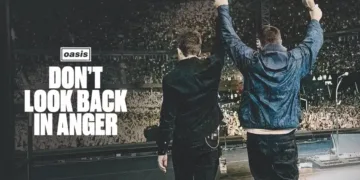
Two ageing brothers walk onto a stage holding hands. Thousands of people roar at the sight. For a few seconds, nobody asks what was negotiated, what remains unresolved, or how much the seats cost. The noise takes everything.
Oasis: Don’t Look Back in Anger premiered at the 83rd Venice International Film Festival on September 5, 2026, before heading to theaters worldwide. The documentary captures the historic 2025 reunion tour of the legendary English rock band, featuring backstage footage and the brothers’ first joint interview in over fifteen years.
Where to Watch Oasis: Don’t Look Back in Anger (2026) Online


Full Credits
Title: Oasis: Don’t Look Back in Anger
Distributor: Walt Disney Studios Motion Pictures
Release date: September 5, 2026 (Venice International Film Festival)
Rating: 15
Running time: 2 hours 3 minutes
Director: Will Lovelace, Dylan Southern
Writers: Steven Knight
Producers and Executive Producers: Sam Bridger, Guy Heeley, Steven Knight, Tom Mackay
Cast: Liam Gallagher, Noel Gallagher
Director of Photography (Cinematographer): Haris Zambarloukos
Editors: George Cragg, Martina Zamolo
Composer: Zebedee Budworth
The Review
Oasis: Don’t Look Back in Anger
There is something moving about watching two brothers who once turned estrangement into public mythology walk toward the same stage again. Oasis: Don’t Look Back in Anger sometimes mistrusts that simple image, surrounding it with sermons, testimonials and carefully packaged ideas about forgiveness. The guarded interviews leave the deepest wounds untouched. Then the guitars arrive. “Live Forever,” “Hello” and the title track give the reunion a gravity the documentary keeps trying to manufacture elsewhere. The film explains too much and reveals too little, yet the music keeps breaking through.
PROS
- Immersive concert sound
- Electrifying Cardiff footage
- Genuine Gallagher chemistry
- Powerful crowd photography
- Strong archival contrasts
CONS
- Guarded brotherly interviews
- Forced spiritual framing
- Uneven fan-story detours
- Political ideas left undeveloped
- Commercial tensions largely avoided