


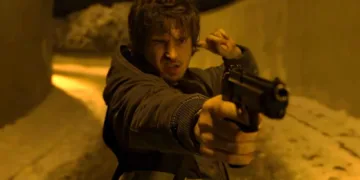























Bryan is bad at this. That sounds like a joke, and much of Resident Evil treats it as one. Austin Abrams’ medical courier cannot shoot straight, cannot plan especially well, drives into a snowstorm in a car he has falsely claimed is equipped for snow, and encounters locked doors with the baffled resentment of a man who thinks architecture has personally betrayed him.
Zach Cregger has built his adaptation around an idea that video game movies usually avoid: sometimes the person holding the controller sucks. Call it player incompetence realism. The phrase is ridiculous, but the effect is strangely clarifying.
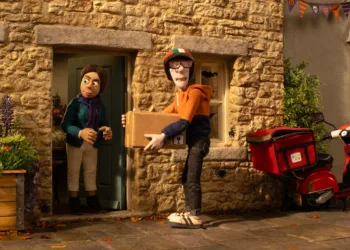
Bryan is finishing a shift when his girlfriend Michelle tells him she is pregnant. He responds poorly, then accepts a double-pay delivery to Raccoon City General Hospital, because apparently facing a biological catastrophe is preferable to having an adult conversation.
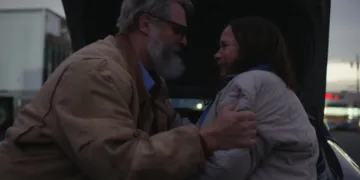
On the mountain road, he hits a woman who emerges from the darkness, tries to help her, and gradually discovers that the night has become a sequence of infected bodies, locked passages, dwindling ammunition and increasingly unpleasant things with teeth.
Cregger and co-writer Shay Hatten could have treated the games as a museum of recognizable names and images. Leon Kennedy does not need to walk through the door. Ada Wong does not need to wink from a balcony. Instead, the film borrows the games’ deeper grammar: enter a space, read it, discover what can kill you, discover what cannot open, count what remains in the gun, find another route. That sounds obvious until you consider how rarely adaptations trust mechanics as storytelling.
Dariusz Wolski’s camera occasionally scans a new location with the patience of a player rotating the view before moving. First-person compositions place a weapon centrally in the frame. Bryan collects information from people who sometimes resemble NPCs with unusually expensive casting.
Paul Walter Hauser effectively materializes to explain what needs doing next. A maternity ward announces danger simply by becoming the only available route forward. Cregger understands that half the pleasure of survival horror comes from seeing the door you absolutely do not want to open and realizing, with quiet spiritual devastation, that the game has removed all the other doors.
The clever part is that these devices rarely feel pasted onto a movie-shaped object. Bryan has practical reasons to move through them. His courier job gives him an objective. His lack of expertise keeps the objective unstable. Guns do not solve the horror because ammunition matters and Bryan, by his own admission, is much better at shooting things when those things are made of pixels.
I initially thought the explicit gaming jokes weakened the conceit. Sometimes they do. Bryan announcing that his firearm competence comes from video games explains something Abrams has already communicated through posture, panic and several catastrophic attempts at control. Yet the occasional overstatement also reveals what Cregger is gambling on. He wants the audience to recognize the game beneath the film without letting recognition become the film. Abrams is the reason that gamble survives.
Bryan is almost constantly present, often alone, which makes this a peculiar one-man horror comedy disguised as franchise filmmaking. Abrams gives him the loose, irritated energy of somebody whose fear keeps arriving half a second after his bad decisions. He mutters, overcommits, retreats, tries again. After several encounters with bodily ruin, he can still find room in his personal hierarchy of suffering for wet socks. More important, he makes incompetence sympathetic.
Bryan tries to help the woman he hits. He attempts to complete a medical delivery even after the situation becomes absurdly dangerous. His instincts are frequently clumsy, but they are not malicious. That distinction matters because horror has trained audiences to punish stupidity as if poor judgment were a moral offense. Cregger reverses the equation. Bryan’s errors make him vulnerable, and his vulnerability keeps the spectacle attached to a person rather than an avatar.

There is a weakness hidden inside that design. Characters around Bryan sometimes feel temporary because the movie treats them as temporary. Kali Reis’ Maxine arrives with the suggestion of formidable Umbrella Corporation authority, then disappears before that promise can develop into much. One can defend this as deliberate game logic. You meet the character, receive the function, proceed to the next objective. I am not convinced the defense fully works.
A movie can reproduce the sensation of NPC encounters and still leave those encounters dramatically thin. Formal fidelity does not magically abolish characterization. Sometimes an underwritten supporting role is simply an underwritten supporting role wearing a clever theoretical hat.
Cregger compensates by making the physical world aggressively alive. The roadside sequence builds tension from darkness, ice and uncertainty before the film starts detonating flesh with enthusiasm. Sound gives attention to floorboards and loaded chambers. Joe Murphy’s editing keeps scares and jokes moving without confusing speed with noise.
Then the monsters arrive in increasingly obscene configurations: rupturing bodies, acid, swollen growths, a maternity ward soaked in biological nightmare fuel, and creatures that begin to look as though human anatomy has filed for divorce. The gore is disgusting. It is also funny.
That distinction should collapse the horror, but Cregger understands the elasticity of disgust. A body can burst so violently that the image becomes absurd, then the next sound from an empty corridor can still tighten the room. The comedy vents pressure without permanently releasing it. Abrams panicking through grotesque situations helps because Bryan never adopts the audience’s amusement. For him, this remains the worst night imaginable. For us, it is occasionally the funniest.
The film becomes shakier when it starts admiring this rhythm. Its middle stretch leans harder into the joke of its own video-game construction, and the tension loosens whenever the movie explains the mechanism it had already demonstrated. Cregger is strongest when he trusts space, ammunition and Bryan’s face. He is less interesting when the film nudges the audience and asks, essentially, “See? Like a game.” There is another problem waiting underneath all this machinery, and it arrives through Michelle.
Bryan’s pregnancy panic gives the night emotional significance before Raccoon City supplies monsters. Children, birth and bodily mutation then recur in increasingly grotesque forms, especially around the maternity ward. It is tempting to read the outbreak as a nightmare of impending fatherhood, adulthood rendered as infection, responsibility transformed into something wet and screaming. Too neat.
The film certainly invites that reading, then stops short of giving it enough weight to become its governing idea. Bryan changes, but the final stretch treats that change with less patience than it gives ammunition counts and environmental obstacles. Several earlier sequences have trained us to expect each problem to lead organically into another. The ending breaks that rhythm. It arrives with the peculiar sensation of reaching the edge of a level and discovering that somebody has removed the corridor connecting it to the next one.
Perhaps that incompleteness is fitting. Cregger has spent the film transforming Bryan from a man trying to avoid one frightening conversation into a man who has survived almost every grotesque diversion imaginable on the way back toward it. The zombies, mutants and exploding bodies keep producing new problems with clear physical solutions. Then the guns run out, the doors stop mattering, and Bryan is left with the problem he was avoiding before Raccoon City gave him easier ones.
Resident Evil arrives in theaters nationwide on September 18, 2026, distributed by Sony Pictures Releasing. The horror film follows a young medical courier who gets trapped in a terrifying outbreak during a routine delivery.
Where to Watch Resident Evil (2026) Online
Full Credits
Title: Resident Evil
Distributor: Sony Pictures Releasing
Release date: September 18, 2026
Rating: R
Running time: 1 hour 35 minutes (95 minutes)
Director: Zach Cregger
Writers: Zach Cregger, Shay Hatten
Producers and Executive Producers: Robert Kulzer, Zach Cregger, Roy Lee, Miri Yoon, Carter Swan, Asad Qizilbash
Cast: Austin Abrams, Zach Cherry, Kali Reis, Paul Walter Hauser, Johnno Wilson
Director of Photography (Cinematographer): Dariusz Wolski
Editors: Joe Murphy
Composer: Hays Holladay, Ryan Holladay
The Review
Resident Evil
Cregger understands that Resident Evil becomes interesting on screen once survival stops looking heroic. Austin Abrams turns Bryan’s incompetence into vulnerability, comedy, and genuine tension, while the film translates ammunition counts, hostile spaces, locked routes, and grotesque escalation into cinematic language with unusual confidence. Its supporting characters can feel functional, and the ending abandons Bryan’s emotional problem just as it becomes most interesting. Still, few video game adaptations capture the humiliating panic of actually playing badly this well.
PROS
- Austin Abrams’ superb comic panic
- Game mechanics translated into film grammar
- Excellent horror-comedy timing
- Inventive, excessive creature design
- Strong spatial tension and resource pressure
CONS
- Thin supporting characters
- Meta-gaming jokes sometimes overexplain the conceit
- Fatherhood theme remains underdeveloped
- Abrupt final stretch