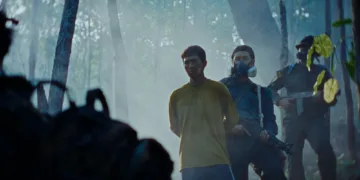

























Phuttiphong Aroonpheng turns western Thailand’s forests into contested territory before his characters have any chance to define them as home. Toxic fog drifts through the trees, leaving horrific burn-like wounds on those exposed to it, and the state responds with quarantines, armed patrols, forced evacuation, and the language of public safety. For the S’gaw White Karen community living there, protection quickly begins to resemble expulsion.
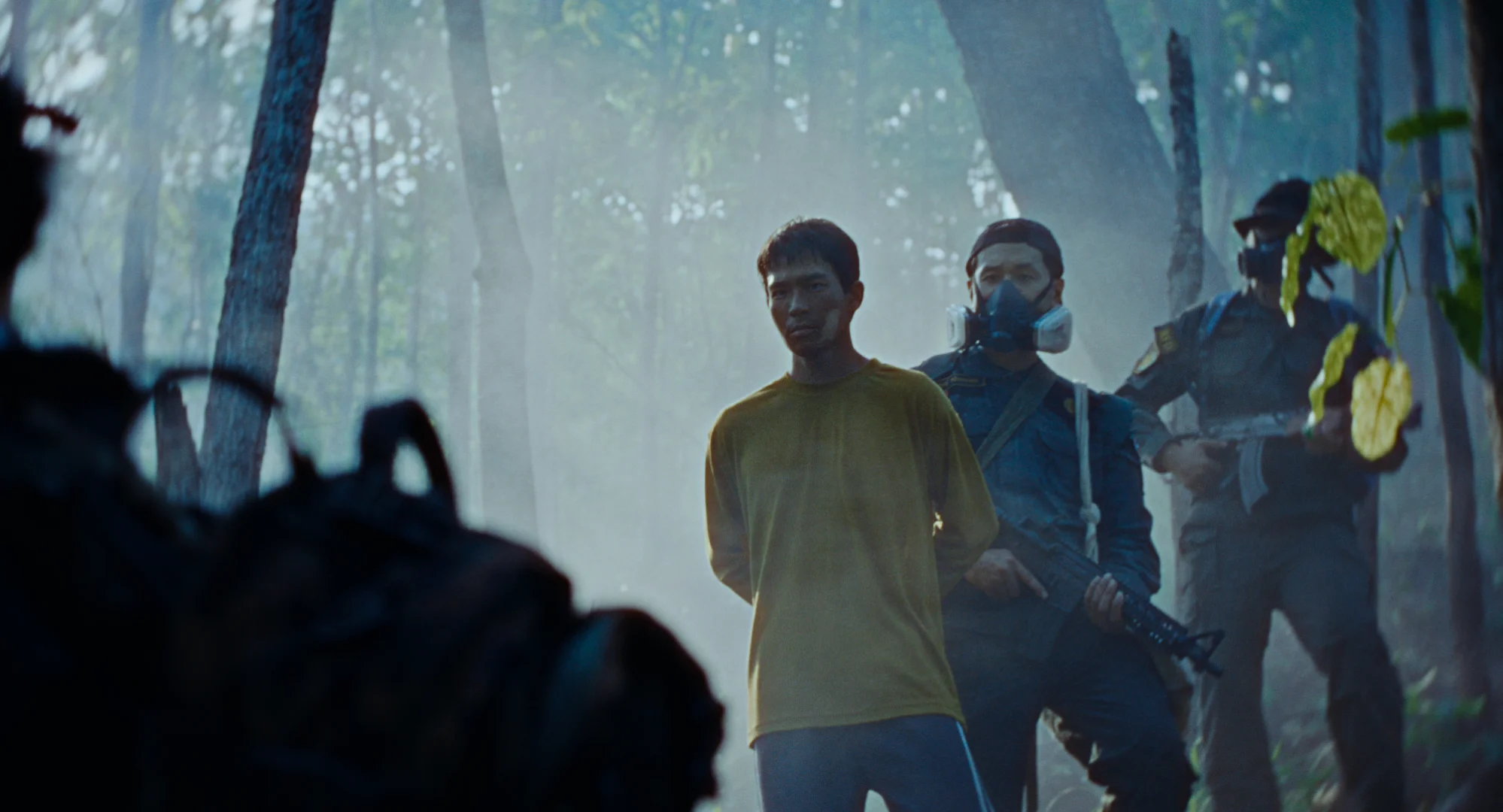
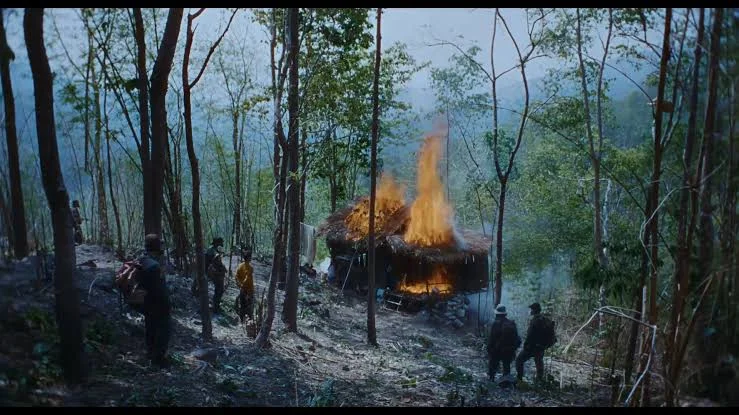
Yak, played by Awat Ratanapintha, has remained behind after the clearances. Soldiers find him wandering through the forest, arrest him, and burn his hut. The sequence gives the film its clearest political image: a medical emergency can be real while the authority built around it can still target people already vulnerable to displacement.
Aroonpheng draws the story from the 2014 disappearance and murder of Karen Indigenous rights activist Porlajee “Billy” Rakchongcharoen, giving the fictional smoke an unmistakable historical shadow. The particulars belong to Thailand, yet the structure of power is recognisable far outside it. Borders, emergencies, conservation policy, and policing can all become languages through which a state decides who is permitted to remain on land.
Exile in the City
The film grows quieter once it leaves the forest. Lak, played by Pakapol Srirongmuang, is one of the officers involved in Yak’s detention, yet he carries none of the certainty his uniform suggests. His tentative relationship with Aepoh, played by Phunthida Phairuangkij, places him close to the community his job helps control.
That connection tightens when Aepoh tells her sister Aeva about the detained Karen man. Aeva, played by Waywiree Ittianunkul, has been separated from her husband since the evacuation and is raising their daughter while working as a nanny for a wealthier family. The arrangement is brutally simple. She cares for someone else’s household while her own family has been split apart by policy.
Ittianunkul gives these scenes their weight through restraint. Her return toward the mountain is built from long stretches of movement, waiting, and uncertain hope rather than dramatic speeches. Ratanapintha gets one sharper burst of emotion when Yak pleads for release, briefly puncturing the film’s controlled rhythm.
Lak could have carried a richer conflict between institutional duty and personal conscience. Instead, his importance fades once Aeva’s search becomes dominant. That loss matters because he occupies a particularly interesting cultural position: someone standing inside the machinery of state power while emotionally tied to those living beneath it.
The Ogres Leave the Stage
Then the film changes its language. Aroonpheng leaves behind the quasi-realist register and enters the world of the Ramakien, Thailand’s adaptation of the Ramayana, alongside elements from the folk tale Sang Thong. Khon performers move through caves, tunnels, and a strange smoke-filled theatre connected to the forest through machinery and pipes. The realistic story does not disappear so much as dissolve into national mythology.
For viewers raised outside Thailand, the shift may initially feel like discovering that the final reel belongs to another film. Yet the cultural logic becomes clearer once Aroonpheng redirects attention away from heroic figures and toward the ogres left in the wake of celebrated victories.
Thanatwut Rodpai’s Thulee escapes the mythological world and enters contemporary society, where freedom offers little comfort. He wanders through poverty and humiliation, unable to understand the social order surrounding him. Rodpai speaks largely through posture and movement, turning bewilderment into physical performance.
His exile mirrors Aeva and Yak’s displacement without flattening one story into the other. A national epic traditionally organised around heroes and defeated monsters is reoriented toward those cast as outsiders. The Karen characters occupy a similar political position in modern Thailand: present within the nation, yet treated as inconvenient to its preferred image of itself.
The idea is stronger than the transition. By shifting so abruptly, Aroonpheng sacrifices some of the emotional momentum built around Aeva’s search and Lak’s divided loyalties. The film asks its audience to cross from political realism into myth with very little bridge between them.
Beauty Inside the Haze
Emo Weemhoff’s cinematography makes that crossing easier than the screenplay does. The forest appears alternately beautiful and diseased, with thick fog swallowing depth and purple skies making familiar terrain look slightly poisoned. The later mythological spaces use softer gold light, giving the performers an almost sculptural presence against caves and theatrical ruins.
The city is harsher. Streets and interiors divide people with harder lines, replacing the forest’s murky openness with spaces shaped by employment, class, and surveillance. Sarawut Karwnamyen and Wan Ping Looi’s production design reaches its strangest expression in the ruined theatre, a place where industrial machinery, performance, folklore, and environmental menace occupy the same physical space.
Christine Ott and Mathieu Gabry’s score strengthens the unease during these passages, though its emotional pressure can become insistent. Daniel Hui’s editing is strongest earlier, moving between Lak and Aepoh’s hesitant romance and Aeva’s unresolved grief with enough patience to let both relationships acquire texture.
The slower pacing becomes less productive once the film begins changing narrative direction repeatedly. Several threads disappear before they have developed enough force, and the mythological section must carry political, cultural, and emotional meanings that the earlier drama had been distributing across several characters.
Still, few films would place an Indigenous eviction, pandemic imagery, Khon theatre, urban poverty, and the Ramakien within the same cinematic argument. Aroonpheng uses that collision to question whose stories become national heritage and whose lives are pushed outside the frame. Thulee walking through the modern world makes that question painfully literal.
The Burning Giants had its world premiere in the Orizzonti competition at the 83rd Venice International Film Festival on September 6, 2026. The drama blends real-world political displacement with magical realism, following an Indigenous Karen woman who travels back to the mountains as a mysterious toxic smog infects her village.
Full Credits
Title: The Burning Giants
Distributor: Diversion, Sluizer Film Productions, Nord-Ouest Films
Release date: September 6, 2026 (Venice International Film Festival)
Running time: 1 hour 58 minutes
Director: Phuttiphong Aroonpheng
Writers: Phuttiphong Aroonpheng
Producers and Executive Producers: Phuttiphong Aroonpheng, Leong Pui Yee, Guillaume de Seille, Caroline Velan
Cast: Awat Ratanapintha, Pakapol Srirongmuang, Waywiree Ittianunkul, Thanatwut Rodpai
Director of Photography (Cinematographer): Emo Weemhoff
The Review
The Burning Giants
The Burning Giants turns Karen displacement, pandemic-era fear, and Thai mythology into a politically charged fable whose cultural specificity gives it real force. Emo Weemhoff’s fog-heavy forest imagery and the strange passage from contemporary persecution into the Ramakien create several unforgettable stretches. The fracture between those modes is also the film’s central weakness. Aeva’s search and Thulee’s exile speak powerfully to one another, yet the abrupt handoff leaves character threads underdeveloped and the pacing increasingly distant. Its ideas travel further than its narrative does, but the images stay with you.
PROS
- Haunting forest cinematography
- Strong Karen cultural perspective
- Bold use of Thai mythology
- Waywiree Ittianunkul’s restrained performance
- Memorable wordless work from Thanatwut Rodpai
CONS
- Abrupt final-act transformation
- Underdeveloped character threads
- Uneven pacing
- Mythological links can feel opaque