












Daniel Pierce receives a pistol for his seventeenth birthday, and nobody in his family treats the gesture as extraordinary. That ordinariness is where Dylan King Welter locates the danger. The gun is a present from his father, Lee, folded into the same emotional vocabulary as trust, adulthood, and paternal approval. Sam Williamson plays Daniel’s excitement without irony. He wants the weapon because he wants the life attached to it.
Daniel has already begun rehearsing that life with his friends John, Russ, Sammy, and Tyler. Their self-appointed militia, “The Wild Bunch,” trains with airsoft guns and copies the tactical routines practiced by their fathers. Welter films these boys less like budding revolutionaries than apprentices studying a family trade. The distinction matters. Radicalization here does not arrive through a sinister recruiter or some dramatic ideological conversion. It arrives through repetition.
Michael Broderick’s Lee strengthens that reading. He is affectionate with Daniel and attentive toward his wife, Elinor, played with steady assurance by Laurel Feierbach. His politics never cancel his capacity for love. They coexist with it, which makes his influence harder to dismiss. Daniel is learning from someone he has every personal reason to trust.
The Traffic Stop
The film’s moral geometry tightens during a routine traffic stop. Sheriff Webb pulls Lee over for expired plates, discovers unregistered firearms, and arrests him after Lee reacts with indignation at the very idea of being questioned.
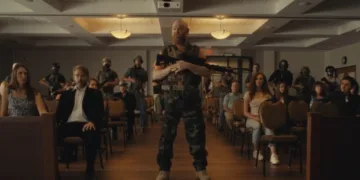
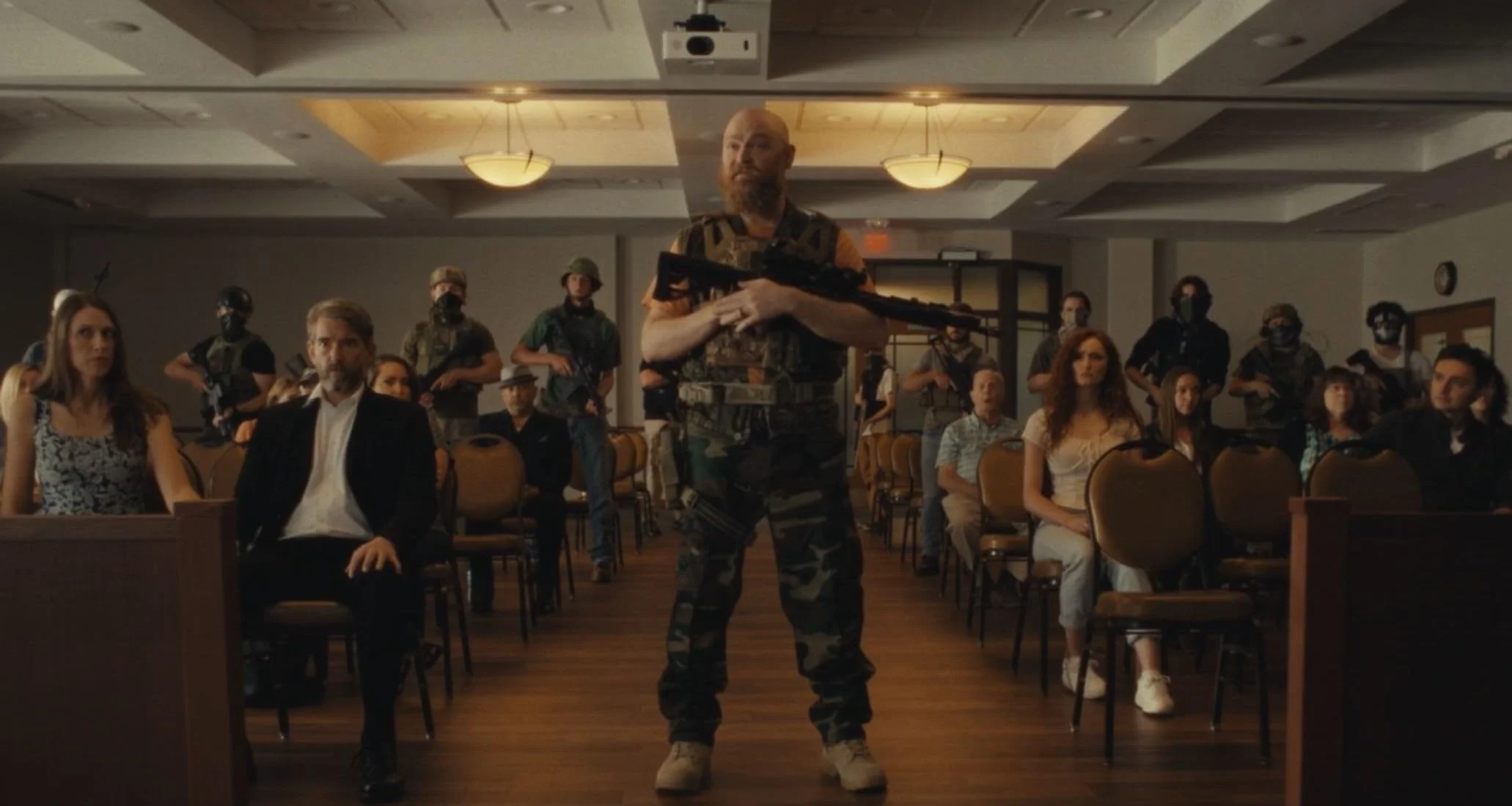
The scene exposes a contradiction Welter keeps returning to. Lee expects legal authority to protect the freedoms he values, yet he treats that authority as illegitimate the instant it inconveniences him. Later, armed militia members extracting him from a courtroom carry the same contradiction into physical space. Rules are binding until belief decides otherwise.
Luke Stratte-McClure gives Webb an unusual degree of restraint. He does not posture as the government boot Lee imagines him to be. When deputies become too eager for confrontation, Webb reins them in. His insistence on procedure quietly destabilizes Daniel’s inherited worldview because the supposed enemy refuses to perform villainy on command.
Welter resists turning the conflict into clean visual opposition. The sheriff is not framed as a monster waiting across some moral border, and Lee is never photographed as a grotesque fanatic. The ambiguity is useful because Daniel’s tragedy depends on failing to recognize distinctions that the film keeps placing directly in front of him.
Boys Playing War
Once Lee disappears, Daniel begins converting imitation into action. He recruits the Wild Bunch into plans meant to protect his family and eventually approaches violence with the certainty of someone convinced he is fulfilling an obligation.
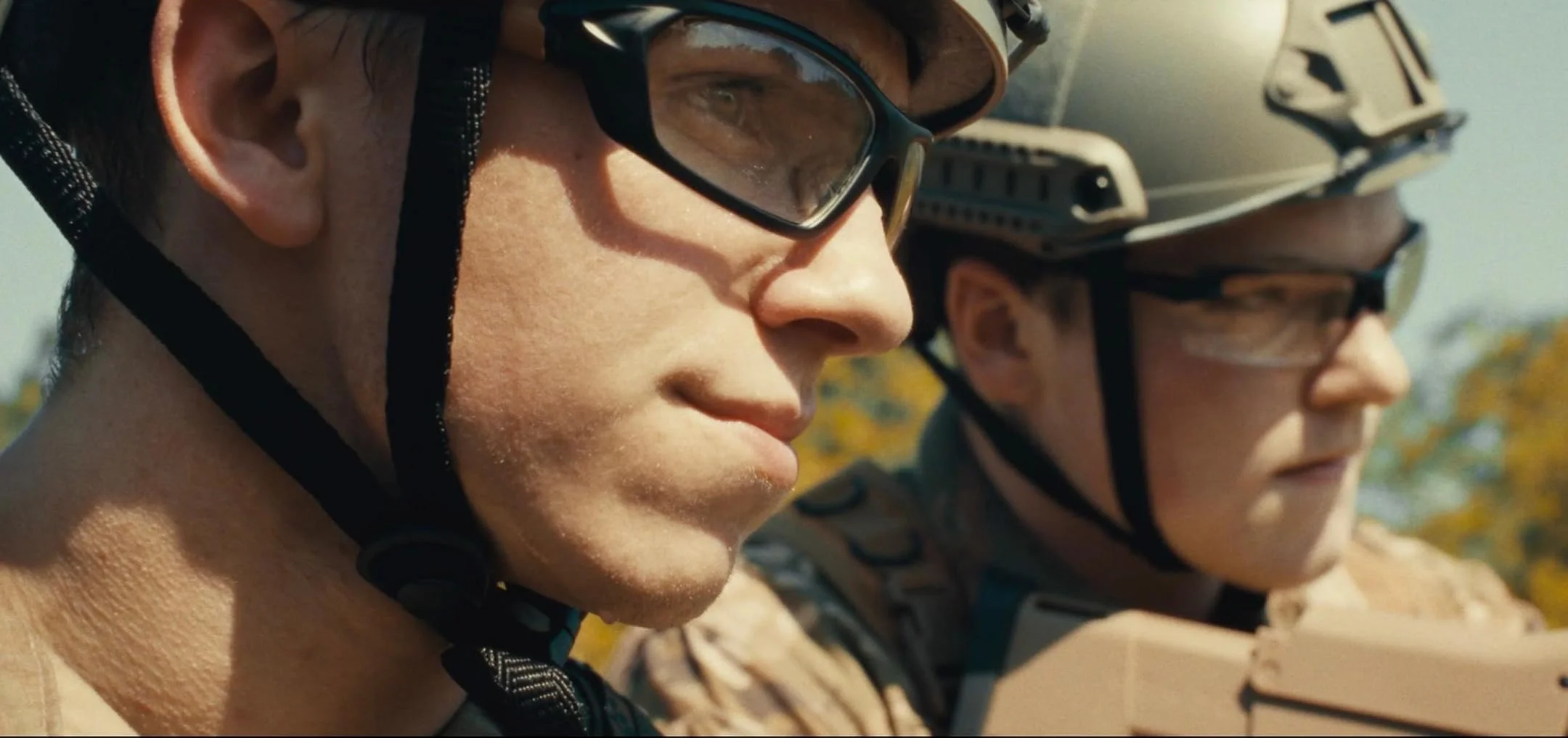
Williamson is strongest during this escalation because he refuses the obvious performance of teenage instability. Daniel does not twitch, rant, or suddenly acquire the feverish mannerisms movies often use as shorthand for extremism. He becomes calmer. His conviction hardens.
That choice gives the sequences involving makeshift explosives their unsettling quality. Welter stages the preparations with stillness rather than spectacle, keeping the boys inside patient compositions long enough for their behavior to lose the protective coating of adolescent play. These are children working with dangerous materials, yet their movements carry the routine confidence of a drill practiced too many times.
Violence follows the same principle. It arrives without the sort of musical announcement that tells an audience how to brace itself. The lack of theatrical emphasis produces a harsher sensation because the images are denied the catharsis of an action sequence. An irreversible choice can sit inside the same visual register as a conversation on a farm.
The Wild Bunch themselves remain the film’s clearest weakness. John, Russ, Sammy, and Tyler support Daniel through increasingly reckless decisions, but the script gives limited access to the individual pressures carrying each boy forward. Loyalty explains part of their behavior. Fear, boredom, insecurity, and competition remain largely outside the frame.
The Ethics of Stillness
Welter’s rural America looks peaceful enough to make paranoia seem almost absurd. Farms, fields, family homes, and shooting ranges occupy the same landscape, and the film treats militia culture as something woven into daily routine rather than hidden in some cinematic bunker.
His long takes often allow uncomfortable moments to continue after a faster drama would have cut away. That duration becomes an ethical device. The audience has time to inspect a choice before the next plot beat rushes in to excuse it. Daniel’s decisions become harder to romanticize when the camera simply remains present.
The same patience occasionally hurts the pacing. Several passages between major confrontations linger without gaining equivalent dramatic pressure, and Welter’s preference for observation can become inert when neither character nor situation changes under the gaze.
Still, the restraint produces the film’s sharpest images. Daniel believes he is acting independently, yet every gesture traces back to something taught, modeled, or normalized by the adults around him. By the time his childhood exercises carry real consequences, the frightening part is not that he has abandoned his father’s lessons. He has followed them precisely.
The Militia was released on U.S. digital and VOD platforms by Freestyle Digital Media on September 8, 2026. The military drama follows a driven teenager who forms an unauthorized youth group with his friends to confront the local sheriff after his father goes into hiding.
Where to Watch The Militia (2026) Online





Full Credits
Title: The Militia
Distributor: Freestyle Digital Media
Release date: September 8, 2026
Running time: 1 hour 55 minutes
Director: Dylan King Welter
Writers: Dylan King Welter
Producers and Executive Producers: Bruno Albuquerque, Dylan King Welter
Cast: Sam Williamson, Michael Broderick, Luke Stratte-McClure, Chris Bylsma, Laurel Feierbach, Scott Callenberger
The Review
The Militia
The Militia finds its menace in ordinary spaces: a birthday gun, a traffic stop, boys rehearsing adult violence as if learning farm work. Dylan King Welter’s patient framing and refusal to turn Sheriff Webb or the Pierce family into easy symbols give the drama its moral tension. Sam Williamson makes Daniel’s certainty chilling because it never looks theatrical. The pacing can sag, and the Wild Bunch needs sharper individual definition, yet the film understands how inherited belief can make catastrophe feel like responsibility.
PROS
- Sam Williamson’s controlled performance
- Patient, naturalistic direction
- Strong moral ambiguity
- Sheriff Webb’s nuanced characterization
- Violence staged without spectacle
CONS
- Uneven pacing
- Thinly developed Wild Bunch members
- Ambiguity occasionally softens the critique