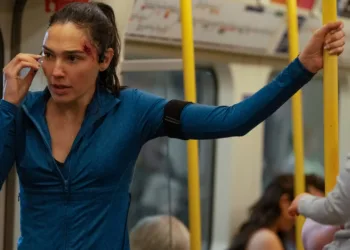














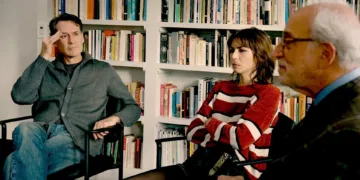

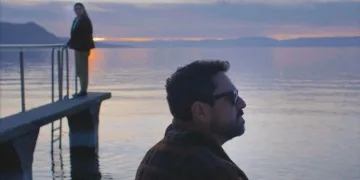













Maia Marten’s worst morning begins with something banal enough to feel contemporary: a phone call. Her son Noah has been taken, his insulin system has been manipulated, and the man holding him demands that she cross London on foot and murder a protected witness before time expires.
Kevin Macdonald’s The Runner understands the efficiency of this setup. One device contains Maia’s location, memories, relationships, professional life, private photographs, and the voice of the man dismantling her sense of control. The entire thriller can fit inside her pocket.
Gal Gadot plays Maia, a London attorney and single mother whose morning routine involves dropping Noah off at school before running to work. On this particular day, she lets him walk the final stretch alone. Soon after, Damian Lewis’s unnamed Caller informs her that he has Noah and has pushed the diabetic child toward a medical emergency. Maia has roughly an hour to reach Tafa, a witness connected to a major criminal case, and kill him.
Macdonald gives that premise constant physical movement. Gadot sprints through streets, tunnels, transit spaces, buildings, crowds, and traffic while the Caller listens through her phone and dictates her route. Motion is never scarce. Suspense is.
A Countdown Built From Familiar Parts
The basic machinery belongs to a long line of coercion thrillers built around an ordinary person receiving impossible instructions from an unseen controller. Nick of Time, Phone Booth, Red Eye, Eagle Eye, and recent films such as Carry-On and Drop have all worked variations on the same equation: limited time, remote surveillance, escalating demands, nowhere safe to turn.
The Runner adds a literal footrace. Maia cannot disappear into a taxi or simply race straight toward her destination. The Caller wants her moving according to his rules, and the film keeps placing barriers between her and Tafa. She collides with pedestrians, gets struck by a vehicle, steals phones, loses one in a canal, ventures onto train tracks, escapes from the back of an ambulance, and continues after suffering a conspicuous head wound. One late attempt at concealment involves a denim bucket hat, apparently because London’s surveillance infrastructure has finally met its natural predator: mediocre headwear.
Some of these incidents carry the manic pleasure of a thriller willing to become ridiculous. The problem is that Mark Gibson’s screenplay wants them accepted as carefully calibrated obstacles. Maia’s intelligence fluctuates according to what the next set piece requires. She can devise a clever route toward another phone or exploit a crowd, then immediately lose that advantage through a contrivance. Resourcefulness becomes something granted and withdrawn by the screenplay rather than a stable part of her character.
The Caller operates under equally flexible rules. Early scenes make him appear virtually omniscient. He knows Maia’s schedule, monitors her phone, accesses private material, tracks her movement, controls information, and later deploys an AI reproduction of her voice. That degree of access creates a useful dramatic prison because every apparent escape should leave a digital trace. Then the prison develops conveniently unlocked doors.
Maia can occasionally act outside his awareness, manipulate what he sees, or prepare resistance without detection. His extraordinary access returns once the story needs him dominant again. A thriller structured around rules needs the audience to understand the cage before watching its protagonist search for weaknesses. Here, the dimensions keep changing.
The climactic switch depends on the same principle. The film conceals information already known to Maia, then reveals it through a montage designed to reframe previous events. There is an immediate pleasure in watching pieces snap into place. Yet the trick works because the audience has been denied Maia’s actual knowledge rather than encouraged toward the wrong interpretation of visible evidence. That distinction separates misdirection from concealment.
Maia Can Run Further Than the Character Can Stretch
Gadot’s casting makes complete sense whenever Maia is required to move. She can sell fatigue, pace herself convincingly during longer stretches, and communicate the physical damage of being forced through London without rest. Macdonald often keeps the camera near her body, allowing strained breathing and increasingly heavy movement to supply sensations the dialogue cannot.
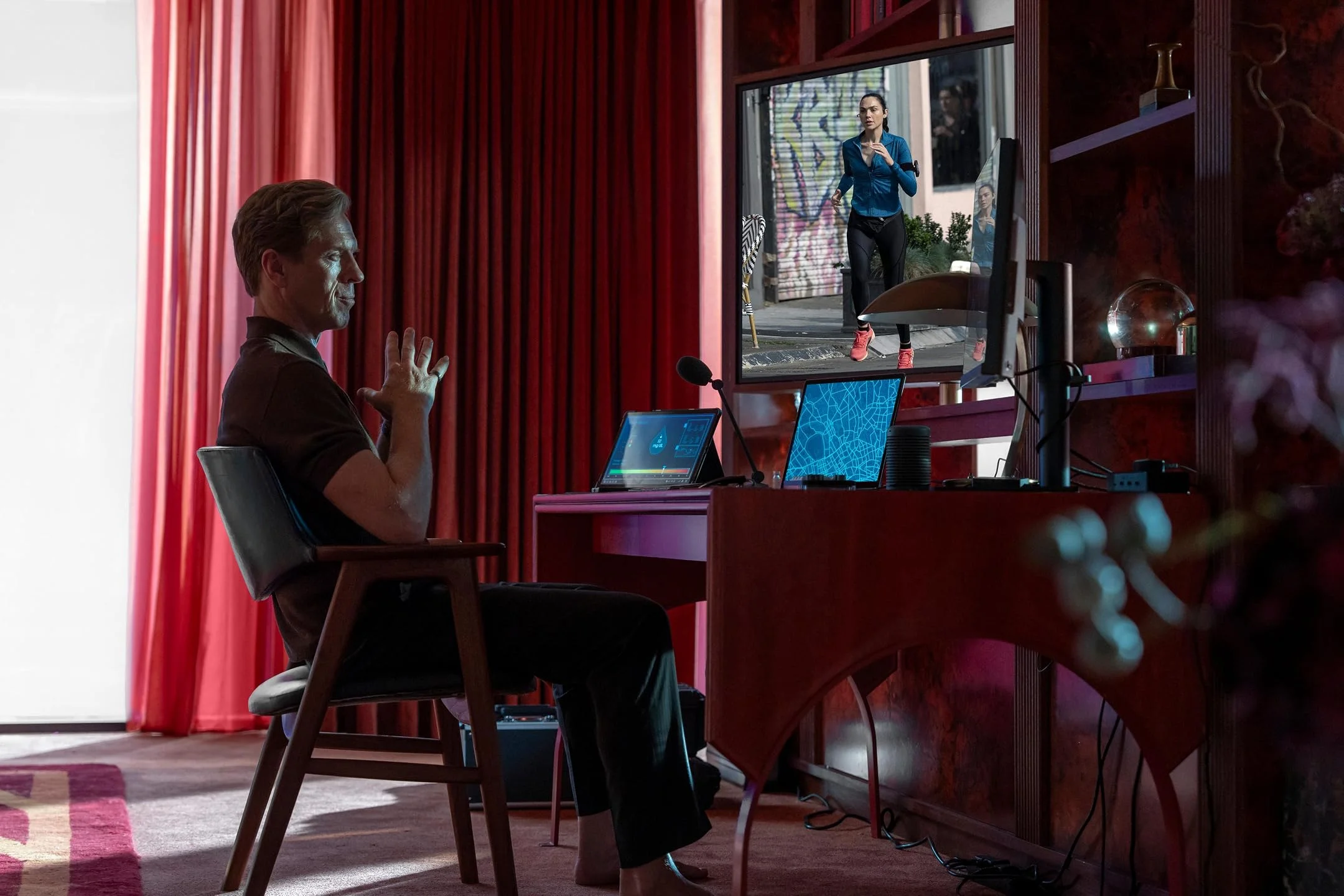
Those sequences place Maia’s exhaustion on screen with genuine clarity. Her emotional ordeal remains harder to locate. Noah’s abduction should create shifts in fear, denial, fury, calculation, and moral terror as Maia gets closer to Tafa. Gadot tends to hold these states at the same register. Tearful pleas and confrontations with the Caller arrive with visible effort, yet the emotional temperature rarely changes enough to suggest that Maia is being psychologically transformed by each new demand.
A painfully awkward exchange arrives after the Caller accesses private photographs from Maia’s phone. Her response, “You perv. You freakin’ perv!”, lands with the artificiality of a line written to announce violation rather than reveal it. Gadot’s stiff delivery exposes the construction.
The deeper problem belongs to the screenplay. Maia’s profession should make her predicament vicious. She works within the law, speaks for victims, and participates in a justice system that places enormous importance on testimony and evidence. Now she has been ordered to privately execute a witness because someone has placed her child on the opposite side of the moral scale.
That setup invites something ugly. Instead, Maia spends large portions of her conversations negotiating practicalities with the Caller, explaining delays and insisting that particular demands cannot be completed. The Caller responds by excavating her biography. Her childhood, running history, career, motherhood, relationships, routines, and stored digital life become exposition disguised as intimidation.
Lewis fares better because the movie initially restricts him. Fragments of his face emerge from darkness, his mouth appears in close-up, and his calm voice gives the Caller a composure that contrasts effectively with Maia’s exertion. Concealment gives Lewis authority. Each partially obscured glimpse suggests a person who can see Maia while remaining unseen himself.
Kevin Macdonald Runs the Camera Ragged
London should be the ideal city for this kind of thriller. Crowds create concealment and obstruction simultaneously. Public transportation can save time or destroy it. Bridges, narrow streets, waterways, intersections, stations, and dense pedestrian traffic naturally turn distance into conflict.
Macdonald and cinematographer Anthony Dod Mantle exploit that density aggressively. The camera circles Maia, rushes alongside her, dives into low angles, isolates pieces of her face, and occasionally pushes into blurry close-ups. Slow-shutter and step-printing effects fracture movement during moments of stress. Their purpose is clear: Maia’s physical exhaustion should infect the image itself.
Repeated often enough, the technique becomes another obstacle between the audience and the action. The visual distortion announces panic so loudly that it begins competing with Gadot rather than translating her experience. A run through London can already generate instability through changing terrain, crowds, traffic, and narrowing time. The added agitation frequently resembles an advertisement trying to convince viewers that jogging is an extreme sport.
Editing creates a related problem. Maia’s position inside the city becomes increasingly difficult to grasp. GPS imagery occasionally reminds us that a route exists, yet the movie rarely gives a useful sense of how each detour alters her distance from Tafa. Trains, bridges, boats, the ambulance, and the constantly changing streets become disconnected bursts of activity. Spatial clarity matters in a countdown movie. Five remaining miles means something only when the audience can feel what losing ten minutes has cost.
Macdonald is considerably sharper when watching London rather than assaulting it. Early images linger on pedestrians absorbed by their phones, moving beside one another while inhabiting separate digital worlds. The city becomes a mass of connected individuals barely noticing the bodies around them. Maia can be bleeding, sprinting, crashing into people, or desperately searching for another device while life continues at pedestrian speed.
Tom Hodge’s percussion-heavy score keeps hammering the clock forward, sometimes with such insistence that the soundtrack seems to be running alongside Maia. Blondie’s “Heart of Glass” and “Hanging on the Telephone” supply a cheekier retro personality around the film’s edges. Those songs suggest a version of The Runner comfortable with being a nasty, playful B-movie. The screenplay keeps pulling it toward solemn digital anxiety instead.
The Phone Knows Too Much
The Caller’s most persuasive weapon is not physical force. It is accumulated information. Maia’s phone contains the architecture of her life. Locations reveal routine. Photographs reveal intimacy. Messages reveal relationships. Search histories and stored files reveal private concerns. Noah’s connected medical system transforms care into vulnerability. AI can reproduce Maia’s voice closely enough to turn identity itself into another stolen credential.
The Caller explicitly mocks this dependence. At one point, his AI imitation of Maia prompts a remark about the irresponsibility of placing such technology in public hands. He claims to know Maia better than she knows herself because her device has preserved a searchable version of her existence.
The idea has bite. The film’s treatment of it mostly has volume. Macdonald repeatedly returns to pedestrians staring at screens, apparently unaware of Maia or the surrounding city. The images turn technological dependence into a visual refrain. Yet repetition gradually converts observation into scolding. People use phones. They fail to notice things. Their attention has been privatized by small glowing rectangles. The movie identifies the symptom and keeps pointing at it.
Its own plotting is far less skeptical whenever technology becomes useful. Digital systems possess terrifying reach when the Caller needs control, then become porous when Maia requires breathing room. The screenplay condemns technological omnipresence while depending on conveniently incomplete omnipresence to keep its heroine functional.
The sharper question sits elsewhere. Maia is a lawyer ordered to murder a witness to save her child. Her legal authority, maternal responsibility, and private morality have been forced into direct collision. Saving Noah could demand an act that permanently destroys the moral identity of the person saving him.
That possibility is where The Runner becomes cautious. The script constructs escape routes that preserve Maia as a conventional heroine and spends its late energy demonstrating how cleverly she has manipulated the situation. It prefers ingenuity over contamination. Maia may suffer physically, but the story remains reluctant to let love for her son turn her into someone capable of an irreparable act.
A city filled with cameras, hacked devices, cloned voices, distracted witnesses, and invisible observers surrounds her. The most frightening form of surveillance would have been the one Maia could never escape afterward: knowing exactly what she had chosen to do.
The Runner premieres globally on Amazon Prime Video on September 2, 2026. The psychological thriller follows a high-powered London attorney forced to run through the city and execute dangerous demands from an anonymous caller to save her abducted son.
Where to Watch The Runner (2026) Online


Full Credits
Title: The Runner
Distributor: Amazon MGM Studios
Release date: September 2, 2026
Rating: PG-13
Running time: 1 hour 24 minutes
Director: Kevin Macdonald
Writers: Mark Gibson
Producers and Executive Producers: David Kosse, Jane Robertson, Amy Paquette, Elliott Kleinberg, Claire Willats
Cast: Gal Gadot, Damian Lewis, Rory Wilmot, Alfred Enoch
Director of Photography (Cinematographer): Anthony Dod Mantle
Composer: Tom Hodge
The Review
The Runner
The Runner turns London into a network of screens, cameras, location data, and distracted bodies, then struggles to say anything sharper about that condition than phones are dangerous and privacy is fragile. Kevin Macdonald gives Maia’s race physical velocity, while Gal Gadot supplies the stamina the role demands, yet Mark Gibson’s screenplay repeatedly rescues its heroine from the moral ugliness that could have made the premise sting. The surveillance rules bend whenever convenient, the climactic deception cheats, and frantic technique keeps substituting movement for suspense.
PROS
- Strong use of London locations
- Gadot’s physical commitment
- Damian Lewis’s controlled vocal menace
- Energetic visual experimentation
CONS
- Predictable thriller structure
- Weak emotional performance
- Inconsistent surveillance logic
- Heavy-handed technology commentary
- Manipulative final twist