




























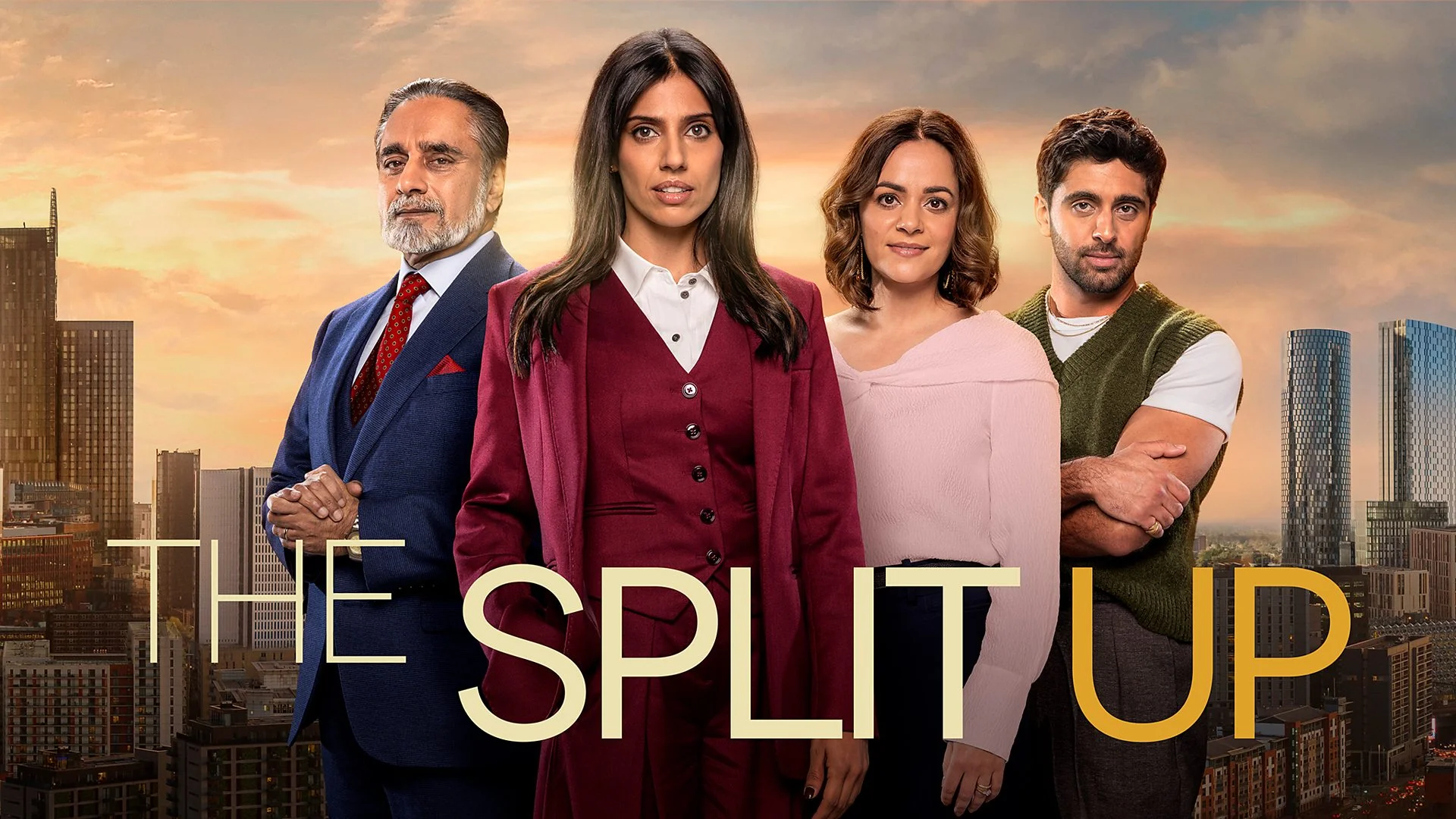

Kishan Law sells order to people whose private lives have become expensive forms of chaos. That arrangement gives The Split Up its neatest irony, because the family running the firm can barely keep professional authority, romantic loyalty and parental expectation from bleeding into one another. The clients arrive with broken marriages and complicated assets. The Kishans have the harder problem: deciding where family ends and business begins.
Ursula Rani Sarma’s six-part series inherits the machinery of The Split and relocates it to Manchester, where widowed patriarch Dhruv Kishan has spent decades building a high-end family law practice. His daughter Aria is supposed to inherit the firm, and Ritu Arya plays her with the brisk competence of someone who has already started behaving like the person in charge. Dhruv, played by Sanjeev Bhaskar, seems less convinced by the transition each time he has to act on it.
That tension gives the show firmer ground than its weekly divorce cases. Dhruv wants Aria to succeed, yet repeatedly makes decisions around her, most significantly when he hires financial specialist Luke Christos. The professional slight would be enough. The complication is that Luke is the man Aria slept with during a break in her long relationship with Neal, and his arrival turns an argument about succession into an argument about secrecy, judgment and the life Aria believes she has already chosen.
The love triangle is unapologetic soap. It works because the series rarely pretends otherwise. Luke is handsome, inconvenient and professionally impossible to avoid. Neal has history on his side. Aria has enough ambition to make any emotional distraction feel like an administrative error, which is precisely why the distraction keeps gaining weight. The show is far more convincing when it treats these elements as pressure points inside a family than when it tries to lend its legal cases equivalent gravity.
What gives the Kishans distinction is the ease with which cultural tradition and contemporary British life occupy the same spaces. Aria’s engagement rituals, including the chunni ceremony, sit alongside smart bars, fashionable restaurants, demanding careers and relationships shaped by the same compromises found in any glossy metropolitan drama. The family visits the temple, then returns to a world of late nights, client crises and romantic damage. Sarma does not present these modes of life as opposing forces waiting for a dramatic reconciliation. They already coexist.
That matters because British South Asian families on television have often been asked to perform their cultural identity at conspicuous volume, as if every tradition requires explanation before a story can continue. Here, the stronger details are allowed to remain part of ordinary family behavior. Dhruv’s response to his youngest son Kav is especially telling. Kav being gay is accepted. His repeated failure to pass his law exams is a much greater source of paternal frustration. The joke works because it reveals the hierarchy of values inside this particular household without turning Dhruv into a symbolic spokesman for an entire culture.

Maya adds another angle. She has stepped back from legal practice to raise her children, yet she is still drawn into the orbit of the firm. Her apparently stable marriage begins acquiring familiar warning signs as her husband’s work keeps him away for longer hours. Kav, meanwhile, struggles with professional confidence while journalist and influencer Ashok circles both him and the kind of privileged information that comes with the Kishan name. Each subplot turns some version of family obligation into potential exposure.
The show is less assured when the clients take center stage. The first episode gives Lenny Henry and Jane Horrocks a marriage built partly around their public image as relationship experts. Tash has been caught with a younger woman, yet she wants an open marriage rather than a divorce. Alex still wants her happiness protected, while Aria thinks in the language of assets and legal exposure. It is an efficient setup, with a suitably cheeky reversal in who has been unfaithful, yet the case feels disposable almost as soon as it has done its thematic work.
Later guest cases operate similarly. Jameela Jamil appears in another story built around money, betrayal and a man ready to exploit the situation. Other disputes involve divorce settlements and elaborate financial arrangements. They give the lawyers something to do and keep the series moving, though the writing becomes thinner whenever these clients are asked to carry emotional weight. A line such as “Our friendship is our legacy, that’s the real loss here” exposes the strain. The Kishans sound like people with histories. Too many clients sound like episode machinery.
That imbalance also explains why Aria can occasionally feel less vivid than Maya or Kav despite occupying the narrative center. She is asked to carry succession, romance, professional conflict and each week’s client problem at once. The siblings are granted cleaner emotional shapes. Aria sometimes functions as the junction through which every storyline must pass, and Arya has to supply the personality that the architecture leaves compressed.
Bhaskar benefits from the opposite condition. Dhruv has room to hesitate. His reluctance to surrender the firm can look controlling in one scene and understandable in the next. He built Kishan Law from scratch, and retirement asks him to hand over a professional identity that has also structured his role as a father. The series is at its strongest when those two forms of authority become impossible to separate.
All of this unfolds inside the kind of polished wealth television understands very well. There are immaculate clothes, handsome offices, expensive settlements, crowded parties and enough beautiful interiors to make even professional anxiety appear properly catered. The glamour is part of the contract. This is escapism built around people whose problems arrive dressed for dinner.
The Split Up premiered on BBC One and BBC iPlayer on September 20, 2026. As a spin-off to the hit legal drama The Split, this series follows a powerful British South Asian family running an elite divorce law firm in Manchester as long-buried secrets threaten their legacy.
Full Credits
Title: The Split Up
Distributor: BBC One, BBC iPlayer
Release date: September 20, 2026
Rating: TV-MA
Running time: 60 minutes per episode
Writers: Ursula Rani Sarma
Producers and Executive Producers: Abi Morgan, Ursula Rani Sarma, Jane Featherstone, Bryony Arnold
Cast: Ritu Arya, Sanjeev Bhaskar, Aysha Kala, Arian Nik, Danny Ashok, Dimitri Leonidas, Mawaan Rizwan, Sindhu Vee, Shalini Peiris, Tom Forbes
The Review
The Split Up
The Split Up works best when the Kishans themselves become the real case under examination. Its legal stories are often disposable, and Aria can feel overburdened by the number of plots routed through her, but the family dynamics have warmth, specificity and enough friction to keep the glossy soap machinery moving. The British South Asian setting gives familiar succession, romance and professional rivalry a sharper texture without turning culture into exposition. Sanjeev Bhaskar is especially effective as a father discovering that handing over a firm is easier on paper than in practice.
PROS
- Warm, convincing Kishan family dynamics
- British South Asian detail handled naturally
- Strong Dhruv and Aria succession conflict
- Glossy soap instincts used confidently
- Sanjeev Bhaskar gives Dhruv welcome nuance
CONS
- Weekly legal cases feel disposable
- Aria carries too many narrative functions
- Client dialogue can turn mechanical
- Familiar romantic complications limit surprise