


























The birth of a royal heir gives the Ōoku a reason to celebrate and the official consort a reason to feel cornered. She is supposed to accept the baby, accept her place, and accept that this is happiness. Her refusal makes the festivities uncomfortable before the supernatural danger takes hold. Set a year after The Ashes of Rage, Mononoke the Movie: Chapter III – The Curse of the Serpent places her distress beside Fuki’s new motherhood and the ruler’s preference for Fuki. A son can settle a question of succession. It cannot make the consort feel wanted.
Tokiwai, her nurse and maternal guardian, makes that discomfort harder to escape. Her concern is sincere, which gives her insistence that the consort fulfill her position a particular sting. Someone who loves her keeps directing her toward the role that hurts her.
The film makes room for the frightening possibility that care can become coercive without ever feeling cruel to the person administering it. Tokiwai wants her charge to be secure and rewarded, but the court has supplied the only language she knows for achieving that. The consort’s immediate feelings struggle to register inside those protective intentions.
This is an effective emotional foothold in a film that can otherwise leave you scrambling to assemble its revelations. You do not need to understand every connection in the royal bloodline to recognize the pressure of being told that your circumstances should satisfy you. The mystery around the infant complicates the consort’s refusal, keeping it from settling into a simple portrait of resentment.
Meanwhile, the investigation reaches back approximately 150 years, toward the Ōoku’s origins and the woman worshipped as its Water Goddess. Her abandoned hopes make the consort’s distress feel horribly familiar across generations. The historical disclosure matters because it gives present disappointment an earlier human counterpart.
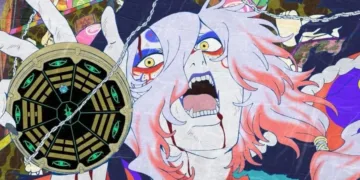
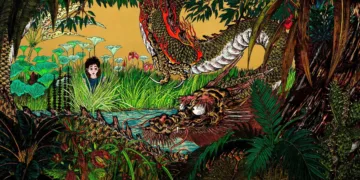
The palace itself starts to feel implicated when Hebigami moves through its decorated surfaces. The serpent travels across floors, walls, and ceilings as a two-dimensional presence, turning the room’s elaborate ornamentation into a possible route of attack. Your eyes have to renegotiate the space.
A wall offers no reassurance if the thing pursuing you can move along it like an image coming loose from its assigned place. Triangular scales falling from the building extend that unease: even the architecture seems capable of shedding its appearance and participating in the violence. The horror works through a loss of usable, dependable space.
The textured, paper-like image gives this movement an unusual physical appeal. Dense patterns and saturated colors invite you to study the frame while the serpent’s movement makes that attention feel unsafe. Dynamic camera movement intensifies the pursuit, and the attacks can produce a bodily jolt before their place in the larger mystery becomes clear.
This is a film worth seeing for the way it changes your relationship with a drawn surface. Animation becomes frightening through possibilities that live-action space would struggle to offer. The pleasure of looking and the anxiety of watching share the same visual information.

There are stretches, though, when that information becomes difficult to sort. Crowded designs, rapidly changing compositions, and the pace of the action can leave you working out what happened while the film is already asking for your response to the next event. Disorientation suits a palace whose surfaces cannot be trusted.
It becomes less useful when you lose the thread of a danger or have insufficient time to absorb a discovery. The climactic music adds another powerful sensation, combining traditional Japanese singing and instrumentation with electronic bass, rap, and processed vocals. It gives the exorcism a physical surge, but that surge cannot supply every missing beat of comprehension.
Familiarity helps carry some of the burden. Asa, Botan, Fuki, and the guards recognize the Medicine Seller’s purpose by now, so his return can proceed without another prolonged argument over his credibility. Their acceptance creates a welcome feeling of shared experience.
These people have survived enough to know whom to trust, and viewers who followed the earlier films share that recognition. Threatening this returning ensemble also gives the attacks accumulated emotional weight. The cost is a steep entry point for newcomers, while even returning viewers may need a firm memory of the earlier chapters to keep pace with the connections arriving here.
The Medicine Seller’s sword offers a different kind of reassurance. He must establish a mononoke’s Form, Truth, and Reason before drawing it, making investigation part of the promised release. The waiting gives suffering a place in the action: someone has to understand what produced this danger before power can be used against it. Following that process encourages an attachment to the method itself. You come to expect revelation, recognition, and then the confrontation. The serpent mystery benefits from that expectation as the current succession crisis meets the buried history of the Ōoku.
The late arrival of Hyakume disrupts this rhythm, with a strong emotional idea and a hurried dramatic execution. Giving voice to concealed feelings changes the consort’s ordeal. She is exposed to what the people around her have kept unspoken, making the present company threatening in a way the historical revelations cannot.
Yet the film moves through the renewed threat and the sword’s requirements so quickly that the earlier investigation loses some of its earned release. The second Medicine Seller and the two-sword exorcism provide a rush of recognition for longtime fans. Within this film’s immediate emotional progression, the intervention arrives with limited room to turn surprise into attachment.
The consort’s eventual choice to live with the heir, revealed to be a foundling, gives the experience somewhere to settle. She relinquishes the future she wanted with the ruler, without gaining freedom from the Ōoku itself. That leaves her acceptance of the child carrying several feelings at once: grief for an unavailable life, a change in responsibility, and the possibility of affection that does not depend on royal preference. The palace continues after the exorcism. Her decision has to be lived there, among the duties and relationships that remain, with a child whose needs will continue after everyone else has finished celebrating.
Mononoke the Movie: Chapter III – The Curse of the Serpent premiered worldwide on Netflix on September 29, 2026. Set within the grand Ōoku, the striking anime conclusion follows the enigmatic Medicine Seller as he confronts a deadly serpent entity born from the intense political strife and hidden tragedies of the imperial harem.
Where to Watch Mononoke the Movie: Chapter III – The Curse of the Serpent (2026) Online


Full Credits
Title: Mononoke the Movie: Chapter III – The Curse of the Serpent
Distributor: Netflix
Release date: September 29, 2026
Rating: TV-14
Running time: 1 hour 27 minutes
Director: Kenji Nakamura, Tomoaki Koshida
Writers: Yasumi Atarashi
Producers and Executive Producers: Haruka Katō, Kōichi Naruse
Cast: Hiroshi Kamiya, Atsumi Tanezaki, Miyu Irino, Kenjiro Tsuda, Yoshiko Sakakibara, Tomoyo Kurosawa, Yoko Hikasa, Haruka Tomatsu
Editors: Shigeru Nishiyama
Composer: Taku Iwasaki
The Review
Mononoke the Movie: Chapter III - The Curse of the Serpent
The consort’s movement from rejection toward chosen care gives this finale an emotional weight that survives its tangled revelations. The serpent’s movement through decorated surfaces makes the palace frightening to inhabit, while familiar characters deepen the danger. Crowded action and a hurried second confrontation interrupt the release the investigation earns. The human aftermath supplies the breathing room the spectacle sometimes withholds.
PROS
- The consort’s distress gives the mystery emotional focus.
- Inventive serpent animation turns palace decoration into danger.
- Returning characters strengthen tension and attachment.
- The aftermath preserves grief alongside the possibility of care.
CONS
- Visual density sometimes obscures the action.
- The rushed second confrontation weakens the investigative payoff.
- Heavy dependence on earlier chapters limits accessibility.