




























Mika and Tesfay brush their teeth outside in the rain, wearing red and blue raincoats. They are visiting her parents in the countryside, and for a little while their life together has the ease of something neither person needs to explain. Fanni Metelius, who writes, directs, edits, and stars in The Heart, gives this shared routine a tenderness that the couple’s sexual encounters cannot quite contain. They can be unremarkable together. The weather continues around them, indifferent to the small privilege of having someone beside you while you attend to your teeth.
Elsewhere, bodies occupy the camera at close range, and breathing makes desire audible. These encounters belong to the same intimacy, with its pleasure in another person’s physical existence, but they ask something different of Mika and Tesfay. Sex requires a renewed willingness that familiarity cannot guarantee.
Brushing your teeth beside someone can become habitual; wanting them remains beyond the reach of habit. Metelius allows both kinds of closeness to feel convincing, which makes the gradual disappearance of one so difficult to understand from inside the other. The person is still there. Much of the life remains.
Mika, a photography student played by Metelius, initially speaks about relationships with the confidence of someone who imagines she can recognize unhappiness before entering it. She fears becoming the sad, dependent girlfriend. Casual sex and nights with friends seem to offer a life she can keep in her own hands, until her attachment to aspiring musician Tesfay makes those arrangements feel insufficient.
She tells him she wants commitment after sleeping with someone else, an awkward declaration that he receives with affectionate amusement. Their connection has room for this untidiness. Metelius and Ahmed Berhan make the decision to live together feel like an extension of an existing pleasure, rather than a fatal mistake awaiting exposure.
That early warmth matters when Tesfay’s interest in sex begins to diminish. His retreat into gaming, alongside the faltering of his musical ambitions, leaves Mika trying to recover something she cannot restore through effort alone. Metelius’s performance follows the humiliating adjustment from expressing desire to seeking reassurance through it.
Mika continues to want him, but his response increasingly determines what she can believe about herself. The body that once gave her pleasure becomes a body she must assess for faults. Her earlier certainty about independence offers little protection against the particular authority of someone she loves.
When Mika considers therapy, her mother objects to the assumption that the woman must be the person who needs fixing. The exchange gives her private shame a social history without explaining it away. Mika has learned to speak freely about sex, yet freedom of expression has not freed her from measuring herself through a man’s desire. Her needs remain legitimate, and so does his refusal. Metelius stays with the painful space between those truths, where neither bodily autonomy nor a sincere declaration of love can make two people want the same thing. There is no satisfactory reassurance Mika can simply extract from Tesfay.
His eventual acknowledgment of depression changes the weight of his withdrawal. “I want to disappear,” he says, and the wish makes his inactivity feel less comfortably available for judgment. From Mika’s position, his distance can seem like a verdict on her; from his, even being present may have become difficult.
Berhan’s earlier warmth prevents this admission from feeling like an explanation attached to an empty character. We have seen him participate in their happiness. His retreat leaves behind the troubling possibility that affection can persist without supplying the energy to act upon it, and Mika’s attempts to reach him cannot become a treatment for his distress.
The film’s access to Tesfay is still limited. Mika has her early declarations, her sexual disappointment, her conversation with her mother: several ways of making her experience legible. His account of himself remains comparatively compressed around withdrawal and that admission.
Some distance is necessary to convey her confusion, but the confession opens an interior life that the film only briefly enters. Depression gives his behavior another meaning without providing much sense of how he inhabits it. I wanted to stay with that difficulty longer, particularly because the tenderness between the performers makes his partial inaccessibility feel like a loss within the film itself.
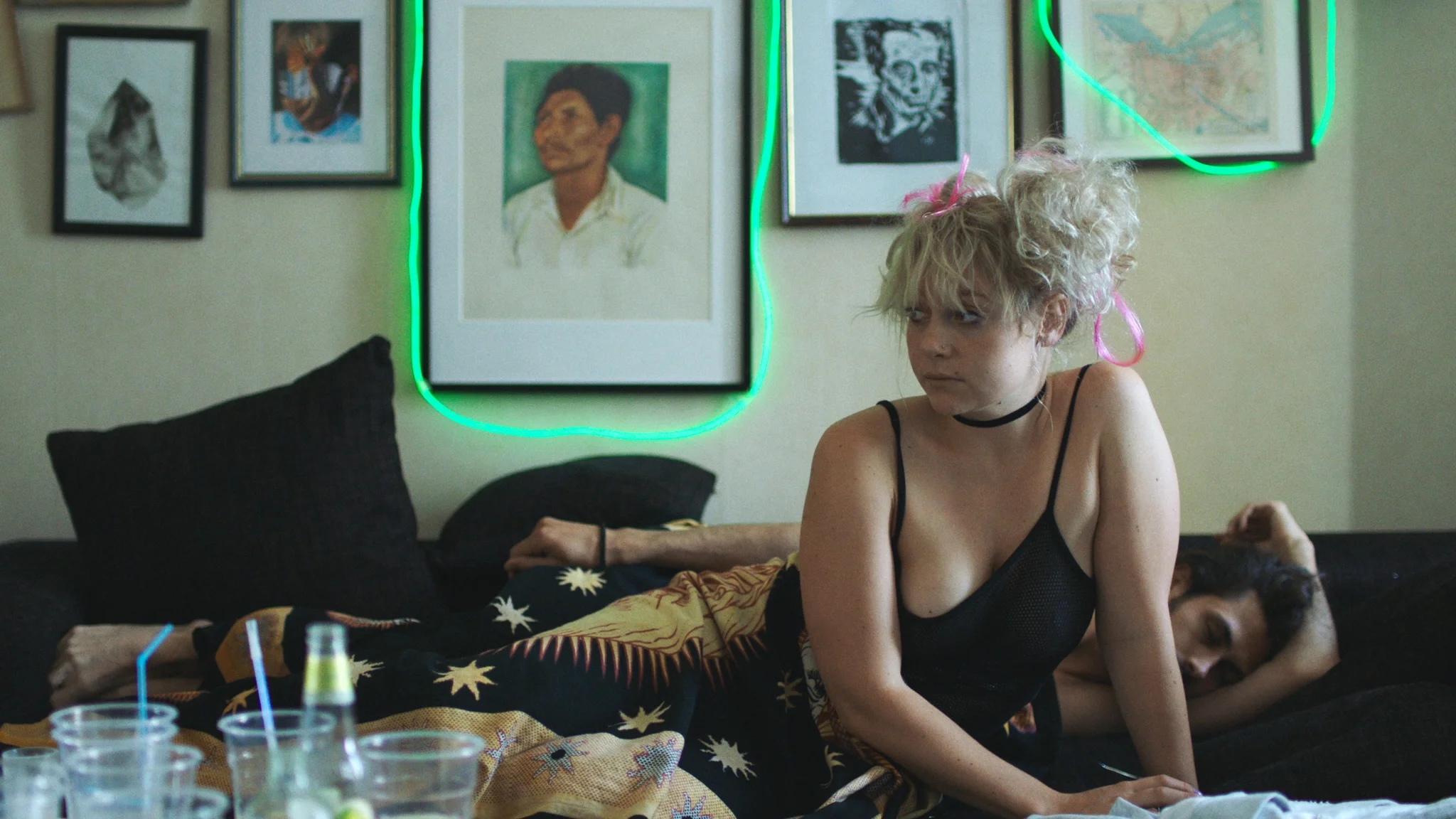
Maja Dennhag’s photography gives the world beyond their shared home an insistent physical appeal. Neon, saturated color, and dancing bodies fill the nightclubs and beach parties; club tracks and hip-hop give those spaces a momentum that requires little explanation from anyone inside them.
Mika can move, feel, and belong among friends without making her pleasure dependent on Tesfay’s response. The brightness does not cancel her loneliness. It gives her other sensations to live through, other people whose company can interrupt the narrowing of attention that has made one relationship the measure of her worth.
Those passages also expose the film’s looseness. As dancing and party imagery recur, their emotional function becomes familiar before Metelius is ready to leave them. The pulse continues, the colors remain attractive, but another interval of release does not always alter our understanding of Mika. The Ibiza escape carries a recognizable wish to put distance between the body and its recent hurt; some of the surrounding nightlife repeats that wish without discovering much within it. The film’s generosity toward youthful pleasure occasionally becomes an unwillingness to cut it short.
Separation leaves Mika with a different problem from the one she imagined freedom would solve. She has already experienced casual sex without the attachment she wanted, then attachment without the sexual closeness she needed. Returning to friends and pleasure cannot restore her earlier certainty about relationships, and the film is wise to let that certainty go.
Her growing independence includes an unwelcome knowledge of her own susceptibility: she can choose to leave a life that diminishes her without ceasing to miss the person who shared it. Future intimacy remains desirable, carrying the possibility that she will again let someone’s presence matter this much.
The Heart premiered at the International Film Festival Rotterdam on January 26, 2018, before opening theatrically in Sweden on February 14, 2018, and is available for streaming on Amazon Prime Video and Film Movement Plus. Directed, written by, and starring Fanni Metelius in her feature directorial debut, the Swedish relationship drama follows a young photographer and her musician boyfriend as they navigate modern passion, intimate insecurity, and subtle power dynamics after moving in together.
Full Credits
Title: The Heart (Swedish: Hjärtat)
Distributor: TriArt Film, Garagefilm International, Film Movement Plus, Omnibus Entertainment
Release date: January 26, 2018 (Rotterdam International Film Festival), February 14, 2018 (Sweden)
Rating: TV-MA / 16+
Running time: 1 hour 40 minutes (100 minutes)
Director: Fanni Metelius
Writers: Fanni Metelius
Producers and Executive Producers: Rebecka Lafrenz, Mimmi Spång, Anna-Maria Kantarius, Anette Mattsson, Frida Mårtensson, Simon Perry, Lisa Widén
Cast: Fanni Metelius, Ahmed Berhan, Leona Axelsen, Daniella Mir, Suzanne Reuter, Claes Hartelius, Mia Ray
Director of Photography (Cinematographer): Maja Dennhag
Editors: Fanni Metelius
Composer: Katharina Nuttall, Linus Andersson
The Review
The Heart
Metelius gives affection a painful persistence: it survives after desire has become a source of shame. Her chemistry with Berhan and attention to ordinary intimacy make the couple’s separation matter. Repetitive party scenes and restricted access to Tesfay’s depression limit the film, but Mika’s growing independence retains the ache of loving someone she needs to leave.
PROS
- Tender, convincing chemistry between the leads
- Sensitive treatment of desire and self-blame
- Domestic details that make intimacy tangible
- Expressive color and music
CONS
- Repetitive nightlife passages weaken momentum
- Tesfay’s inner experience receives limited exploration 1.