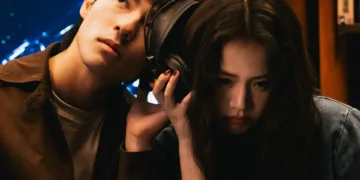




















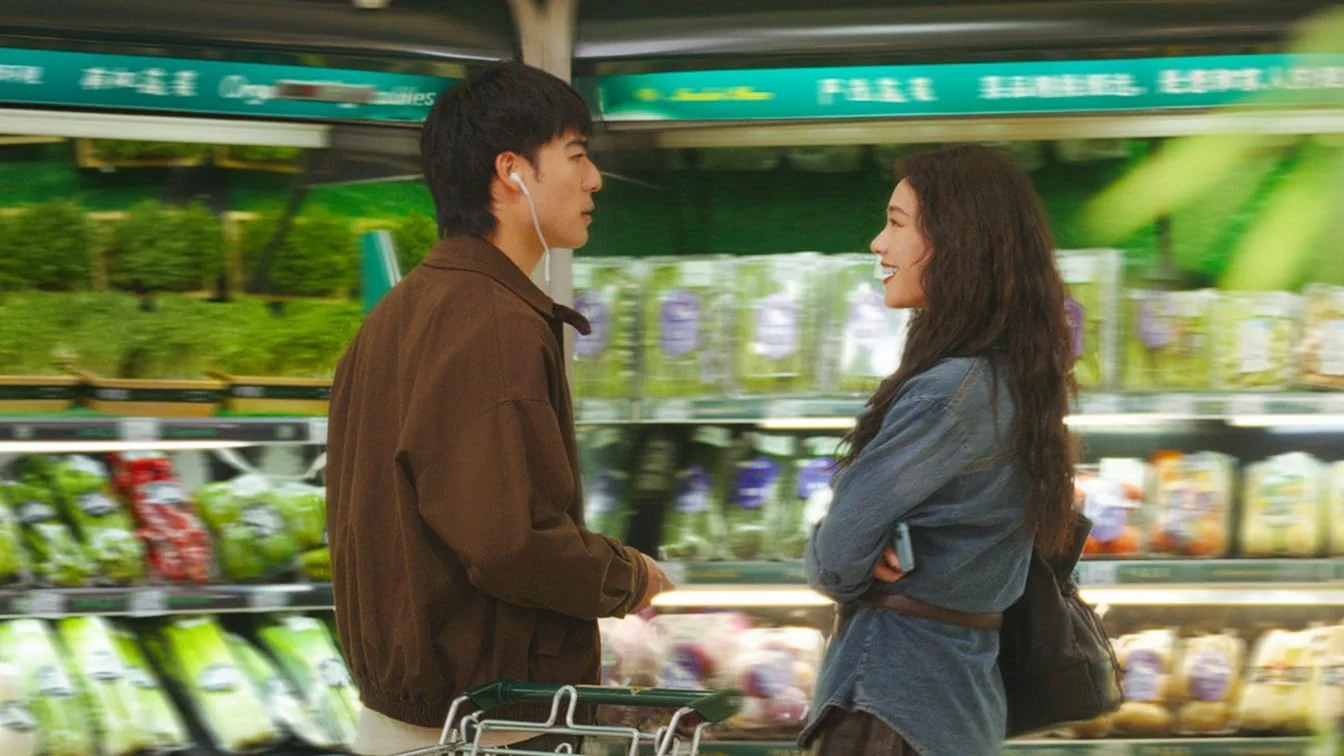
Xu Qiu refuses to let a fraudulent dating profile have the last word on her evening. At a Beijing supermarket, she approaches a man in a brown jacket, discovers he is the wrong person, then finds her actual date bears little resemblance to his photographs. The stranger, Chen Yuzhou, was looking for somewhere to charge a power bank. Xu decides to approach him again. Ma Sichun gives that decision an appealing mixture of appetite and wounded pride: Xu has been embarrassed, but she still wants something from the night, and she is prepared to ask for it.
Their physical interest is refreshingly easy to understand. Finding somewhere to act on it proves harder. Zhao Badou’s Crossing a Dawn keeps interrupting Xu and Chen’s attempts at privacy, sending them back into conversation and through another stretch of the city.
Initially, these delays carry the pleasure of flirtation prolonged. Gradually, the conversations become something worth protecting. The film changes our investment almost without announcing it: getting the pair alone becomes less urgent than keeping them together. Each additional stop gives them another opportunity to discover something they might later miss.
Ma and Edward Chen make that change convincing because their chemistry leaves room for uncertainty. Her amusement often carries a trace of hurt; his gentler, self-mocking manner gives her confidence somewhere to land without turning their exchanges into a competition for charm.
Xu’s description of his body through a subway-map metaphor makes erotic curiosity feel playful and personal. She is inventing a language for this particular person. Elsewhere, her admission of the distance between her presented life and her actual circumstances changes the terms of their conversation. Someone who seemed entertaining becomes someone whose disappointment needs a response.
Beijing supplies plenty of places to prolong that process. Food stalls and convenience stores let them continue spending time together without having to declare the evening significant. A snack or another stop can remain a small decision, even as those decisions accumulate into hours.
The karaoke booths offer an especially apt kind of shelter: enclosed enough to encourage intimacy, insufficiently soundproofed to make the outside world disappear. Cramped apartments have similarly permeable walls. Privacy keeps proving conditional, and the couple have to find ways of being close inside spaces they cannot fully control.
Fan Chao’s nighttime photography makes this movement through the city inviting, but the film’s strongest visual pleasures have an emotional destination. In the nightclub, the imagery and music intensify the charged awareness of another body nearby. The shared taxi ride, with one head resting on the other’s shoulder, offers a quieter form of contact. That shift matters.
The excitement of attracting someone’s attention has begun to accommodate the ease of leaning on them. Zhao gives these ordinary degrees of proximity enough space to register, allowing a ride across town to carry feelings the characters have barely had time to name.
The pair acknowledge Before Sunrise themselves, which neatly dispenses with the need to pretend this setup has no cinematic history. Their awareness also suits people trying to understand an experience while it is happening. A familiar romantic film offers a possible description of their night, though living through the encounter remains messier than recognizing its shape.
The repeated search for privacy occasionally makes the screenplay’s organization visible: another obstruction arrives, and another conversation must follow. The rhythm works best when those detours alter how Xu and Chen see each other, rather than simply keeping them in motion.
A visit with Xu’s wealthy former lover does exactly that. He invites them to join him and the woman he is seeing, placing an undefined new connection beside a history that already exists. The discomfort is immediate in principle and difficult in practice. Xu and Chen have scarcely established what they can expect from each other, yet jealousy and comparison do not wait for an agreement. The presence of other people makes every response socially exposed. They must negotiate their own uncertainty while also appearing to be comfortable company.
This encounter gives their attachment a less flattering, more persuasive texture. Wanting someone becomes tangled with the discovery that their life contains people and experiences beyond the version available tonight. Ma’s blend of confidence and vulnerability is particularly useful here. Xu can initiate the evening and still carry wounds into it; her openness does not make her uncomplicated. The sequence also interrupts the flattering fantasy that two strangers can meet entirely free of their previous lives. Their growing closeness now has something awkward to absorb, and the film gains emotional weight from letting that happen in company.
When Xu’s design work supplies a CAD-created apartment for them to inhabit imaginatively, the attraction takes another form. A place that does not exist lets them briefly experience the possibility of belonging somewhere together. The sequence connects profession, housing, and romantic speculation without needing to separate them into topics. After so much movement through borrowed or temporary spaces, imagining a home has a particular tenderness. Its unreality permits an intimacy that would feel premature as a practical proposal. They can enjoy the possibility before either has to answer for it.
The closing minutes extend that impulse by rearranging earlier incidents into the imagined shape of a conventional love story. There is a slight cost to the neatness: the night’s loose, sometimes awkward encounters become visibly available for romantic reconstruction.
Yet that desire to reorganize experience is emotionally credible. Once someone begins to matter, an accidental meeting can acquire the appearance of an origin story. The breakfast scene, with tears over hot buns, holds the same pressure in a plainer setting. Eating together is an ordinary activity they have only just learned to share. Morning arrives before they have discovered how it might become a habit.
Crossing a Dawn released in Chinese theaters on May 22, 2026, followed by a limited theatrical release in North America on May 29, 2026, courtesy of China Lion Film Distribution. Written and directed by Zhao Badou, the Chinese romantic comedy-drama follows two young lovers whose initial attempt at a romantic date gets repeatedly disrupted by unexpected urban encounters over the course of a single night.
Where to Watch Crossing a Dawn (2026) Online





Full Credits
Title: Crossing a Dawn (Chinese: 今晚正好)
Distributor: China Lion Film Distribution, Momo Pictures, Damai Entertainment, China Film Group Corporation
Release date: May 22, 2026 (China), May 29, 2026 (North America)
Rating: PG / PG-13
Running time: 1 hour 42 minutes (102 minutes)
Director: Zhao Badou
Writers: Zhao Badou
Cast: Ma Sichun, Edward Chen, Zhang Yifan, Lyu Xingchen, Song Yang, Wen Moyan, Liu Chuang, Chen Haoming
Director of Photography (Cinematographer): Fan Chao
The Review
Crossing a Dawn
Crossing a Dawn makes you want two strangers to keep finding excuses to stay together. Ma Sichun and Edward Chen turn flirtation into tentative attachment, while Beijing’s temporary shelters give their closeness a beautifully uncertain rhythm. Some interruptions feel arranged, and the finale tidies an encounter whose awkwardness was part of its appeal. Yet the imagined apartment and tearful breakfast earn their tenderness through everything the pair have learned to enjoy about each other.
PROS
- Ma Sichun and Edward Chen’s tentative, playful chemistry.
- City spaces that shape the couple’s growing intimacy.
- Desire treated with humor and emotional openness.
- An affecting imagined apartment and breakfast scene.
CONS
- Repeated interruptions occasionally expose the screenplay’s machinery.
- The finale slightly overorganizes the night’s appealing messiness.