



























Takaki’s passage through a planetarium exhibition gives his loneliness an unusually comfortable address. A Tokyo programmer who once wanted to become an astronaut, he finds his professional life bringing him close to a childhood ambition. Yoshiyuki Okuyama’s live-action 5 Centimeters Per Second places that recovered possibility beside his attachment to Akari, the girl separated from him by their families’ relocations. The setting accommodates both desires: distant worlds remain available for contemplation, protected from the awkward business of contact. For a man struggling to engage with people nearby, the universe offers excellent terms.
Cinematographer Keisuke Imamura gives the remembered past a similar hospitality. Warm colors lend childhood an attraction that the spectator can feel before examining its reliability. Purple twilight and carefully composed landscapes make longing pleasurable to inhabit.
This is a consequential choice. Takaki’s attachment gains persuasive force from the images themselves; we, too, have been given somewhere beautiful to retreat. Yet the recurring views of clouds, night skies, and falling blossoms sometimes leave his emotional position unchanged. Once the photography has established his distance, another picturesque expression of it can feel like an invitation to remain there.
The childhood bond supplies the necessary human weight beneath that visual seduction. Takaki and Akari find companionship through books and their experience of changing schools, a modest foundation that makes their closeness credible. Haruto Ueda and Noa Shiroyama give those early selves an ease that matters to the later performances.
Here are children who have found relief from feeling displaced. Akari’s move, followed by Takaki’s relocation to Tanegashima, puts their relationship at the mercy of decisions made elsewhere. Their separation has an identifiable cause, and neither child has much authority over it.
That distinction becomes harder to sustain as Takaki grows older. Teenage Takaki, played by Yuzu Aoki, remains distant from Kanae Sumida; as an adult, Hokuto Matsumura’s Takaki cannot meet colleague Risa Mizuno’s romantic interest. Nobody owes affection in return for receiving it.
The film’s sharper question concerns his availability to experience anything that might disturb the privileged position of his past. Matsumura’s occasional faint smiles are valuable precisely because they interrupt the withdrawal. Feeling has survived. His reserve acquires the sadness of a capacity exercised so sparingly that other people struggle to reach it.
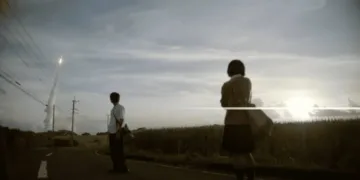
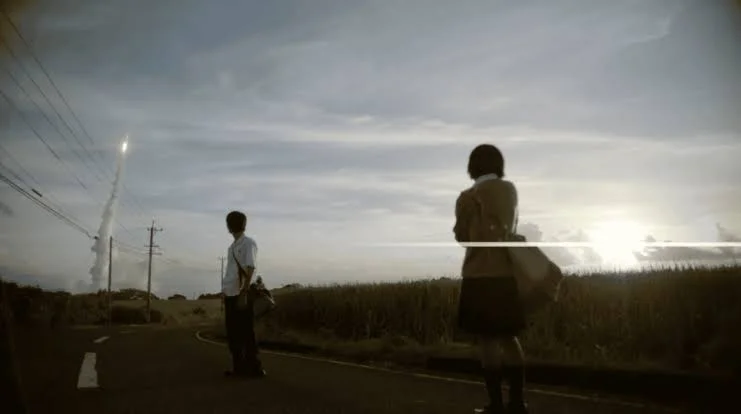
Kanae’s unreturned affection gives the rocket-launch sequence a productive imbalance. The spectacle points outward, toward extraordinary distances, while Nana Mori keeps the immediate emotional problem close: she cares for someone whose attention she cannot secure.
The image can accommodate both scales, but they exert different pressures. Space lends Takaki’s longing grandeur; Kanae’s presence gives that grandeur a human cost. Her disappointment does not make him cruel. It does make the idea of universal forces keeping lovers apart seem insufficient to account for every failed connection.
The Voyager references and the Golden Record extend this tension. Recorded impressions of Earth travel outward while the place they preserve keeps changing. Takaki’s memory works through a comparable separation between a treasured selection and an ongoing life. Okuyama’s imagery is strongest when it allows us to sense that discrepancy.
A preserved encounter may remain emotionally truthful while becoming an inadequate guide to the present. The danger lies in granting a memory authority over people who had no part in creating it, as Kanae and Risa discover from different positions in Takaki’s life.

Adult Akari provides a useful interruption to that arrangement. Played by Mitsuki Takahata, she has a working life in a bookshop near Takaki’s workplace, and an errand carries her toward the planetarium. These ordinary activities give her an existence outside his recollection.
Physical proximity introduces a different kind of ache from the childhood relocations: the city can bring two lives close without restoring their former intimacy. The near convergence is touching, though it also renews the film’s fondness for coincidence. Geography becomes another way of encouraging us to watch for reunion, even as the drama asks us to accept separate lives.
Okuyama’s restructuring of Makoto Shinkai’s 2007 animation makes that expectation central to the viewing experience. The earlier film’s three-part chronology becomes an interlacing of adulthood, adolescence, and childhood, with the snowbound reunion in Iwafune held until late.
We encounter the effects of Takaki’s attachment before receiving its fullest emotional foundation. The arrangement gives us time to question his withdrawal, then supplies evidence capable of softening that judgment. It is an effective use of delayed information, though the early movement between periods and characters can make orientation compete with attachment.
The expansion from 63 to approximately 123 minutes carries a related cost. Childhood companionship and the surrounding adult lives gain space, but Takaki’s governing wound remains partially withheld while its symptoms recur. The film sometimes spends emotional time twice: first asking us to inhabit an absence, then returning to explain its enduring force. Its patience becomes most rewarding when the late encounter changes our understanding of the intervening years.
Ayatake Ezaki’s restrained score suits a film in which feeling often remains difficult to express. The presence of Masayoshi Yamazaki’s “One More Time, One More Chance” adds another articulation of longing to images already organized around recollection and missed contact. The most persuasive emotional detail, however, belongs to the disrupted train trip through winter weather. Takaki reaches Iwafune preparing himself for disappointment and finds Akari still waiting. His memory has preserved an extraordinary relief, rooted in something another person chose to do.
5 Centimeters Per Second was released in Japanese theaters on October 10, 2025, and opened in North American theaters via GKIDS on October 23, 2026. Directed by Yoshiyuki Okuyama and based on Makoto Shinkai’s celebrated 2007 anime, this live-action romantic drama follows Takaki Tōno across nearly two decades of his life as he navigates changing seasons, growing distance, and unexpressed feelings for his childhood sweetheart.
Full Credits
Title: 5 Centimeters Per Second (Japanese: 秒速5センチメートル)
Distributor: Toho, GKIDS, Pony Canyon, Fuji Television
Release date: October 10, 2025 (Japan), October 23, 2026 (North America)
Rating: PG-13 / Unrated
Running time: 2 hours 1 minute (121 minutes)
Director: Yoshiyuki Okuyama
Writers: Ayako Suzuki, Makoto Shinkai
Producers and Executive Producers: Genki Kawamura, Katsuhiro Takei, Noritaka Kawaguchi
Cast: Hokuto Matsumura, Mitsuki Takahata, Yuzu Aoki, Hiyori Sakurada, Kenshi Yonezu
Director of Photography (Cinematographer): Yoshiyuki Okuyama, Masateru Hasui
Editors: Takashi Satō
Composer: Masakatsu Takagi, Masayoshi Yamazaki, Kenshi Yonezu
The Review
5 Centimeters Per Second
Okuyama makes nostalgia seductive enough to implicate the spectator. Warm childhood images and celestial distances lend Takaki’s withdrawal a beauty that Kanae’s disappointment quietly challenges. The expanded running time occasionally leaves us admiring an emotional position the film has already established, but the delayed Iwafune reunion gives that attachment persuasive human weight. Its tenderness survives scrutiny, even when its fatalism deserves some.
PROS
- Photography makes memory’s attraction tangible.
- Restrained performances preserve emotional complexity.
- The delayed reunion deepens our understanding of Takaki.
CONS
- Repeated skyward imagery sometimes stalls the characterization.
- Early timeline shifts compete with emotional engagement.
- The expanded runtime prolongs the withholding of essential history.