


















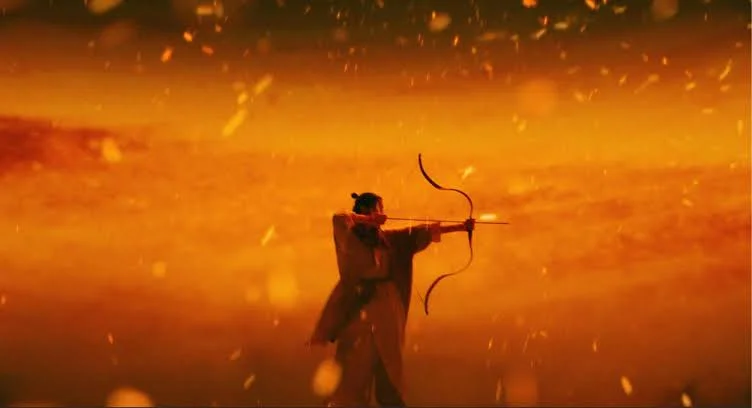

Having shot down nine suns to save the Earth, Hou Yi must now rescue the one he spared. That reversal gives Nelson Yeo’s The House on the Moon an effective starting point: a heroic achievement has become an unfinished obligation. Hou Yi (Dominick Rustam) leaves to save the dying sun, then disappears.
His lover, Chang Er (Lim Shi-An), sets out across the moon to find him. The cosmic emergency supplies the reason for their separation, while her search gives this science-fiction wuxia romance a personal objective that remains understandable even as bodies, identities, and settings become unstable.
One encounter ages Chang Er by decades, with Doreen Toh briefly taking over the role. It is an apt complication for a romance involving immortality. Time, which might otherwise remain an abstraction in the lovers’ separation, becomes visible on the person doing the waiting and searching. The transformation has expressive value without requiring an explanation of its magical workings. Its dramatic value is less secure. The film gives the change considerable imaginative force, yet leaves its effect on Chang Er’s pursuit elusive. An altered body can suggest the cost of devotion; it cannot, by itself, establish how that devotion changes.
Lim supplies continuity through her comparatively grounded responses to the absurd events around her. She allows Chang Er’s longing to remain recognizable without treating every strange encounter as an occasion for astonishment. Meredith Lee’s layered costumes reinforce that composure, giving the character an ethereal presence that survives the film’s changes of register.
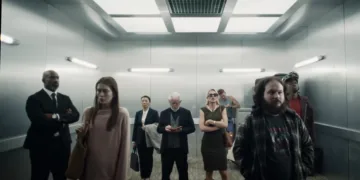
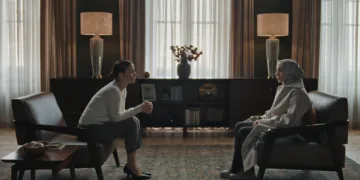
Lim’s restraint is especially useful when Yeo moves between the lunar search, Hou Yi’s strand, and Earthlike passages whose relationship to the surrounding action remains uncertain. Hoping Chen’s abrupt cuts make those transitions feel deliberately unsettled. Keeping track of the heroine’s emotional position, however, becomes a separate task from following her destination.
The arrival of the Nanyang Bandit (Akira Huang) creates the possibility of changing that destination’s meaning. Chang Er initially takes him prisoner, then reluctantly accepts him as a traveling companion. As her affections begin to turn toward him, the search acquires a productive complication: finding Hou Yi may no longer restore the relationship she left behind.
This is the kind of development the film needs, because it makes an encounter bear directly on her original purpose. Yet the movement from shared travel to romantic attachment is less persuasive than the contrast between the performers. Huang’s buffoonery gives Lim something immediate to react against; the developing bond requires firmer definition.
The Bandit’s severed arm, carried as a “backscratcher,” makes the same distinction between an entertaining invention and a developed narrative device in miniature. Its absurdity punctures the solemnity surrounding the lunar expedition, and the casual treatment of a detached limb gives the comedy an enjoyably peculiar footing.
When it springs into useful independent action, though, its convenience becomes harder to overlook. The screenplay has packed its own emergency assistance. Such interventions reduce the pressure on the travelers to resolve difficulties through choices that might reveal something about them. The arm earns its place as a comic disturbance more readily than as a solution.
Peng Meng (Harry Chang) presents a larger problem of connection. His dictatorial activity on Earth interrupts Chang Er’s search, while a tragic same-sex romance gives him a private emotional history. There is a possible relationship between these strands: Chang Er’s devotion and Peng Meng’s destructive attachment offer different expressions of love under pressure.
The film leaves too much of that relationship at the level of shared subject matter. His romance does not sufficiently clarify his actions toward the central couple, and the eventual confrontation involving Hou Yi arrives without the personal antagonism having acquired the necessary weight. Returning a secondary character to the main conflict establishes convergence. It does not supply the missing motive.
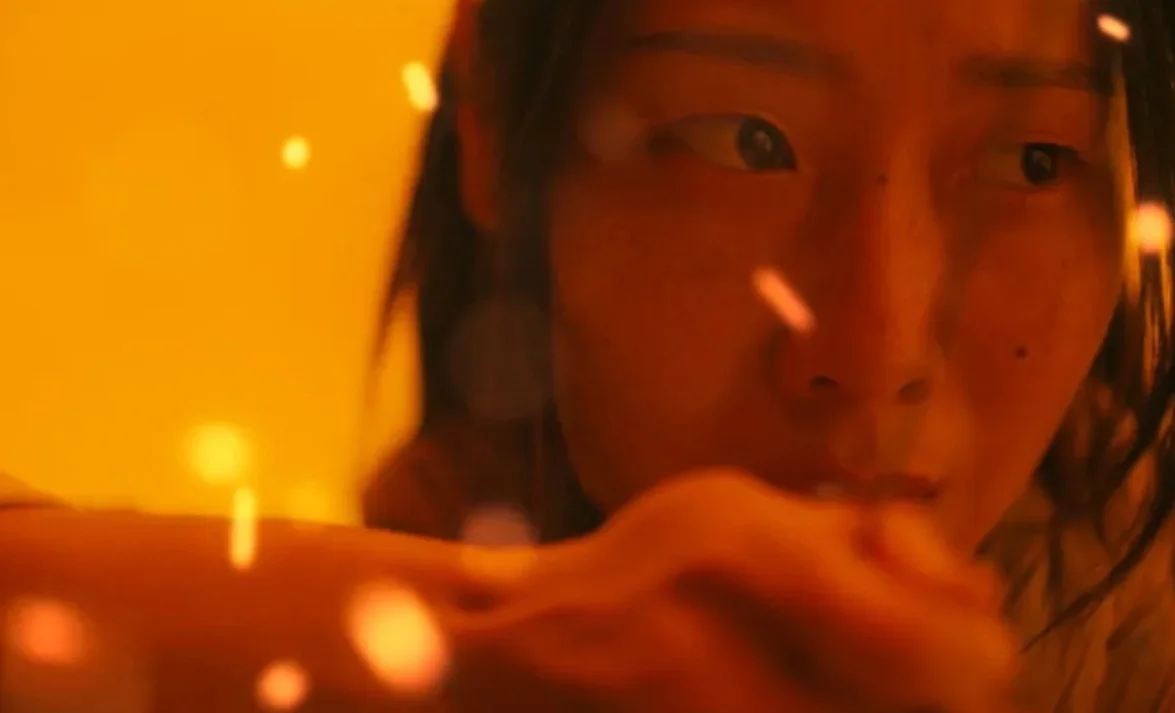
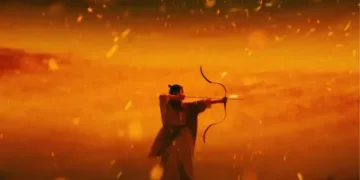
Yeo’s environments communicate with greater assurance. Lincoln Yeo’s photography sets burning orange expanses against cool, volcanic-looking lunar terrain, giving the threat to the sun and the isolation of the search distinct visual temperatures. Lush greenery offers another register, while red costumes hold the figures firmly within these changing surroundings.
The virtual backgrounds have an evident artificiality that suits a world removed from ordinary experience. Their carefully arranged depth gives the characters a monumental presence. Here, scale serves the romance: private longing occupies landscapes large enough to make the separation feel physically immense.
The intermittent swordplay also benefits from that visual design. A fight staged before an inferno gives violence an environment proportionate to the mythic stakes, and the sudden arrival of action can interrupt the film’s contemplative passages effectively.
Counting fights would provide a poor measure of this particular wuxia experiment. The better question is what happens to attention between them. Yeo can sustain interest through colour, composition, and strange encounters, but the uncertain development of the central relationships leaves some passages dependent on atmosphere after their dramatic purpose has become difficult to locate.
Kasimyn’s music finds another way to make an interruption precise. Peng Meng’s introduction is accompanied by a pulsing techno beat, a forceful departure from the film’s more ethereal register. The cue gives his arrival an immediate identity before the narrative has explained him.
Its rhythmic insistence also makes the shift away from the lunar search feel like an event, rather than another passage requiring patient reorientation. That is a useful function for sound in a film assembled from unstable realities. The difficulty comes later, when Peng Meng must confront Hou Yi and the music’s initial assertion of force needs a personal motive to give it direction.
The House on the Moon premiered at the Locarno Film Festival in August 2026. Directed by Nelson Yeo, the fantasy feature reimagines traditional Chinese mythology by following a celestial maiden and an Earth traveler journeying to the dark side of the moon to find a missing archer.
Full Credits
Title: The House on the Moon
Distributor: Locarno Film Festival / Festival Release
Release date: August 14, 2026 (Locarno Film Festival)
Running time: 1 hour 39 minutes (99 minutes)
Director: Nelson Yeo
Writers: Nelson Yeo
Cast: Lim Shi-An, Harry Chang, Guan-Zhi Huang, Lee Kang-sheng, Doreen Toh
The Review
The House on the Moon
The House on the Moon gives romantic isolation an impressive physical scale. Lim Shi-An’s grounded performance, Lincoln Yeo’s lunar compositions, and Kasimyn’s disruptive score make its unstable world worth inhabiting. The screenplay is less assured about connecting encounters to emotional change: Chang Er’s new attachment needs development, Peng Meng’s confrontation needs motivation, and a helpful severed arm occasionally takes over the problem-solving. Yeo’s freedom with form produces memorable effects, though the relationships carrying his romance remain unevenly developed.
PROS
- Lim Shi-An’s steady, emotionally grounded performance.
- Expressive colour, composition, and lunar environments.
- Kasimyn’s forceful musical interventions.
- Peculiar comedy that interrupts the solemnity.
CONS
- Chang Er’s developing romance lacks sufficient preparation.
- Peng Meng’s motives remain underdeveloped.
- Convenient interventions weaken the travelers’ problem-solving.