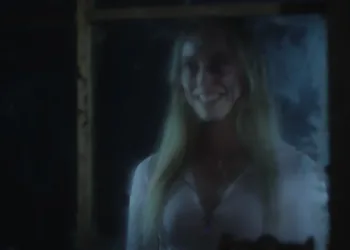





























Charlotte can find new excitement with Roberto while still making an encounter with her ex feel thoroughly unpleasant. Raffaello Degruttola’s To Love a Narcissist places those versions of her close enough together to complicate the appeal of a fresh start.
With one man, conversation carries the bitterness of a relationship that has ended without becoming emotionally finished. With the other, she discovers a youthful appetite for intimacy. The change in company allows a change in feeling. Her capacity for harshness remains, including in her dealings with her children.
I initially found that harshness an obstacle to caring about her. Then I became suspicious of the test I was applying. Charlotte’s impatience with her children deserves attention, but it cannot explain every difficulty between her and Roberto. Nor does her excitement with him cancel out her behavior elsewhere. Lyndsey Marshal gives us someone whose different attachments produce conflicting impressions, and my wish for a more agreeable protagonist would have made the film considerably simpler.
The title, meanwhile, encourages a less patient kind of attention. It promises a category into which someone will eventually fit. Irritability, composure, affection, and withdrawal become possible clues. This creates a productive tension in Degruttola’s drama: we are watching a relationship while being encouraged to assess its participants. Yet identifying troubling behavior and understanding an attachment are separate tasks. The film is stronger at giving us reasons to worry than at making the stages of that attachment persuasive.
Marshal is essential to what does persuade. Charlotte’s romantic enthusiasm, hostility toward her ex, and later anxiety give the actress different emotional demands without requiring her to make the character reassuring. The pleasure of new intimacy can coexist with an abrasive manner; someone capable of tenderness can still treat another person badly. Marshal preserves those uncomfortable combinations. Her performance resists the convenient idea that a person’s most difficult behavior must disclose their entire personality.
Playing Roberto himself, Degruttola often provides a quieter presence opposite her. That difference matters because calmness is so easily mistaken for reasonableness. Charlotte’s agitation draws attention, while his comparative composure can make him appear less implicated in the atmosphere between them.
It is a substantial moral advantage to acquire simply by being the quieter person. His own emotionally charged moments prevent the contrast from remaining absolute, but the difference in register keeps influencing how their encounters are read. I would hesitate, though, to treat every uncertainty about the couple as evidence of psychological depth.
The difficulty is their attraction. The early excitement establishes that Charlotte and Roberto want each other, but the movement from that excitement into sustained mistrust needs a stronger connective life. As anxieties and arguments become prominent, the initial pleasure feels insufficiently developed to explain the relationship’s hold.
Disliking either character is beside the point here. I can remain interested in difficult people if I understand what they continue to find in each other. Marshal makes Charlotte’s changing feelings credible within encounters; the writing gives her less help in connecting those encounters into a convincing emotional history.

The month-labelled chapters contribute directly to that problem. During the earlier portion of the roughly 100-minute film, substantial stretches of time pass quickly. We receive selected moments from the relationship rather than a continuous account. That is a defensible choice.
A brief encounter can expose an accommodation, a resentment, or a change in intimacy without requiring the intervening weeks to be dramatized. The omissions give the viewer work to do, which suits a film interested in the uncertain interpretation of behavior.
Here, however, the balance of selection is uneven. The early months move rapidly, while later encounters occupy longer stretches of screen time. We are given increasing access to conflict after receiving a comparatively compressed account of the bond under pressure. The consequence is psychological as much as rhythmic. The film spends time establishing how unpleasant this relationship can become while leaving some of the reasons for its persistence between chapters.
The slower later passages do have a purpose. Remaining with an uncomfortable interaction can make it harder to dismiss as a single bad evening. The accumulation of arguments and mistrust places pressure on the early promise of renewal. There is something credible about the way an exciting relationship can come to feel dominated by its difficulties, with the pleasure of its beginning growing harder to recover.
Degruttola allows that change to become tiring, and the tiredness belongs to the subject. During the longer later encounters, I wanted access to some of those earlier weeks: the ordinary time in which attraction might have become reliance, and the reasons Charlotte and Roberto might have accumulated for staying.
To Love a Narcissist premiered in London on May 8, 2026, and was subsequently released on digital platforms across North America on May 19, 2026, where it is available to stream on Apple TV, Amazon Prime Video, Google Play, and YouTube Movies. Directed by and starring Raffaello Degruttola alongside Lyndsey Marshal, the psychological drama explores an intense, obsessive relationship on Lake Garda in Italy as trust is weaponized and the thin line between love, vulnerability, and deceit rapidly blurs.
Where to Watch To Love a Narcissist (2025) Online








Full Credits
Title: To Love a Narcissist
Distributor: Freestyle Digital Media, Cardinal XD
Release date: May 19, 2026
Running time: 1 hour 35 minutes (95 minutes)
Director: Raffaello Degruttola
Writers: Raffaello Degruttola, Sadie Kaye
Producers and Executive Producers: Sadie Kaye, Bill Bossert, Sadie Frost
Cast: Lyndsey Marshal, Raffaello Degruttola, Stephen Campbell Moore, Sule Rimi, Andrea Lowe
The Review
To Love a Narcissist
Lyndsey Marshal gives Charlotte enough contradiction to resist an easy judgment, even as the title encourages us to start assigning labels. I found her difficult to like and worth watching. The relationship itself is less persuasive: its early attraction receives too little development before the film settles into prolonged conflict. Degruttola makes the discomfort credible, but leaves the attachment sustaining it insufficiently understood.
PROS
- Marshal’s emotionally complex performance
- Challenges easy judgments about likability and responsibility
- Sustained encounters convey relationship fatigue
CONS
- Underdeveloped romantic attachment
- Uneven pacing across the monthly chapters
- Title encourages labeling before understanding