


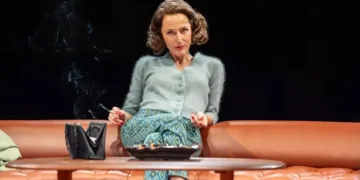









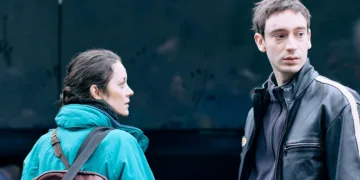















Elif and Mehmet keep their voices down while their relationship comes apart. Their son is asleep, and waking him would add another responsibility to a conversation already buckling under them. In Yeşim Ustaoğlu’s What Remains, the argument takes time because Elif cannot readily explain her unhappiness and Mehmet keeps looking for something he can fix. His university teaching job has disappeared; the household needs an income. Her distress refuses to fit inside that practical emergency. The scene lets two people speak at length without finding a language they can share.
Öykü Karayel and Metin Akdülger make this failure painful without turning either partner into an obstacle the other must overcome. Karayel gives Elif’s difficulty speaking the weight of exhaustion. Akdülger keeps Mehmet’s responses recognizably useful, which makes their failure to help especially uncomfortable. Advice can be reasonable and still miss the person receiving it. The quietness matters here: both characters continue observing a small rule of family life while admitting that the arrangement holding their family together has become intolerable.
Their Istanbul apartment initially seems equipped to nourish almost any creative impulse. Books, records, paintings, and handmade toys fill the rooms; Mehmet has adapted part of it for his experimental music. Elif, an established poet dissatisfied with her recent writing, helps their son Selim build elaborate contraptions and watches over cocooning butterflies with him.
Her curiosity remains available to the child while her own care has deteriorated. Ustaoğlu establishes that discrepancy patiently, sometimes too patiently. The early domestic passages communicate depletion before they substantially deepen our understanding of it. I found the extended argument revealing in ways that the preceding accumulation of stalled routine often struggles to be.
Elif’s departure gives the film a new means of developing that understanding. She drives out of Istanbul before dawn, eventually finding a destination in the mountain village where her grandmother lived. Mehmet remains with Selim, then takes him to Trabzon when his own father becomes seriously ill.
Ustaoğlu alternates between these separated experiences. Moving between two strands usually invites us to anticipate their eventual meeting; here, it lets each strand alter our understanding of the person elsewhere. Elif’s growing responsiveness and Mehmet’s encounters with his father become developments the couple could scarcely have reached through another conversation in their apartment.
The screenplay also keeps the practical connections between them alive. Elif calls Selim by video and stays in touch with Mehmet. Mehmet takes over daily parenting without becoming a resentful figure waiting for the film to vindicate him.
Ali Kayra Kul’s alert, inquisitive Selim gives that care an active recipient, and his relaxed rapport with Akdülger makes their time together feel inhabited. These scenes give Elif’s absence a specific shape. Her departure changes who does the daily work, but affection and responsibility continue across the distance. The film has little interest in making her suffer a punishment that would conveniently settle our feelings about her decision.
On the road, other women help Elif become receptive again: a doctor who admires her poetry, a neighbour of her late grandmother, a minibus driver. Their hospitality supplies ordinary contact without demanding that she immediately account for herself. Karayel allows the tension in Elif’s face to loosen gradually, so recovery registers through changing responses rather than a speech announcing progress.
There is a slight neatness to this succession of helpful encounters, especially the doctor’s recognition of her work. The route can feel arranged to restore her confidence. Yet the performance gives those encounters enough individual emotional weight to keep them from becoming a set of prescribed remedies.
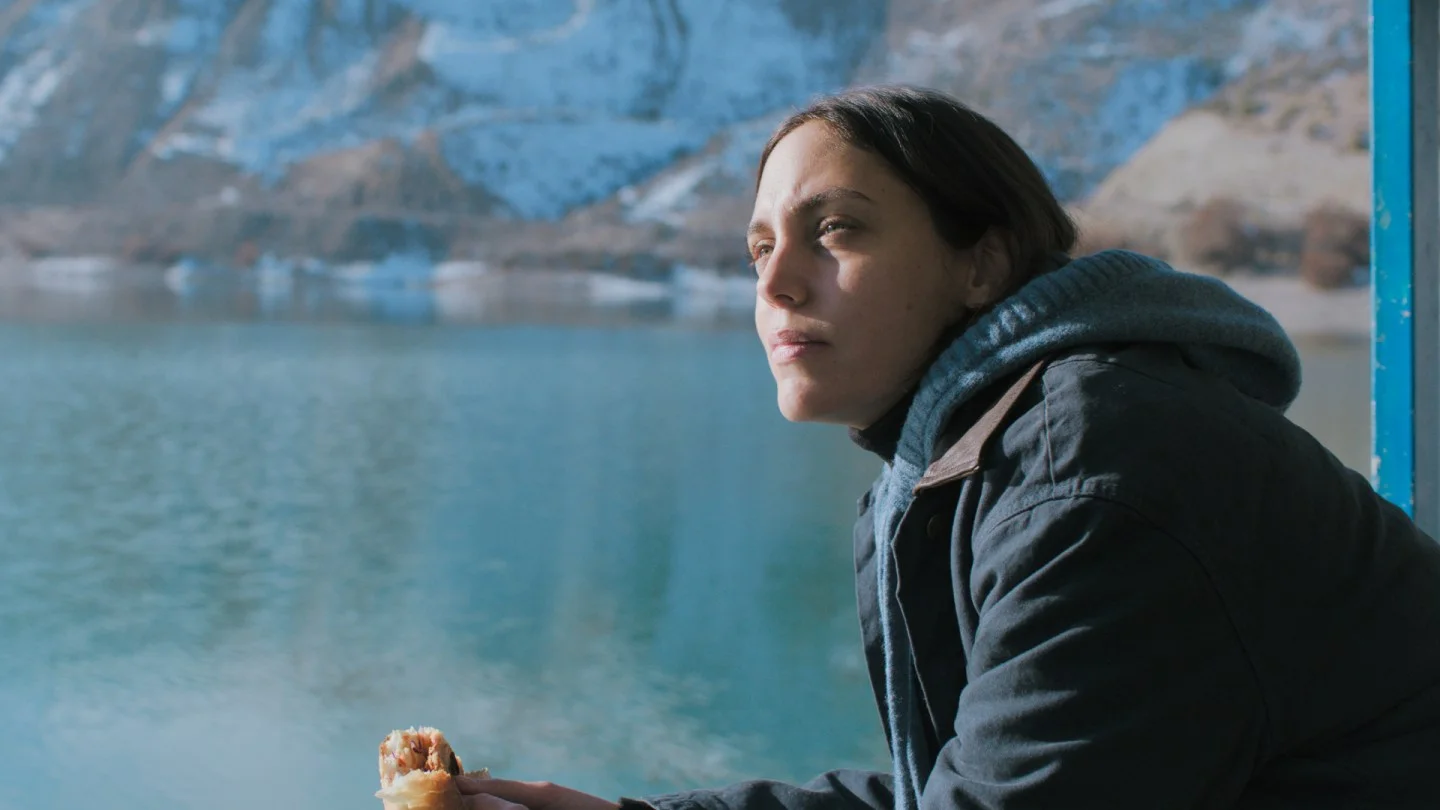
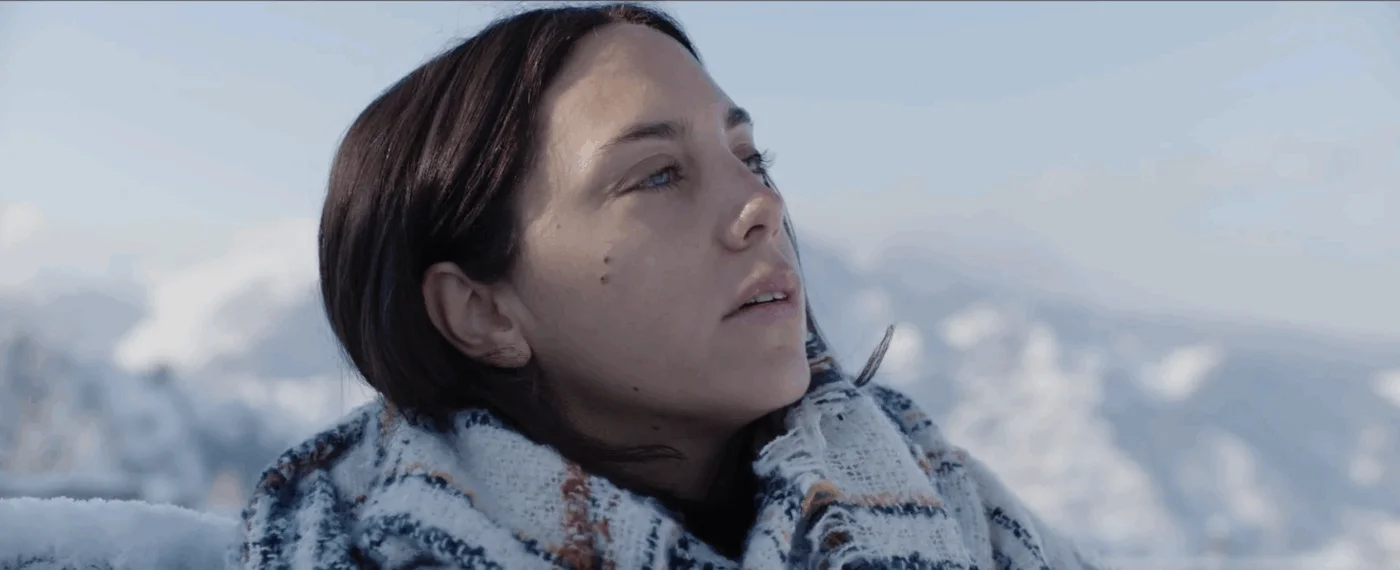
Prodanov’s photography makes the changing scale around Elif equally important. A wide frame places a person in relation to everything surrounding her; when she becomes a small figure beside a vast rocky basin, the landscape has room to command attention independently of her distress.
Close views of Karayel’s face then return us to the person absorbing it. Snow-covered mountains and washes of sunlight offer considerable visual pleasure, but the movement between landscape and expression gives that pleasure a dramatic function. We can see Elif beginning to look outward, with no requirement that she translate everything she sees into words.
The places she visits also resist a simple account of nature repairing urban damage. A dried lake bed and a village submerged beneath water preserve different signs of disappearance. The minibus drops Arabic-speaking passengers at a makeshift migrant-worker camp, briefly placing Elif’s voluntary mobility beside travel shaped by work and necessity. Ustaoğlu does not develop that encounter into a separate political argument. Its presence is enough to qualify the freedom her protagonist enjoys. The countryside contains lives and losses that exceed its usefulness to a visiting poet.
Elif eventually writes again, with Birhan Keskin supplying the poems heard in the film’s voice-over. Her renewed expression includes affection and gratitude toward Mehmet, which gives the separation an emotional outcome without requiring a return to their previous arrangement. Mehmet’s artistic practice has always been less dependent on words. A malfunctioning appliance can interest him as a sound source, and his improvised music opens familiar noises to unfamiliar uses. This habit establishes a way of attending to the world that becomes increasingly difficult to separate from his family life.
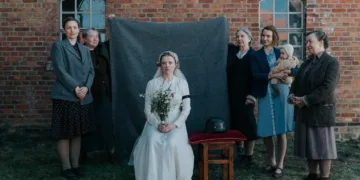
In Trabzon, Mehmet confronts his father Mustafa, played by İlyas Salman, over a buried family tragedy. Akdülger’s stronger intensity here makes the earlier restraint feel consequential: being a patient father to Selim has not removed his pain as a son. Then Mehmet records his dying father’s breathing for an experimental composition. The act brings his habitual listening into contact with something he cannot repair or keep.
It can be heard as tenderness, but the decision to make artistic material from a parent’s final breaths leaves an uncomfortable question inside that tenderness. Listening gives Mehmet a way to remain close to his father while recording begins to turn that presence into something he will possess after the man is gone.
What Remains world-premiered at the 74th San Sebastián International Film Festival in September 2026 before heading toward streaming distribution via MUBI. The meditative Turkish drama follows a poet who breaks free from a suffocating life in Istanbul to embark on an introspective road journey and rediscover her lost creativity.
Full Credits
Title: What Remains (Also known as Artakalan)
Distributor: MUBI
Release date: September 24, 2026 (San Sebastián International Film Festival)
Running time: 2 hours 6 minutes (126 minutes)
Director: Yeşim Ustaoğlu
Writers: Yeşim Ustaoğlu
Producers and Executive Producers: Yeşim Ustaoğlu, Anna Maria Aslanoglu, Behrooz Hashemian
Cast: Öykü Karayel, Metin Akdülger, Ali Kayra Kul, İlyas Salman, Ayşegül Cengiz, Merve Engin, Kezzban Küçük, Feride Karaman
Director of Photography (Cinematographer): Kirill Prodanov
Editors: Mathilde Muyard
Composer: Şevket Akıncı
The Review
What Remains
What Remains finds its emotional strength in the way distance changes attention. The alternating stories, expansive framing, and intimate sound recordings give Elif and Mehmet’s renewal a tangible form, supported by beautifully restrained performances. The domestic setup lingers too long, and Elif’s helpful encounters occasionally feel arranged. Still, Ustaoğlu makes separation persuasive without erasing affection, responsibility, or unresolved pain.
PROS
- Restrained, emotionally precise lead performances.
- Alternating narratives deepen both partners’ experiences.
- Landscape photography connects space with Elif’s changing perception.
- Experimental sound gives Mehmet’s family history unsettling intimacy.
CONS
- Early domestic passages prolong stagnation without enough development.
- Elif’s succession of helpful encounters sometimes feels too neatly arranged.