































Alice damages her moped because a functioning vehicle would give her no reason to visit Milo’s garage. It is an efficient piece of storytelling: she creates a practical problem to approach someone she cannot yet approach honestly. In Nicole Garcia’s Milo, Marion Cotillard plays a woman who has come to Romans-sur-Isère looking for her son, finding restaurant work and offering a reassuring account of time spent in Quebec. The breakdown lets her enter his working day as a customer. She can arrange the encounter, control her explanation, and postpone the question that brought her there.
That arrangement becomes difficult to sustain once Valérie, Milo’s adoptive mother, recognizes her. Alice’s concealed history includes fifteen years in prison and involvement in violent left-wing activism. Recognition changes the purpose of the secrecy: someone already knows enough to challenge her version of events.
Garcia initially makes good use of these unequal positions, moving between a mother studying the life she missed and a son unaware of what her attention means. As Alice’s identity becomes clear to the audience, however, the film needs to develop the consequences of concealment. Continuing to release biographical information cannot do all that work.
Milo has plans that deserve attention independently of Alice’s return. A mechanic who wants to open his own garage, he has found access to a wealthy family’s manor and become involved in criminal activities through Joseph, played by Alexis Manenti. His ambition gives this association a credible attraction without making his judgment sound.
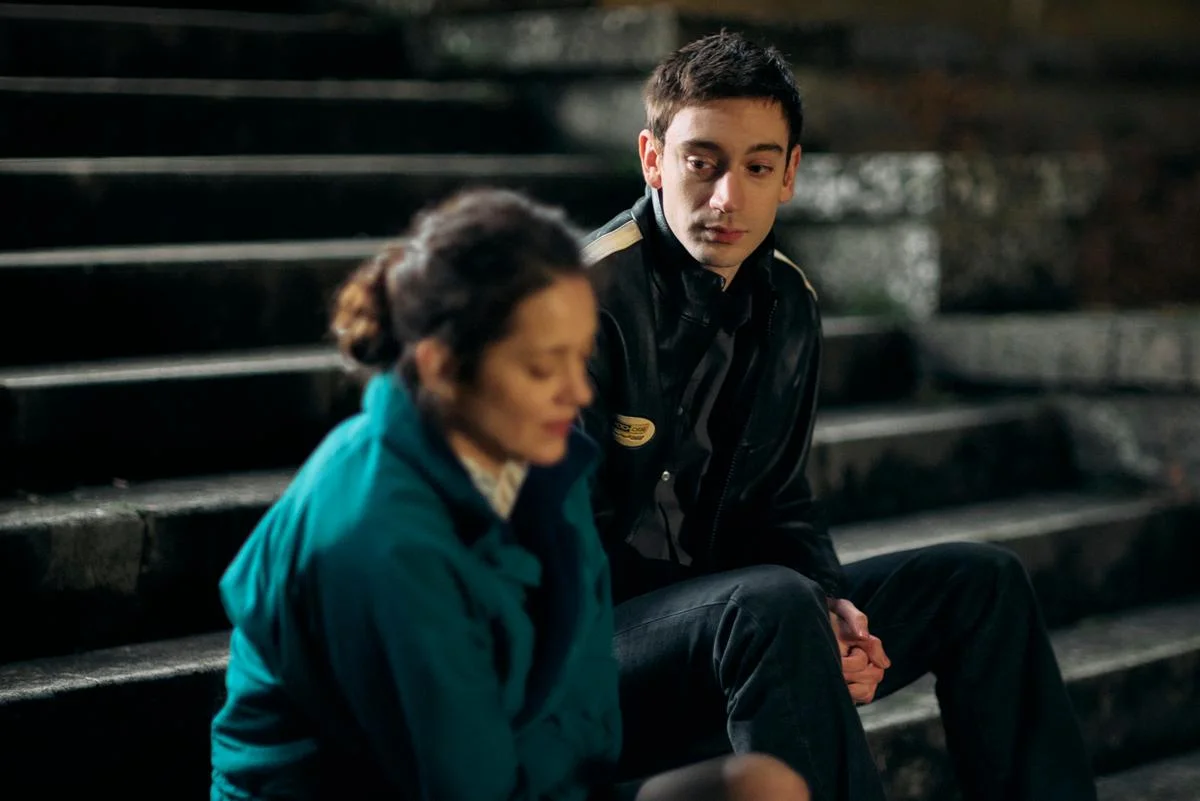
Théodore Pellerin’s relaxed manner, questioning presence, and distinctive deep voice help preserve the difference. Milo is personable and capable of imagining a future; he is less equipped to judge the people who might appear to offer him one. His welcome among the wealthy leaves his actual standing uncertain, giving Alice a reason to fear where his choices are taking him.
Garcia brings those class tensions into unusually clear focus when Alice works at a party at the chateau. She sits down in the kitchen, opens expensive wine, and pours herself a glass before the surprised staff. Cotillard plays the gesture with weariness rather than the satisfaction of someone staging a victory.
Alice has spent part of her life opposing established power and another part paying for her actions; now she is employed to serve its comfortable beneficiaries. The scene gives her past a present expression while retaining the awkwardness of her position. She can briefly disregard the rules of service, but she still needs the work.
The connections between her history and Milo’s predicament are suggestive, though their motives remain distinct. Alice committed herself to political militancy; Milo’s entanglement grows around ambition, attraction, and dubious company. Her visit to a former comrade dying of cancer gives the intervening years an immediate human cost.
An encounter with the circle’s academic mentor introduces a different question: how responsibility was distributed between people who promoted radical commitments and people who acted on them. The screenplay, however, offers only a limited account of Alice’s own thinking. Being influenced by privileged people does not explain the full course of her choices.
That missing development matters because the political material carries such a large explanatory burden. It establishes Alice’s exclusion, her principles, and the severity of the loss she hopes to repair. Yet the film spends relatively little effort distinguishing what she still believes from what she regrets.
The present-day criminal strand has a clearer immediate function, turning her wish for contact into a need to intervene, but its expanding circle of associates also draws attention away from the relationship. Charles Berling’s Baudelaire-quoting occupant of the manor is a particularly visible example. He supplies cultural display and social texture without acquiring a comparably strong dramatic purpose. The screenplay has furnished the house before deciding what everyone in it needs to do.
The pacing problem lies in that uneven allocation of attention. Alice’s approach to Milo earns patience because each encounter contains the possibility of discovery or rejection. Joseph’s dealings and the visits into Alice’s past ask for a different investment, promising explanations and dangers that do not consistently deepen the maternal story.
Their thematic connections are understandable; their dramatic returns are less reliable. At nearly two hours, the film gives these extensions enough space to suggest substantial competing narratives, then relies on Alice’s protective attachment to draw them back together. The emotional connection remains available, but the storytelling repeatedly loosens its grip on it.
Cotillard’s restraint helps hold the film together, particularly when Alice’s behavior contains conflicting impulses. The woman who carefully invents a reason to visit a garage is also capable of disregarding her place at the chateau. Those actions supply useful differences within an otherwise subdued performance. A scene that places her curled up among photographs of her son is less effective.
The arrangement makes grief conspicuous after her watchfulness and elaborate approach have already established its force. Laure Calamy’s wordless glare achieves a sharper concentration of feeling, making Valérie’s recognition a dramatic event without explaining it away. Her limited role leaves too little room for the film to develop the adoptive mother’s position after giving it such immediate weight.
The bus-station farewell returns to familiar dramatic machinery, but the relationship it leaves behind resists an easy restoration. Alice can affect Milo’s future without recovering the years in which she was absent, and protecting him does not automatically establish a place beside him. The ending accepts that limit. It also leaves Valérie’s existing role consequential: Milo already has a family history that Alice’s return cannot replace. Her intervention may change what happens next, while the question of how she could participate in his ordinary life remains open.
Milo premiered at the San Sebastián International Film Festival on September 24, 2026, ahead of its theatrical release by Studiocanal. The French drama follows a woman who, shortly after being released from prison, takes a job at a small café near a garage and befriends a young mechanic unaware that he is her son.
Full Credits
Title: Milo (also known as 7 h 40 ce matin-là)
Distributor: Studiocanal
Release date: September 24, 2026 (San Sebastián International Film Festival) / January 20, 2027 (France)
Running time: 1 hour 54 minutes (114 minutes)
Director: Nicole Garcia
Writers: Nicole Garcia, Jacques Fieschi, Laurette Polmanss, Olivier Demangel
Producers and Executive Producers: Alain Attal
Cast: Marion Cotillard, Théodore Pellerin, Artus, Laure Calamy, Charles Berling, Éric Elmosnino, Alexis Manenti, Anne Brochet
The Review
Milo
Milo is strongest when Alice’s carefully arranged contact with her son meets the limits of what she can reclaim. Cotillard and Pellerin give that conflict credibility, while the chateau scenes make class tension tangible. Garcia’s expanding criminal plot and lightly developed political history weaken the concentration, leaving important relationships short of space. The restrained ending earns respect without resolving those structural weaknesses.
PROS
- Purposeful early storytelling built around Alice’s concealment.
- Cotillard and Pellerin ground the central characters.
- Class tensions emerge through concrete behavior.
- Ending respects the limits of family restoration.
CONS
- Criminal subplots divert attention from the central relationship.
- Alice’s political beliefs and responsibility remain underdeveloped.
- Valérie receives insufficient dramatic space.
- The photograph scene overstates established grief.