
























The schoolteacher’s account of a bee choosing death when it can no longer serve sounds like a lesson in nature. It quietly gives usefulness the authority to decide who should live. In the northeastern German village of Tony Vahl’s Krux, such instruction belongs to the same everyday order as laundry, church, and marriage. The Second World War is approaching its end, most of the able-bodied men are absent, and children still attend school. What they learn there prepares them to accept a future in which their continued existence might be judged an offense against the community.
Mayor Walter (Lukas Miko) gives that education its practical application. Ordered to leave nobody alive for the approaching Red Army, he distributes cyanide and treats collective death as an administrative responsibility. Children rehearse tying a noose.
The passage from instruction to action is horrifying because so little of the village’s organization needs to change. Familiar authorities remain in place, offering guidance in familiar tones. A society accustomed to having its decisions made elsewhere can receive the demand for its own extinction through the channels that once arranged its daily life.
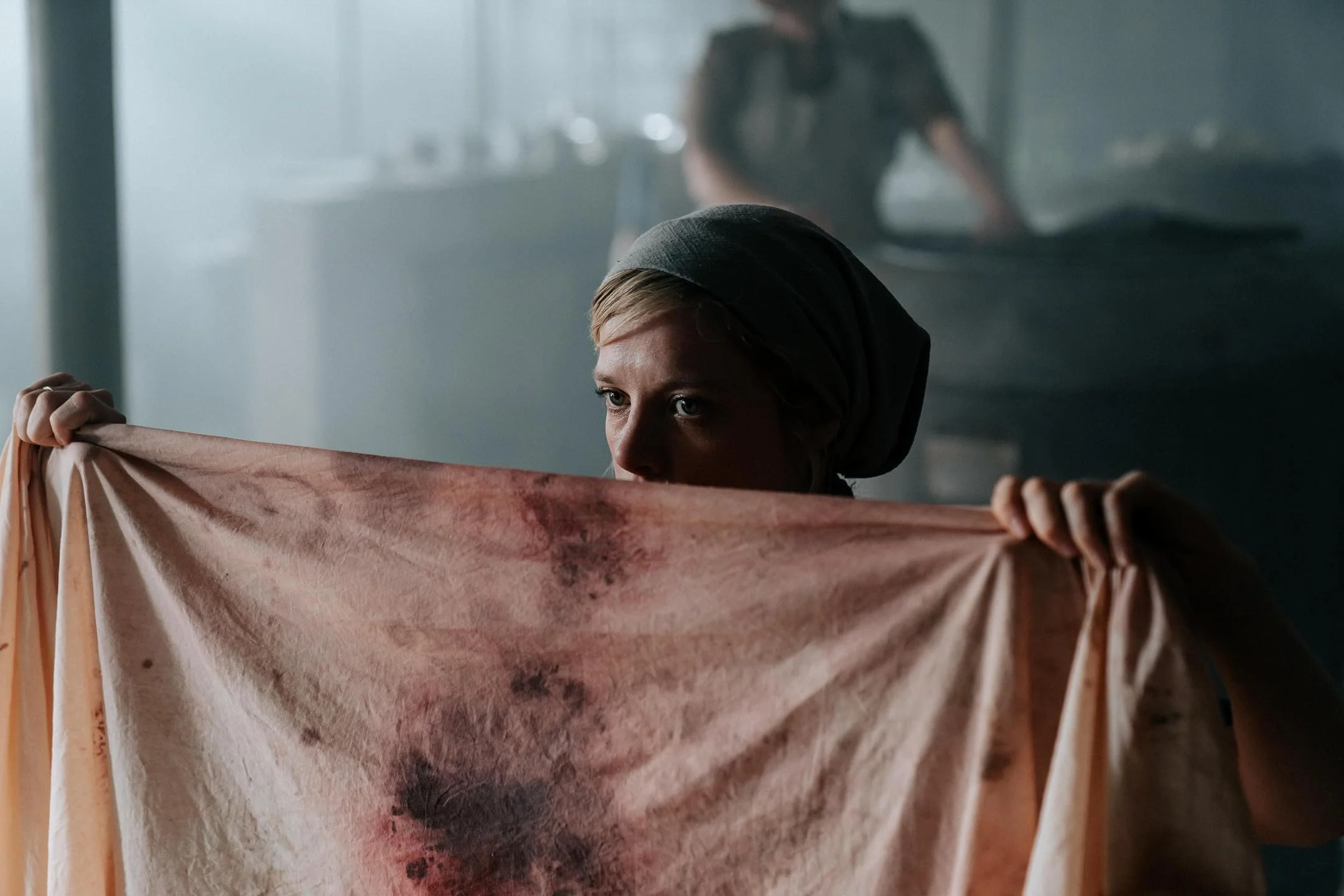
Vahl’s feature debut, rooted in the civilian suicide wave near Nazi Germany’s defeat, gives this submission a physical texture through the people who keep the village functioning. Greta (Jella Haase) and Anni (Frida-Lovisa Hamann) wash bloodstained military clothing. War reaches their hands as something requiring labor, long before it arrives as an event they can influence.
Their work maintains a connection with the absent soldiers while exposing them to the bodily consequences of decisions made beyond their reach. The remaining male authorities discuss the community’s fate; women continue cleaning what that fate has already deposited in their care.
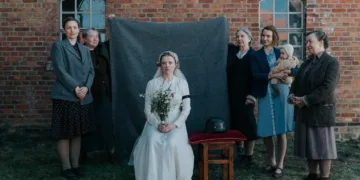
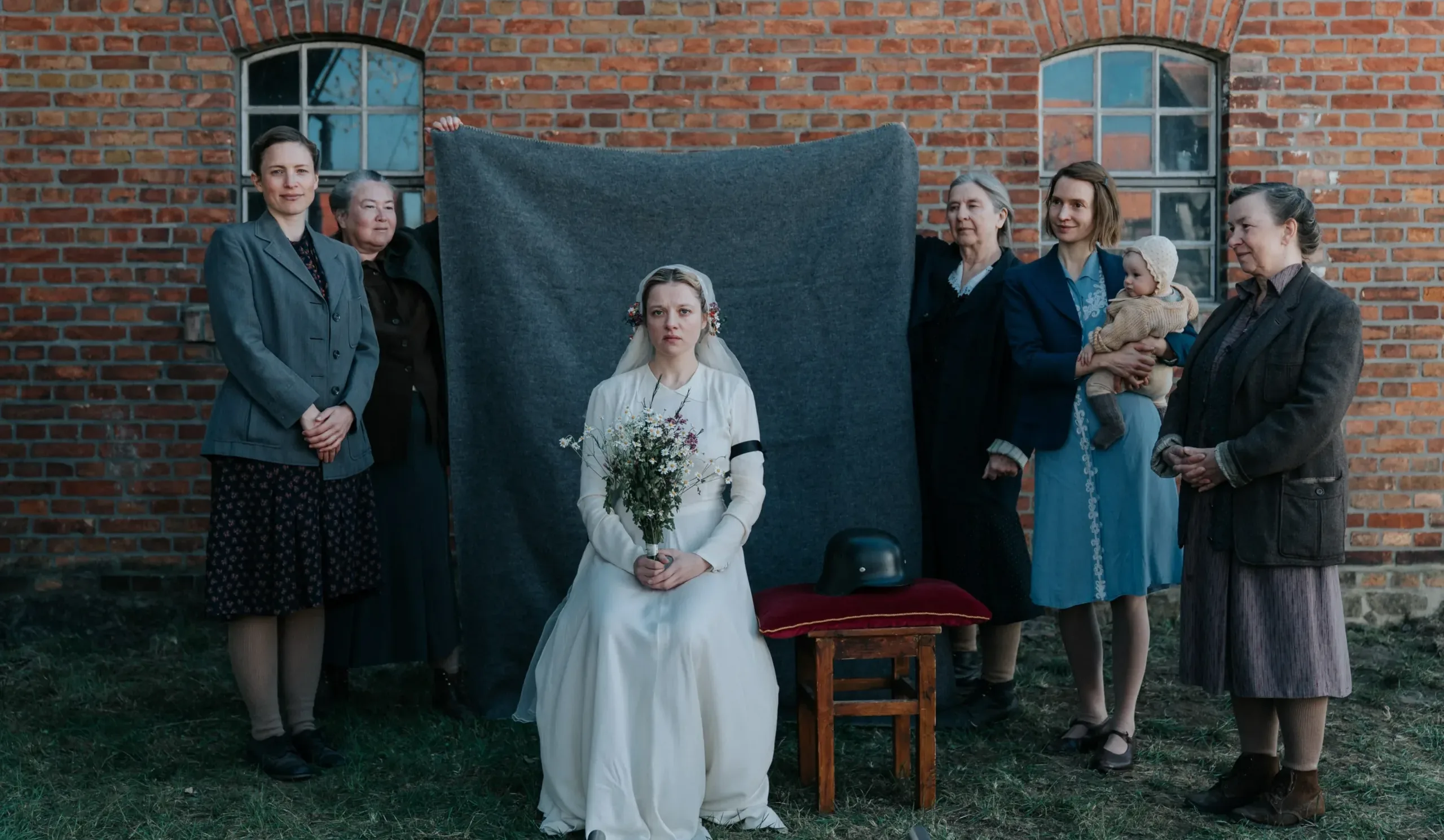
Greta’s posthumous wedding makes the distribution of power especially painful. Her fiancé’s severed heart has been delivered to her, and she preserves it in a jar. The pastor then marries her to a military helmet standing in for the dead groom.
Private mourning acquires a publicly recognizable form, complete with the promise that attachment can persist after the person has disappeared. Haase’s restrained presence suits the ceremony’s terrible composure. The ritual accommodates her grief while keeping her socially bound to the soldier. Death has interrupted the relationship, yet the village can still formalize her obligations within it.
Anni’s responsibility for several children places another pressure on the language of duty. Care does not automatically protect a person from indoctrination; fear can enter through the very wish to protect someone. The command to die exploits attachments that ought to make survival necessary.
Vahl’s attention to mothers, children, and widows gives that exploitation weight, but sympathy requires care. A dying soldier raises the question of what German forces have done. His testimony interrupts the village’s absorption in its own anticipated suffering. These civilians have limited power, yet the film contains enough evidence to resist treating their isolation as a certificate of innocence.
Piotr Sobociński Jr.’s photography makes that isolation palpable. Blue-gray daylight, mist over the water, and orange candlelight restrict the village to a narrow range of visibility. The landscape offers little reassurance or reliable information. At a dinner table, the discussion of collective suicide takes on the composure of a painting.
This beauty has a disturbing purpose: the proposed violence remains seated inside a recognizable domestic order. People can discuss annihilation under warm light, surrounded by the arrangements through which they ordinarily express hospitality and belonging. The table gives the decision a setting in which it can sound socially acceptable.
The soundtrack’s low hum and the sound of distant mortar fire supply a threat whose approach can be heard before it can be understood. Bodies arriving along the river provide another kind of information, material and undeniable, yet some are hidden in the school gym. The building that teaches children how to interpret the world also becomes a place for withholding evidence about it.
Vahl finds considerable dread in this discrepancy. The villagers encounter fragments of reality while authority supplies the account that is meant to join them together. Their dependence on that account continues even as the physical evidence becomes harder to contain.
The film is less persuasive when it supplies its own overly complete explanations. Recurring images of a snake moving around a miniature village turn encirclement into an emblem with little interpretive resistance. The device initially gives shape to an enemy kept outside the action, but its return adds less than the bloodied laundry or concealed corpses.
Those details expose relationships between work, knowledge, and authority; the snake repeatedly announces danger. This is also where the slow accumulation of atmosphere begins to lose dramatic force. Sustaining the same pressure cannot indefinitely replace a change in what a character understands or chooses. Vahl’s control of mood remains impressive, while the repeated allegorical emphasis makes the village’s behavior seem increasingly settled.
The dissenting characters recover some of its uncertainty. Teacher Fritz (Clemens Schick) secretly listens to Thomas Mann’s antifascist broadcasts, complicating his position within the machinery of instruction. Access to another account of the war does not instantly produce the capacity to oppose the order governing his neighbors.
Pastor Albert (Martin Wuttke), who has officiated Greta’s grotesque marriage, rejects Walter’s demand and challenges the cowardice behind it. His refusal matters because it comes from inside the village’s hierarchy. The same institutional authority that sanctions one binding ritual can dispute another demand for obedience.
Meta, the healer who tends the dead, contests the mayor’s right to determine when death should occur. Alongside Greta’s resistance, her position gives refusal a basis in care that has no need for Walter’s political vocabulary. These gestures remain vulnerable.
The Red Army has still not arrived when the film ends, and rejecting the death directive offers no guarantee about what comes next. It requires the villagers to live without the certainty their authorities have supplied, accepting a future whose dangers cannot yet be measured. For Greta, that future must also contain the grief that the helmet ceremony has given a place but cannot resolve.
Krux premiered in September 2026 through festival screenings at Toronto and San Sebastián. Set in a German village near the end of World War II, the historical drama follows local residents struggling to maintain normalcy as mysterious corpses appear along the river while approaching forces draw near.
Full Credits
Title: Krux (also known as The Crux)
Release date: September 2026 (Toronto International Film Festival / San Sebastián International Film Festival)
Running time: 1 hour 40 minutes (100 minutes)
Director: Ulrike Vahl
Writers: Ulrike Vahl
Cast: Jella Haase, Frida Lovisa Hamann, Clemens Schick, Lukas Miko, Martin Wuttke
Director of Photography (Cinematographer): Piotrek Sobocinski
The Review
Krux
Krux finds its horror in the institutions that make death sound dutiful: the classroom, the marriage ceremony, the mayor’s office. Vahl’s attention to women’s labor and compromised authority gives the village’s suffering moral complexity, while candlelit interiors and distant gunfire make its isolation palpable. Repeated animal symbolism overexplains what the human encounters already reveal, and sustained dread sometimes substitutes for dramatic development. The strongest scenes expose how care itself becomes vulnerable to commands demanding its destruction.
PROS
- Precise examination of obedience through everyday institutions.
- Women’s labor and grief give political violence physical weight.
- Photography and sound create oppressive isolation.
- Dissent complicates the village’s responsibility.
CONS
- Recurring animal symbolism overexplains the film’s ideas.
- Sustained atmosphere sometimes replaces dramatic development.