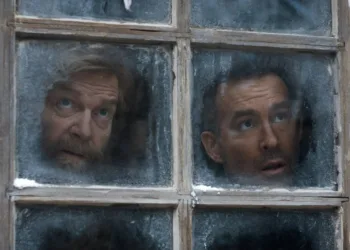





























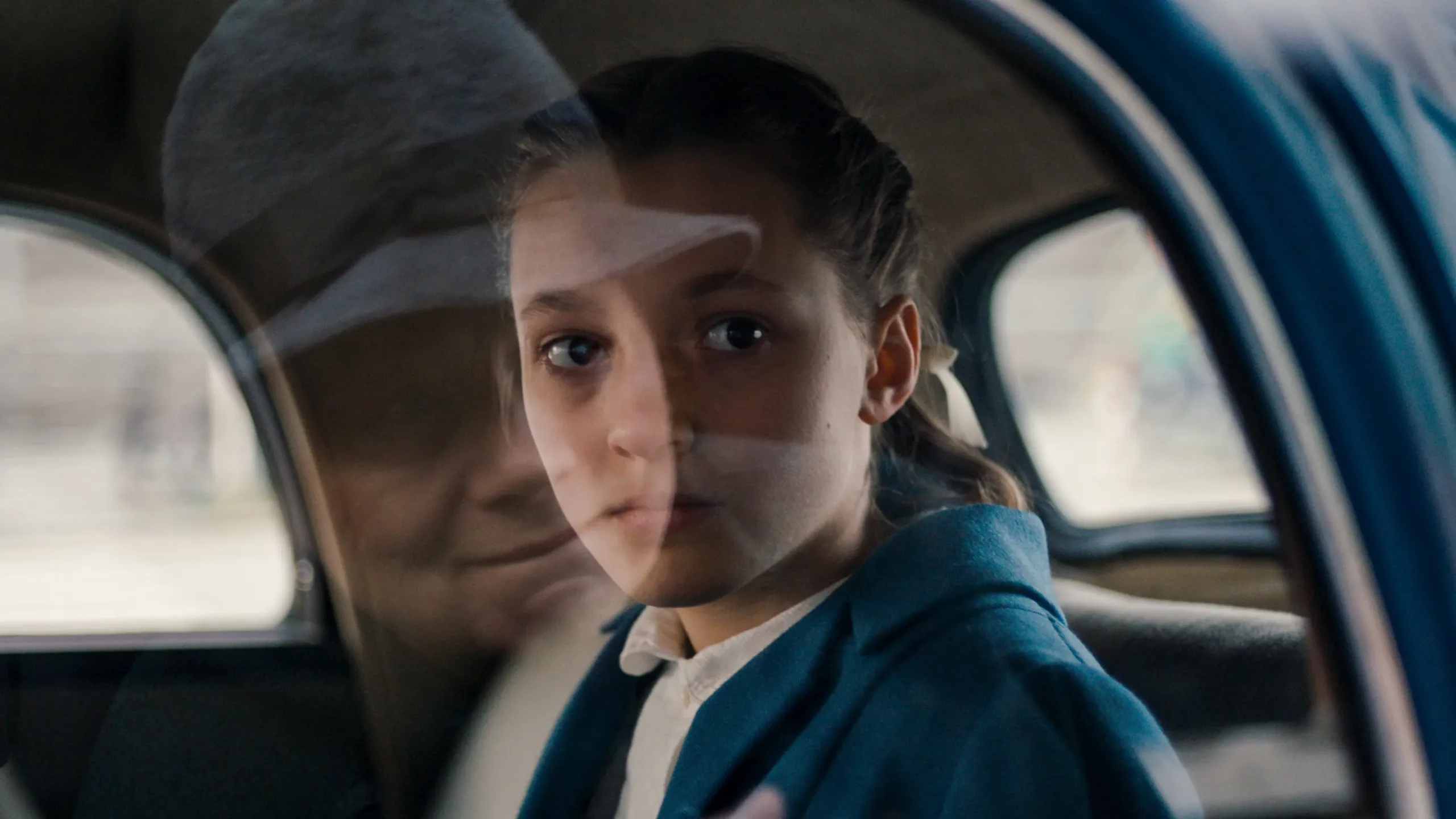

The story of Karla begins with an act of quiet, immense courage. In Germany, 1962, a twelve-year-old girl walks into a police station and announces her intention to file a complaint against her father. She is methodical, firm, and offers no immediate details, insisting only on speaking to a judge. Director Christina Tournatzés immediately establishes the gravity of this action.
This is not just a family dispute; it is a child confronting a social architecture built on silence, an era where the inner lives of families were sacrosanct and the voices of children were background noise. The film places its central question before us without ceremony: in a world determined to look away, can a single, unwavering voice force the system to listen?
The Unlikely Alliance
The film’s narrative engine is not a sprawling investigation but a series of tense, intimate conversations that form a compelling two-hander. The story wisely anchors itself in the developing relationship between Karla (Elise Krieps) and Judge Lamy (Rainer Bock), and it’s in the space between them that the film’s heart beats.
He is introduced as the embodiment of a weary, patriarchal system: a by-the-book official encased in the cautious bureaucracy of the judiciary, who initially sees only a hopeless case with no evidence and significant professional risk. His reluctance is deeper than simple procedure; it reflects a post-war German society that prized order above disruptive truths.
Yet Karla’s persistence, her refusal to be dismissed, acts as a slow, steady pressure against his defenses. She is not presented as a pitiable figure but as the story’s most determined force. Their meetings in his suffocating, smoke-filled office—a room that feels like a time capsule with its heavy books and ticking clock—become the stage for a fragile trust to be built.
Elise Krieps delivers a remarkable performance, using a restrained physicality to convey a universe of experience. Her stillness is a shield, her darting eyes a map of a mind constantly assessing threat and safety. Opposite her, Rainer Bock masterfully charts the judge’s internal journey, the weariness in his face slowly transforming into a look of protective concern.
His decision to help is not a sudden epiphany but a gradual surrender to the undeniable truth he sees in the girl before him, a choice quietly validated by his compassionate secretary, Erika (Imogen Kogge), who acts as the story’s initial moral compass.
The Language of Trauma
Karla distinguishes itself through its disciplined and intelligent approach to depicting trauma, a masterclass in narrative restraint. The filmmakers make a crucial choice to never show the abuse, a decision that shifts the narrative focus from the spectacle of suffering to the complex, quiet aftermath.
Instead of explicit acts, we are given Karla’s experience through a carefully constructed cinematic language. The camera often stays at her eye level, a simple yet powerful technique that denies the audience a detached, objective viewpoint and forces us directly into her perspective.
The story is punctuated by fleeting, gauzy flashbacks—fragments of memory that are felt rather than clearly seen. The sound design is spare and sharp. The recurring, unnerving buzz of insects becomes a potent trigger, locating us within Karla’s anxious state without a word being spoken.
This effect is amplified by the deliberate absence of a musical score, a choice that strips the audience of emotional cues and makes every silence, every footstep, every sharp sound profoundly significant. This non-verbal storytelling is exemplified by the tuning fork the judge gives Karla. It is a brilliant narrative device, an object that allows her to exercise control.
It is a contract between them, a tool that allows her to communicate her inability to speak, thereby giving her agency over her own silence. In a landscape often populated by exploitative trauma plots, this film’s method feels responsible and deeply humane, prioritizing the survivor’s psychological reality above all else.
A World of Oppression and Respite
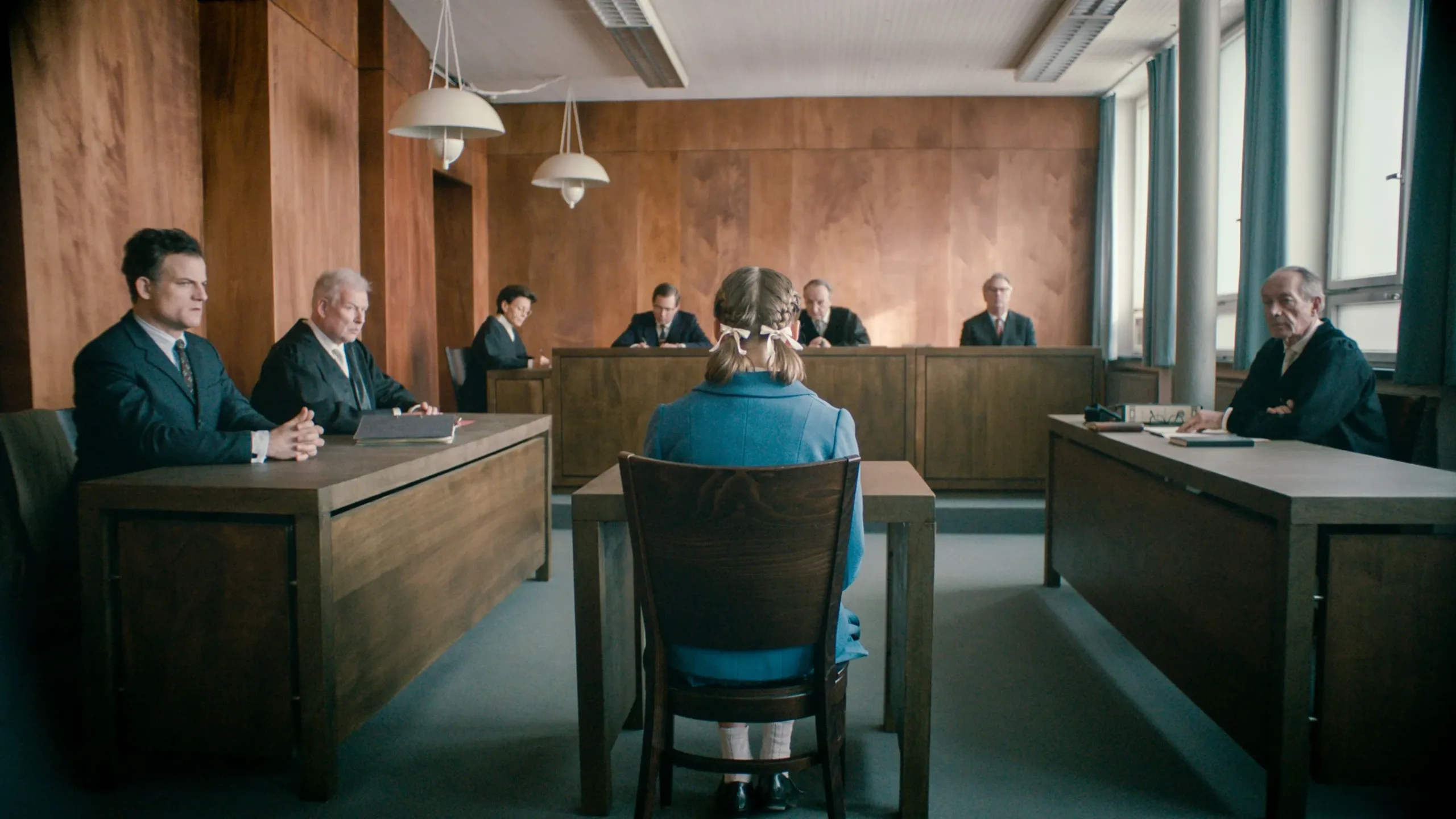
The film’s production design is an active participant in the story, meticulously building a world that is both historically accurate and thematically resonant. The oppressive interiors mirror the suffocating social norms of the era. The heavy, dark wood of the courthouse and the judge’s office symbolize the weight and inflexibility of the patriarchal law.

The world feels brown and grey, constricted and airless. This is reinforced by the costume design; Karla’s heavy, buttoned-up clothing seems to physically weigh her down, making her appear even smaller against the imposing institutional backdrops. Yet the narrative provides a necessary counterpoint to this suffocation. When Karla is sent to a convent, the film allows for a breath of air.
The visual palette may not change drastically, but the atmosphere does. Her friendship with another resident, Ada, offers moments of genuine lightness and connection. These scenes are structurally vital. They are not mere interludes but serve the crucial purpose of showing the audience the child Karla still is, the person she is fighting to protect. Seeing her whisper with Ada while listening to the radio under the covers is essential; it reveals exactly what is at stake—her right to a life not solely defined by what was done to her.
The Trial of Silence
The climactic courtroom sequence stages the film’s central conflict, serving as a structural showdown between two incompatible systems of truth. The tension is palpable as Karla’s testimony is pitted against the steadfast denials of her family. Here, the narrative meticulously deconstructs the chasm between legal procedure and human dignity.

The court demands a linear, explicit recitation of events—facts, dates, details. But Karla’s truth is held in her guarded silence, in the resonance of a tuning fork, and in the fragmented memories she is willing to share. The film powerfully argues against the simplistic notion that justice is merely a guilty verdict.
It proposes a more profound victory: Karla’s success in forcing the system to bend, however slightly, to her terms. She makes it listen to her silence and acknowledge her story without consuming her dignity in the process.
The trial becomes less about what happened to her and more about her right to control how it is told. The film’s final statement is a quiet but radical transfer of the burden of shame, moving it from the victim to the perpetrator and the complicit world that allowed the silence to fester.
“Karla” is a German drama film that premiered on June 29, 2025, at the Filmfest München.
Full Credits
Director: Christina Tournatzés
Writers: Yvonne Görlach
Producers & Executive Producers: Jamila Wenske, Melanie Blocksdorf, Milena Maitz, Falk Sanne, Olivier Dubois
Cast: Elise Krieps, Rainer Bock, Imogen Kogge, Torben Liebrecht, Katharina Schüttler, Robert Hunger-Bühler, Frank Vockroth, Carlotta von Falkenhayn, Ulla Geiger, Ben Braun, Christian A. Koch, Jonathan Joèl Albrecht, Luis Vorbach
Director of Photography (Cinematographer): Florian Emmerich
Editors: Isabel Meier, Bader Khlifi, Sthiti Padhy
The Review
Karla
Karla is a masterfully constructed and deeply intelligent film that tackles its difficult subject with profound respect and narrative discipline. Anchored by two exceptional lead performances, the film forgoes sensationalism in favor of a quiet, methodical examination of trauma, dignity, and the courage required to speak truth to a system not designed to hear it. It is a powerful and essential piece of filmmaking, demonstrating how restraint and cinematic precision can achieve a greater emotional impact than any overt display. It stands as a significant work of quiet power.
PROS
- Outstanding and nuanced lead performances from Elise Krieps and Rainer Bock.
- Intelligent, sensitive direction that handles the subject matter with immense dignity.
- Exceptional use of sound design and silence to build atmosphere and psychological tension.
- A script that powerfully champions a survivor’s right to control their own story.
CONS
- Its deliberate, methodical pacing may feel distancing for some viewers.
- The singular focus on Karla and the judge leaves family members feeling more like symbolic obstacles than fully drawn characters.
- The film’s admirable restraint occasionally keeps raw emotion at an analytical distance.