
























![Kingdom Hearts Collection [I-III] Review](https://gazettely.com/wp-content/uploads/2026/10/Kingdom-Hearts-Collection-I-III-1-360x180.webp "Kingdom Hearts Collection [I-III] Review: KHII Holds Steady as Newer Entries Fluctuate 37")



The dark rural cell where Dejan vomits through withdrawal teaches the local meaning of obedience before anyone calls it recovery. Goran Stanković’s Our Father enters its Serbian Orthodox rehabilitation center through a body in crisis: Vučić Perović’s Dejan shivers, scratches, retches, and searches for any remaining piece of control. The center takes that from him quickly. Phones disappear. Medical support is absent. Privacy has no practical use in a place where salvation has been turned into a timetable.
This is Stanković’s fiction feature debut, inspired by the real case of Branislav Peranović and testimonies from former residents of the Crna Reka center. The film does not treat that history as an invitation to make a lurid abuse drama. Its intelligence lies in the way it builds the institution before it breaks it. Meals, chores, prayers, haircuts, shared rooms, and stern rules create a working community. That matters. Bad systems rarely survive on violence alone. They survive because they offer order to people who have been denied it elsewhere.
Dejan Learns the Rules
Dejan’s first arc is simple on paper: resistance, submission, usefulness, promotion. The script, written by Stanković with Ognjen Sviličić, Dejan Prćić, and Maja Pelević, gives that arc enough behavioral detail to keep it from feeling schematic. Dejan wants a phone. He looks for drugs on a newcomer. He lashes out. Then he starts cutting other men’s hair, joining the labor rhythm, and reading the room with a survivor’s alertness.
Perović plays those shifts without asking for easy sympathy. His Dejan has the wounded intensity of someone who knows he is failing and resents everyone who can see it. Watch his eyes in the early group scenes: they keep moving, measuring exits, threats, and weaknesses. Later, that same watchfulness becomes loyalty to Father Branko. The change is disturbing because it is readable. Dejan does not turn into a different person. He learns which version of himself the center rewards.
Goran Marković’s Mionica gives the film its most useful emotional complication. Assigned as Dejan’s mentor, he has the warmth of a man who remembers suffering and the obedience of a man who has survived by accepting the chain of command. His kindness is genuine. His complicity is genuine too. That is the trap the film understands.
The Priest and the Shovel
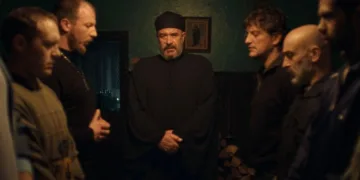
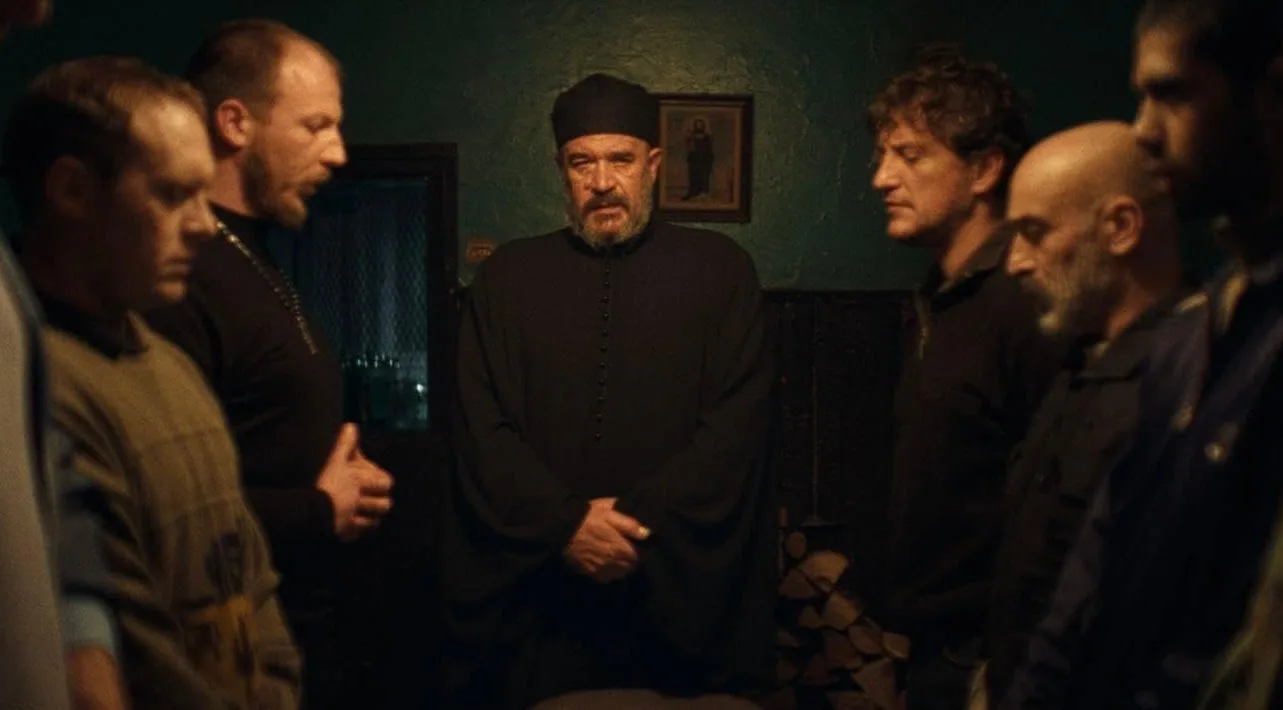
Father Branko could easily have become a stock monster with a cassock and a temper. Boris Isaković avoids that lazy route. Branko is calm, paternal, and persuasive when the center’s rituals are working. He can defend his methods with the confidence of a man who has seen addicts eat properly, sleep regularly, and stand upright again. Then he orders punishment with the same calm. That is the performance’s chill: he never has to switch masks. The mask is the man.
The shovel beating is the film’s structural hinge. After Dejan is caught using drugs, Branko orders Mionica to beat him. Stanković stages the violence from a distance and lets the scene run with little mercy. There is no dramatic rescue, no editing trick to soften the blows, no speech to explain the moral equation. The other men stand by, trained into silence. The scene shows the institution doing its real work: converting patients into witnesses, witnesses into enforcers, and enforcers into believers.
When video of the beating leaks, the story widens without losing its spine. Public scandal arrives, but the film stays close to Dejan’s altered position inside the center. He has been hurt by the system, helped by its structure, and seduced by its certainty. Asking him to condemn Branko means asking him to admit that his recovery may have been built inside abuse. That is a cruel bit of narrative engineering. It is also the point.
Rooms That Press Inward
Dragan Vildović’s cinematography and Zorana Petrov’s production design do much of the film’s silent labor. The center’s rooms are bare, dark, and practical, with icons and crosses standing out because almost nothing else has been allowed to remain. The rural landscape, with its distant mountains and cold air, gives the setting a horror outline, but Stanković keeps the camera closer to institutional realism than genre theatrics.
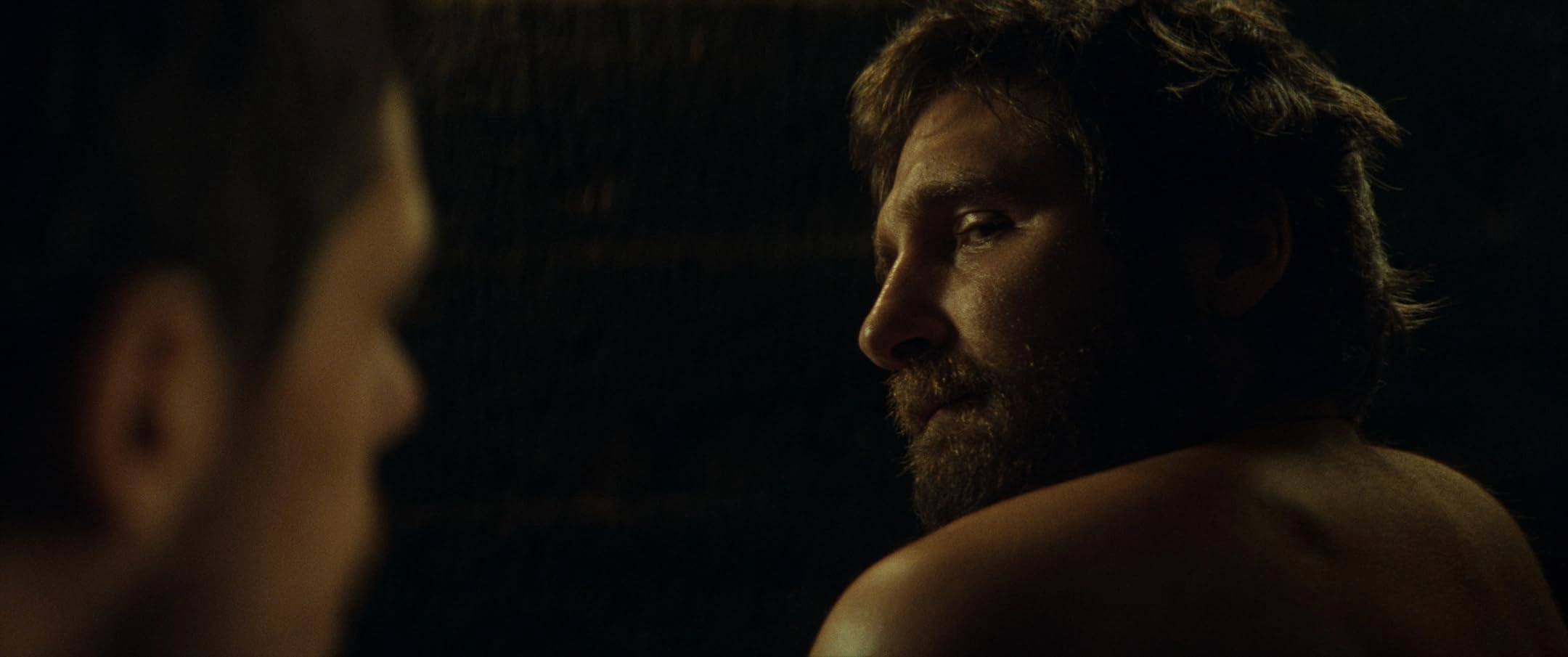
Handheld closeups during meals and chores place pressure on faces rather than architecture. The men are usually framed as bodies in a system: eating together, working together, waiting together, watching together. The editing by Marko Ferković keeps the 90-minute film tightly shaped, moving from Dejan’s arrival to his assimilation, then to scandal and escalation. No act overstays its function. A mercy, given how many films about institutional cruelty mistake repetition for depth.
The visit from Dejan’s mother and the drawing from his five-year-old son cut through the center’s closed logic. These moments do not sentimentalize him. They remind us what recovery should be pointed toward: a life beyond Branko’s command. The tragedy is that the center can name that goal while making itself the obstacle.
Control Disguised as Care
Our Father is strongest when it refuses clean categories. Branko’s center is abusive, but it also gives some men food, work, routine, and a reason to stay sober. Dejan is a victim, but he becomes useful to the machinery that harms him. Mionica is tender, then obedient, then terrible by instruction. Stanković keeps these contradictions visible without letting them become excuses.
The result is a grim, controlled debut about power that learns the language of rescue. Its sharpest idea is also its most unsettling one: an institution can damage people while giving them the shape of a life. That is why the locked door is frightening. Some of the men have begun to call it shelter.
The psychological crime drama Our Father made its global debut in the Discovery section of the Toronto International Film Festival on September 9, 2025. It continues to travel through international festival programs, including its regional showcase at the Pula Film Festival. The film follows a recovering drug addict who enters a remote, isolated monastery rehabilitation community under the severe guidance of an authoritarian priest. As the newcomer becomes the priest’s right-hand assistant, their dynamic faces a grueling test when the cleric’s violent tactics spiral out of control, threatening the survival and mental stability of everyone inside the sanctuary.
Full Credits
Title: Our Father (Oče naš)
Distributor: This and That Productions, Nightswim, PomPom Film, Dream Factory, KINO, Novi Film, Cineplanet
Release date: September 9, 2025 (Toronto International Film Festival)
Rating: R
Running time: 90 minutes
Director: Goran Stanković
Writers: Goran Stanković, Ognjen Sviličić, Maja Pelević, Dejan Prćić
Producers and Executive Producers: Snežana van Houwelingen
Cast: Vučić Perović, Boris Isaković, Goran Marković, Jasna Žalica, Toni Mihajlovski, Nenad Heraković, Dado Ćosić, Tatjana Kecman, Petar Novaković, Goran Slavić
Director of Photography (Cinematographer): Dragan Vildović
Editors: Marko Ferković
Composer: Alen Sinkauz, Nenad Sinkauz
The Review
Our Father
Our Father is a grim, disciplined debut that understands abusive institutions as stories people are taught to believe. Its best scenes, from Dejan’s withdrawal to the shovel beating, show control being renamed care with chilling precision. Stanković’s film can feel emotionally severe, but that severity has purpose. It studies recovery, faith, and obedience through character behavior rather than speeches, with Perović, Isaković, and Marković giving the machinery its bruised human shape.
PROS
- Vučić Perović’s tense physical work
- Boris Isaković’s calm menace
- Shovel beating staged with restraint
- Tight 90-minute escalation
- Spartan, oppressive setting
CONS
- Emotional severity may limit access
- Secondary patients stay thin
- Branko’s deputies need sharper definition
- Some true-story context remains outside frame







