



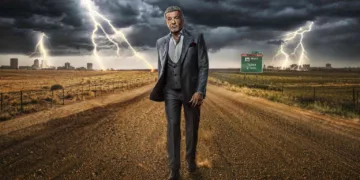
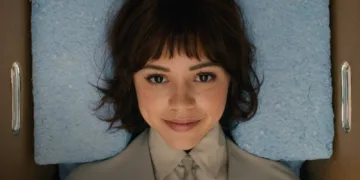






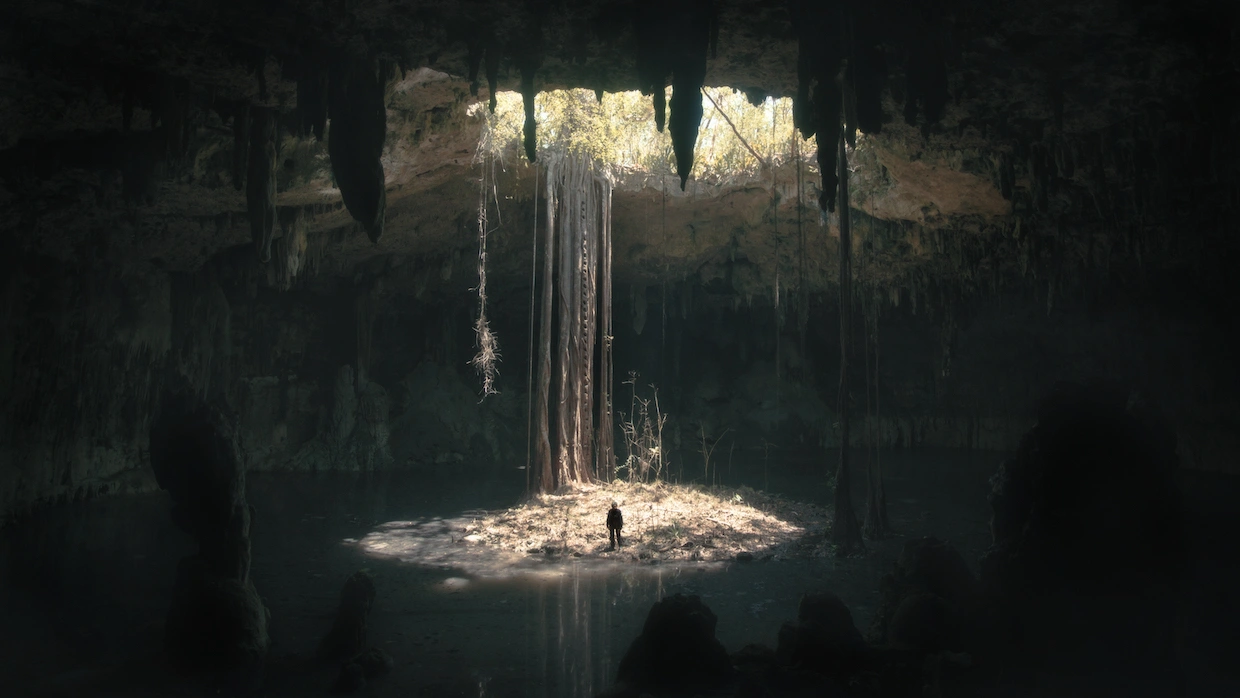

A camera slips beneath tree roots and keeps descending until daylight begins to feel like a rumor. That is the spell Rob Petit casts in Underland, a 79-minute documentary adapted from Robert Macfarlane’s book about the worlds hidden below ordinary ground. The film does not treat caves, drains, mines, and labs as scenic curiosities. It treats them as emotional pressure chambers.
Petit narrows Macfarlane’s wide-ranging source to three strands: Fátima Tec Pool entering a Yucatán cave system linked to Mayan ritual life, Bradley Garrett moving through the storm drains beneath Las Vegas, and Mariangela Lisanti working in Canada’s SNOLAB facility in search of dark matter. Each descent carries a different feeling. One reaches backward. One stares at the present with a flashlight. One looks toward particles so elusive they sound almost mythic.
The film’s reach can be larger than its grasp, especially when its philosophical language strains to bind these places together. Still, its best moments create the rare sensation that the planet has been hiding rooms from us.
Past, Present, Future
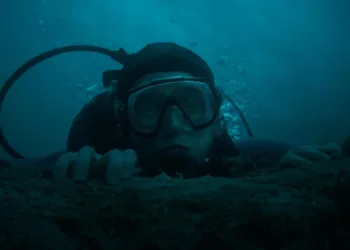
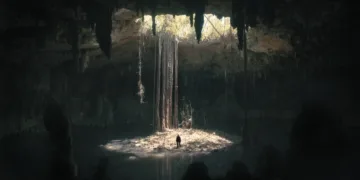
Fátima Tec Pool’s sequence gives Underland its most immediate physical suspense. Her team crawls through spaces so narrow they seem designed to reject the human body, and the camera stays close enough to make each scrape against rock feel personal. The discovery of ancient Mayan handprints, made with pulverized charcoal, shifts the sequence from danger to contact. The cave is no longer an empty chamber. It is a place where someone reached out from the dark and left proof of presence.
Bradley Garrett’s Las Vegas passages carry a different ache. His line about wealth rising while poverty sinks could have been too neat, yet the storm drains make it brutally literal. Above him, the city sells brightness. Below, the tunnels hold trash, graffiti, traces of shelter, and the risk of sudden flood. Garrett’s later venture into an abandoned uranium mine sharpens the film’s unease. The underground is not only sacred or mysterious. It is where modern life stores its poisoned leftovers.
Mariangela Lisanti’s work at SNOLAB brings the film into a cleaner, stranger register. Two kilometers beneath the surface, away from cosmic radiation, she studies dark matter, which cannot be seen directly yet shapes the universe through gravitational effects. Her scenes are less dangerous than Pool’s crawls or Garrett’s trespassing, yet they may be the most humbling. She is looking for evidence of something everywhere, hidden by its own silence.
The Feeling of Descent
Petit’s strongest choice is to avoid the usual documentary rhythm of seated experts explaining what we are seeing. The subjects speak over images of work: Pool squeezing through rock, Garrett slipping into forbidden spaces, Lisanti entering the sterile quiet of the lab. That structure keeps the film tactile. Knowledge here comes through bodies in motion.
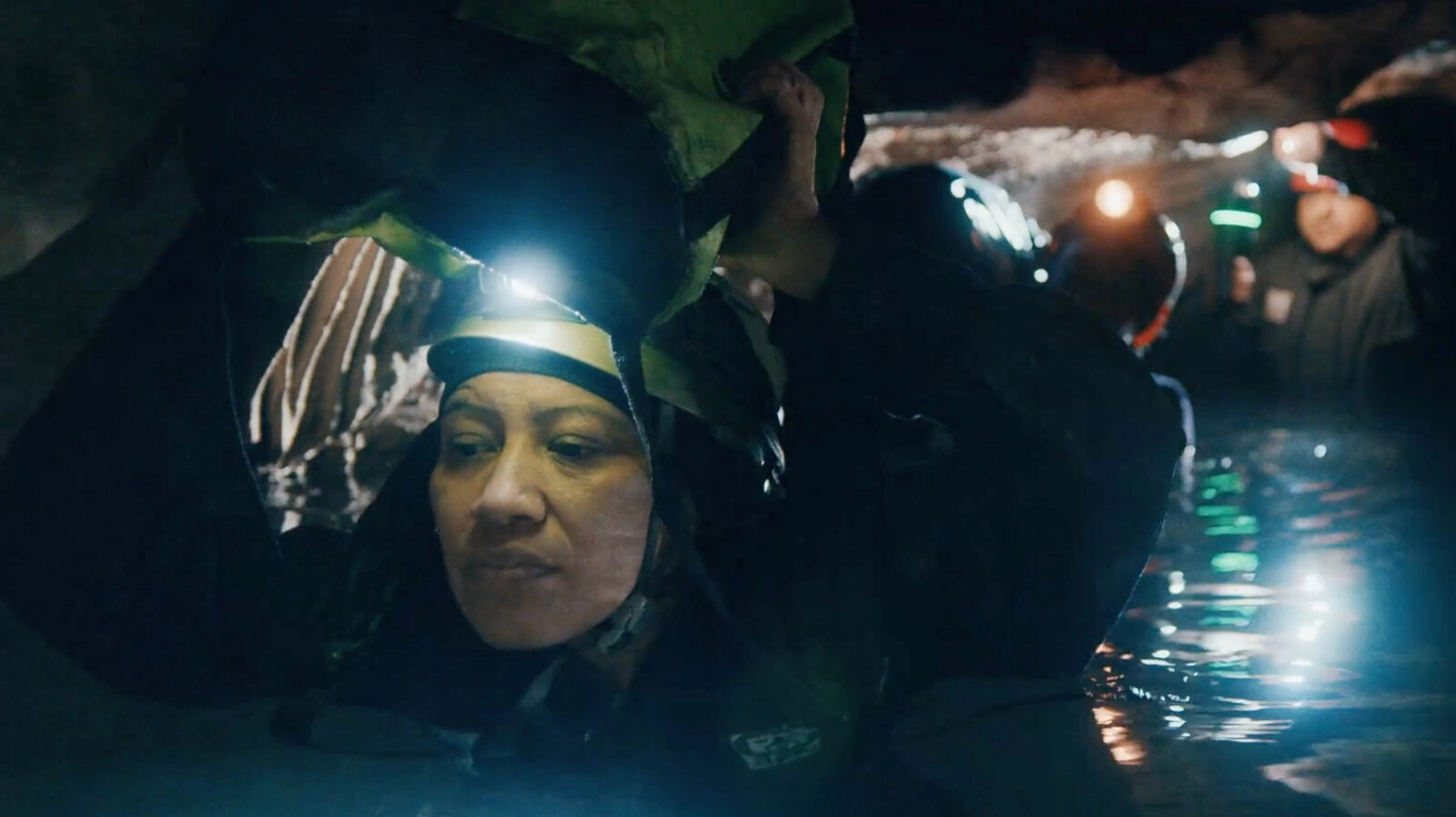
Ruben Woodin Dechamps’ cinematography makes darkness active. In the Yucatán caves, the beam of a headlamp turns stone into a moving wall. In Las Vegas, the tunnels flatten into long corridors where every distant sound feels like weather, police, or disaster. At SNOLAB, the clean room looks almost alien, all polished surfaces and controlled air, a place built to listen for particles that refuse to announce themselves.
Hannah Peel’s score does a lot of emotional work. It moves between sci-fi hum, ritual pulse, and ambient unease, giving the three settings a shared nervous system. Sandra Hüller’s narration is calm, poetic, and sometimes heavy with meaning, especially around the film’s interest in “deep time.” At times, that language hovers above the images rather than sinking into them. The images rarely need that much help.
The best visual passages understand that awe and fear are close relatives. A cenote can look holy and hostile in the same shot. A drain can feel like freedom until rain becomes a death sentence. A laboratory can look like the future and still feel like a cave.
What the Darkness Holds
Underland keeps returning to one powerful idea: humans put things underground because we want to preserve them, hide them, study them, or forget them. The Mayan handprints belong to preservation. The Las Vegas debris belongs to neglect. The uranium mine belongs to damage. SNOLAB belongs to faith in questions that may outlive the person asking them.
That idea is strong enough to carry much of the film, but Petit sometimes leaves the connections too soft. The natural cave, the man-made drainage system, and the underground physics lab sit beside one another beautifully, yet the film rarely presses hard on what separates them. A sacred cave and a city drain are both underground, but they mean radically different things. The documentary senses that difference without fully shaping it.
The short runtime helps the film avoid becoming overburdened, though it also leaves gaps. Burial, famous cave disasters, and other parts of Macfarlane’s wider exploration pass by quickly or remain outside the frame. That choice makes sense for a film built around mood and immersion, but it also explains why Underland can feel lighter in thought than in atmosphere.
This is a film of partial revelations. It does not uncover the full meaning of the world below us. It gives us three ways to feel it: the ancient hand on stone, the wet concrete under a glittering city, and the silent machine waiting for dark matter to make itself known.
The documentary Underland premiered at the Tribeca Festival in June 2025 and debuted in UK cinemas on March 27, 2026. This feature film follows three expert subterranean explorers as they map out caves, hidden storm drains, and an underground research laboratory. Audiences can catch this cinematic journey through select independent theatrical screenings and subsequent streaming platforms via Dogwoof and Sandbox Films.
Full Credits
Title: Underland
Distributor: Dogwoof (UK theatrical), Sandbox Films
Release date: June 2025 (World Premiere at Tribeca Festival) / March 27, 2026 (UK Theatrical Release)
Running time: 79 minutes
Director: Robert Petit
Writers: Robert Macfarlane, Robert Petit
Producers and Executive Producers: Darren Aronofsky, Ari Handel, Lauren Greenwood, Jessica Harrop (Producers), André Singer, Figs Jackman, Robert Macfarlane, Craig Miller, Elizabeth Radshaw, Richard Wolfe, Keith Potter (Executive Producers)
Cast: Sandra Hüller, Bradley Garrett, Mariangela Lisanti, Fátima Tec Pool
Director of Photography (Cinematographer): Ruben Woodin Dechamps
Editors: David G. Hill, Anna Price, Andy R. Worboys, Julian Quantrill
Composer: Hannah Peel
The Review
Underland
Underland works best as a sensory descent, with rock, concrete, and laboratory silence carrying feelings the narration sometimes over-explains. Its three strands do not always connect with full force, yet the film gives each underground space a distinct emotional charge: ancient contact in the Yucatán, social neglect beneath Las Vegas, cosmic patience at SNOLAB. The images linger like handprints in the dark.
PROS
- Stunning underground imagery
- Strong three-subject structure
- Haunting sound and score
- Fátima Tec Pool’s cave sequence
- Clear emotional atmosphere
CONS
- Ideas can feel underdeveloped
- Narration sometimes overstates
- Book’s scale feels compressed
- Links between locations stay soft