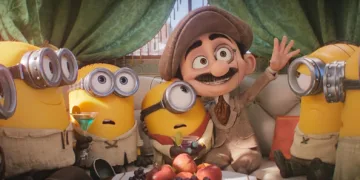









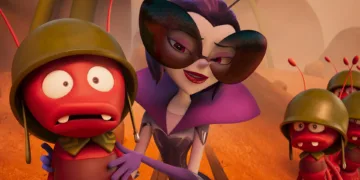

A banana-yellow creature who cannot speak intelligibly is a perfect comic instrument for a story about silent cinema’s extinction. Minions & Monsters sends James and Henry, two misfit members of Illumination’s babbling species, into 1920s Hollywood, where their bodily chaos becomes art by accident.
Pierre Coffin, directing solo and again voicing the entire Minion tribe, understands the franchise’s basic social fact: these characters are funniest when they overwhelm polite systems. In Gru’s orbit, they often act as garnish around a family-villain plot. Here, they become the infestation itself, an army of denim-clad impulse without supervision. The film’s best joke is structural. Silent cinema accepts them because it cannot hear them. Sound cinema rejects them because it finally can.
This gives the seventh film in the wider Despicable Me universe a sharper engine than the series usually receives. It remains proudly juvenile, soaked in gibberish, pratfalls, and weaponized stupidity. Yet for a long stretch, its stupidity has cultural literacy. That is a dangerous sentence to write about the Minions, but the film earns it.
The Anarchy Has a Shape
James and Henry are not deep characters, and the film is wise enough not to pretend otherwise. Their distinction comes through action: they disrupt rituals, sabotage villains through eagerness, and turn obedience into carnage. Their early travels with the tribe offer the franchise’s familiar premise, the search for a despicable master, but the repetition has a new rhythm because every potential authority figure is treated as temporary furniture waiting to collapse.
The comedy is frequently grisly in the sugar-coated way this series favors. A sudden beheading lands with cheerful brutality. A prehistoric stone Lego brick becomes an instrument of agony. These are little rituals of anti-authority, executions performed by accident. The film’s politics, such as they are, remain hilariously unserious: hierarchy exists so small yellow workers can destroy it while trying to serve it.
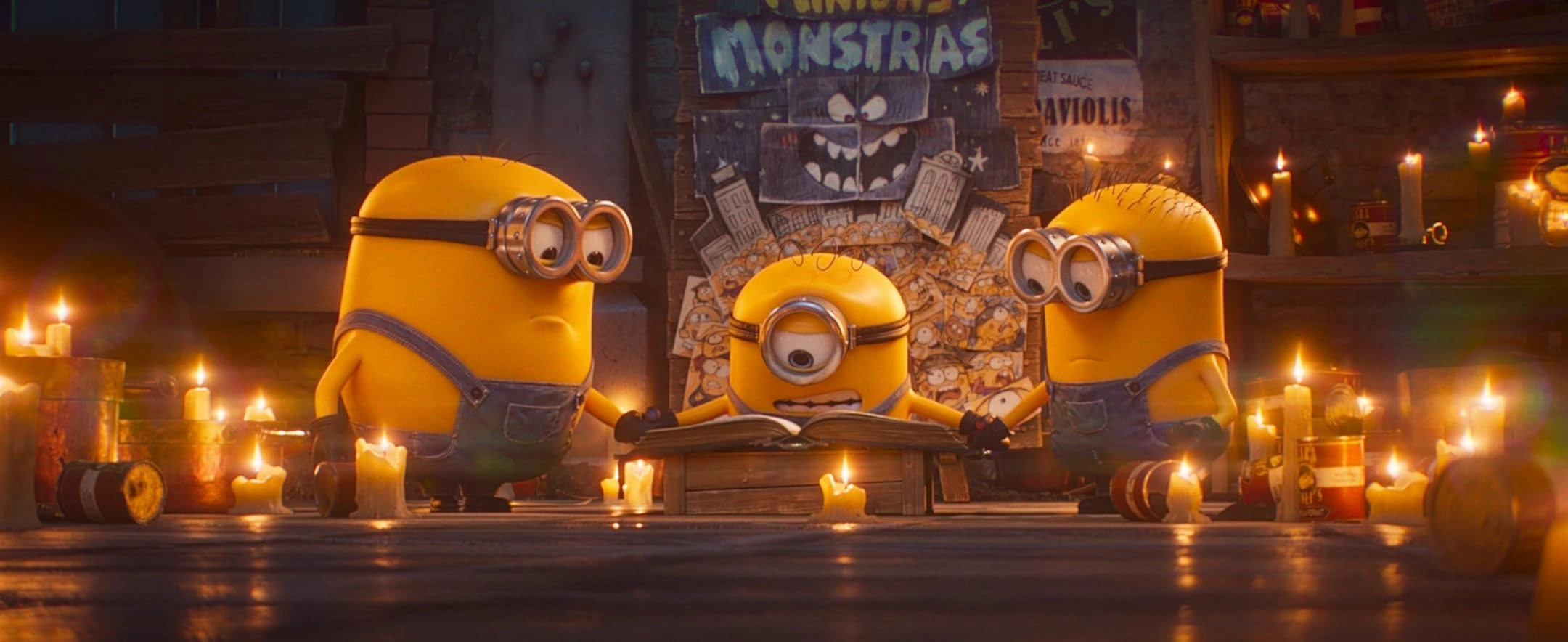
The bond between James and Henry softens the machinery. Their friendship carries a faint ache of exclusion, since they are too chaotic even for a species built from chaos. They also want to tell stories. That desire gives their mischief direction. A Minion staring solemnly into artistic yearning would be a felony.
James and Henry’s creative ambition works because it appears through mess: a hijacked movie set, an improvised performance, a dream of directing monsters before anyone has checked if they should be trusted with a camera.
Hollywood Eats the Pest and Calls It Talent
The opening frame places viewers on a Universal Studios tour, with Allison Janney’s guide marching families through memorabilia until the past cracks open. The device is thin, but the details have bite: vintage Universal logos scroll backward through studio time, a George Lucas gag treats mythmaking as museum property, and Hollywood history becomes a showroom where industrial memory is both sacred and absurd.
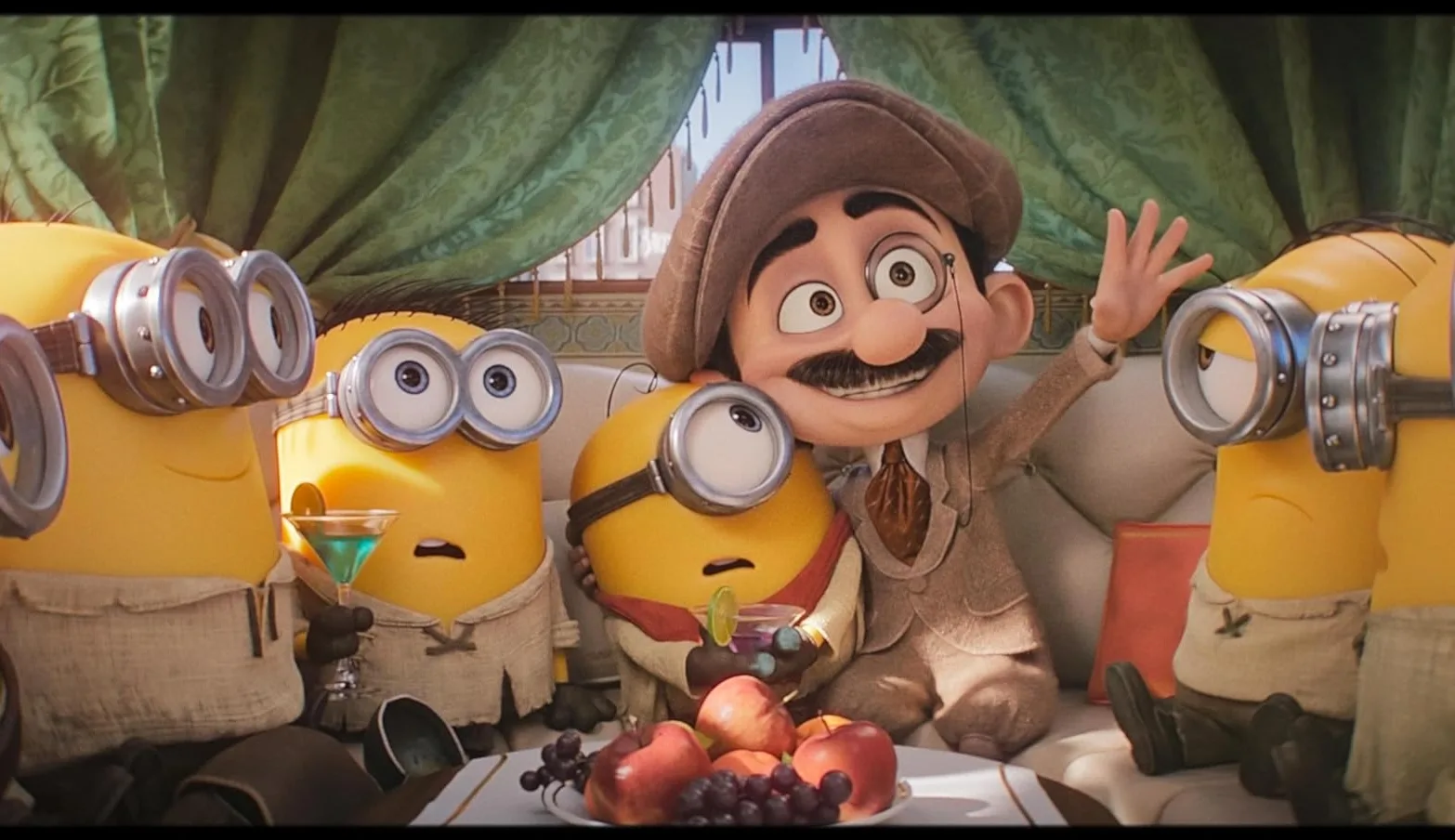
The film locks into form when the Minions stumble onto a Western shoot run by Max, voiced by Christoph Waltz with peevish control. Max has the vocal posture of a man whose monocle would fall into his soup given the chance. His film set, designed for old frontier heroics, becomes a playground for the Minions’ destructive timing.
The sequence begins as a production accident, then mutates into a desert chase, then a runaway-train disaster. It is the cleanest set-piece in the film because each escalation has a visual cause. A horse bolts. A prop becomes a hazard. A shot goes wrong, then the wrongness photographs beautifully.
Jeff Bridges voices the studio bosses who recognize profit inside the wreckage. Hollywood does not reject chaos. It packages chaos if chaos sells. Soon the Minions are silent-era celebrities, living in a studio-funded mansion, churning through comedies and genre pictures, and launching merchandise with the shameless speed of an industry that has always known children are a market before they are an audience.
The pastiches have real affection behind them. Modern Times, Safety Last!, Citizen Kane, and the Universal monster tradition all pass through the Minion filter. A thriller poster titled Look Behind You, and Then Down captures the film’s best gag-writing: short, visual, stupid in exactly the right register. They understand why the Minions belong there. Silent slapstick turns bodies into arguments. A fall, a chase, a panicked glance, a ladder in the wrong place: these are complete sentences. The Minions have always spoken that language fluently.
Gibberish as Film History
Coffin’s vocal work remains a strange feat of comic semiotics. The Minions’ speech is nonsense built from recognizable fragments, a stew of toddler rhythm, Italian exclamations, stray European syllables, and pure throat music. “Bellissima!” and “Moviosa!” register less as words than as emotional weather. Their meaning comes through pitch, speed, and physical context. A shriek near a collapsing train needs no translation.
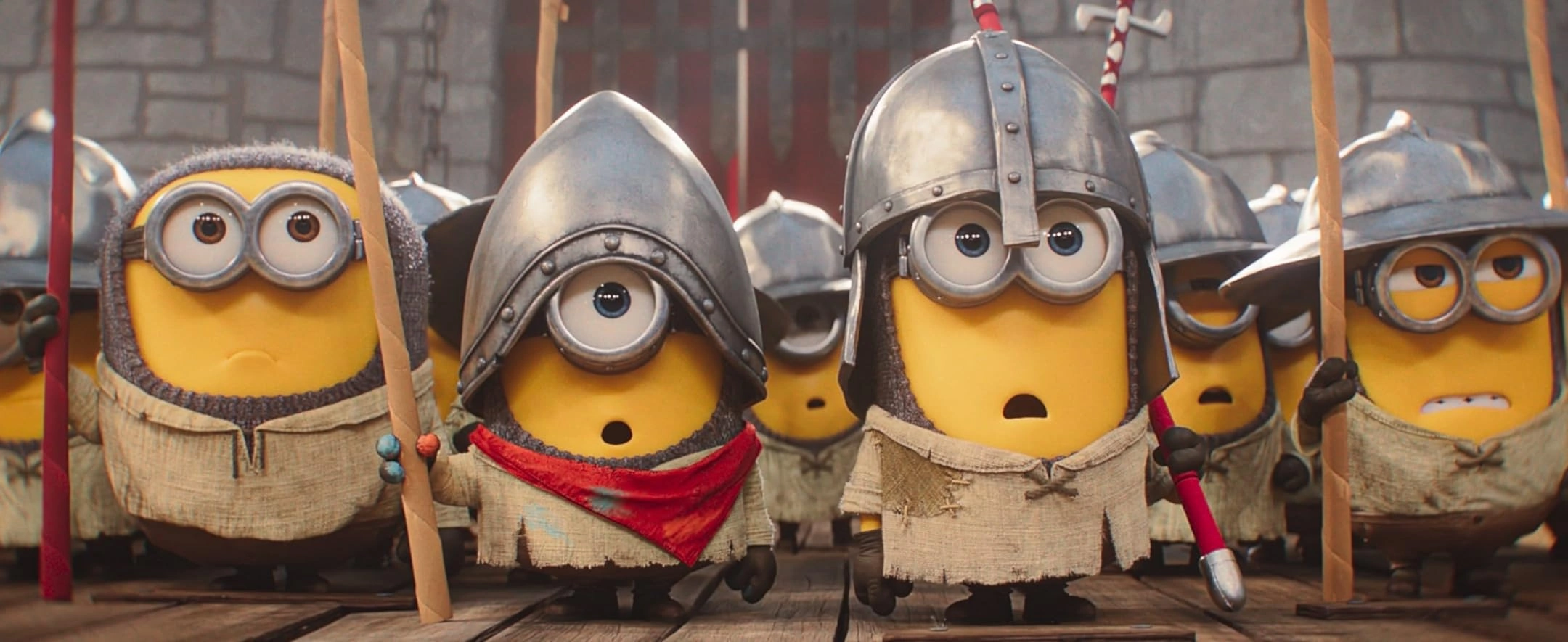
That is why the sound-era turn is such a fine joke. For once, the franchise’s most obvious irritation becomes the story’s organizing principle. Talking pictures do not simply end the Minions’ Hollywood reign; they expose the absurdity that silent cinema had gracefully hidden. The film borrows the grand anxiety of Singin’ in the Rain, then miniaturizes it into a gag about market incompatibility. These stars cannot survive sound because sound reveals what they are.
The voice cast around them sharpens the joke without smothering it. Waltz gives Max a brittle dignity that keeps cracking under assault. Bridges supplies the studio heads with a warm, corrupt majesty, making them sound like men who would greenlight a fire if the flames tested well. Trey Parker’s Goomi, a squat green creature tangled in James and Henry’s plans, adds a different comic texture.
The animation supports this range of comedy with care. The studio lots glow with manufactured glamour. The Western landscapes feel broad enough for chase mechanics. The mansion scenes turn success into a cluttered toy chest. Later monster imagery carries the right old-Universal shadows before the film trades that texture for larger digital destruction. The movie’s visual rhythm is fast without becoming mush. Each gag has a readable silhouette, a rare virtue in animated chaos.
The Monsters Arrive, and the Idea Thins
The film’s trouble begins once Hollywood throws the Minions out. The premise has been so elegantly matched to film history that the next movement cannot help feeling less exact. Splitting the group weakens the swarm logic, and the robot Dort, voiced by Jesse Eisenberg, proves funnier as a concept than as a sustained plot engine. His cowardice, nodding toward The Day the Earth Stood Still, has a pleasingly brittle sound, but the scenes keep asking him to fill space rather than sharpen it.
Debbie, voiced by Zoey Deutch, fares worse. A strong-willed suffragette paired with a cowardly robot sounds like a joke with teeth, or at least a useful collision between political modernity and sci-fi parody. The film leaves her mostly stranded inside a romantic subplot that feels drafted for grown-ups yet too underfed to engage them. It signals adult awareness, then gets abandoned once the next chase sequence arrives.
James’ dream of directing a Universal monster movie should rescue the second half. The image of a Minion trying to command gothic horror carries obvious promise. The execution turns literal: movie magic summons destructive beasts, and the film swells into a save-the-world battle against monstrous forces. Irene, the eye-filled blob menacing Los Angeles, hints at a satire of spectatorship, an audience appetite grown enormous and hungry. The movie notices the metaphor, then runs away to smash buildings.
That shift is revealing. Minions & Monsters is happiest when chaos collides with systems of production: a film set, a studio office, a silent-era marketplace, the technological panic of talkies. When it becomes another animated climax full of noise and scale, the comedy loses its historical pressure. The final battle has speed and cartoon stamina, but fewer jokes with clean edges. The monsters are large. The earlier ideas were sharper.
A Late-Franchise Curiosity With Banana Peels
The emotional ceiling remains low by design. James and Henry’s friendship supplies warmth, and their shared creative hunger gives the plot a gentle pulse, but the film’s real feeling lies in its affection for cinema as organized lunacy. A studio is a place where accidents become assets, where gibberish becomes a career, where a train disaster can be good footage if the camera is pointed correctly.
That affection makes the film one of the franchise’s livelier oddities. It is messy, yes. The second half gives up too much precision. The Dort and Debbie thread sags. The monster climax chooses volume after the first half has taught the audience to expect wit. Yet the movie’s best stretch is so buoyant, so densely stocked with silent-comedy logic and studio-era parody, that the franchise briefly looks less like a merchandising empire and closer to a slapstick organism that wandered into cinema history and started chewing the furniture.
The Minions remain pests. Minions & Monsters simply gives them a museum worth vandalizing.
The animated franchise comedy Minions & Monsters held its global premiere at the Annecy International Animation Film Festival on June 21, 2026, and is scheduled to debut in wide theatrical release across the United States via Universal Pictures on July 1, 2026. Set approximately forty years before the events of the original Minions spin-off, the family adventure tracks the mischievous yellow henchmen as they arrive in Old Hollywood with the goal of creating their very own cinematic monster movie. Naturally, their chaotic ambitions backfire when they accidentally release real mythical creatures into the world, forcing the entire tribe to band together to reverse the global mayhem they just unleashed.
Where to Watch Minions & Monsters (2026) Online





Full Credits
Title: Minions & Monsters
Distributor: Universal Pictures
Release date: June 21, 2026 (Annecy International Animation Film Festival), July 1, 2026 (United States Theatrical Release)
Rating: PG
Running time: 90 minutes
Director: Pierre Coffin
Writers: Brian Lynch, Pierre Coffin
Producers and Executive Producers: Chris Meledandri, Bill Ryan, Brian Lynch
Cast: Pierre Coffin, Allison Janney, Christoph Waltz, Jeff Bridges, Jesse Eisenberg, Zoey Deutch, Bobby Moynihan, Phil LaMarr, Trey Parker
Editors: Animation production team / Illumination editing department
Composer: John Powell
The Review
Minions & Monsters
Minions & Monsters gives the franchise one of its smartest comic premises: gibberish-spewing pests thriving in silent Hollywood, then collapsing the moment sound arrives. Its first half has wit, movie-history play, and brisk visual comedy; its monster-heavy back half grows louder and less exact. Still, the film has enough oddball cultural mischief to feel like a rare late-franchise entry with an actual spark.
PROS
- Clever silent-cinema premise
- Strong James and Henry pairing
- Sharp Hollywood pastiches
- Readable, energetic slapstick
- Coffin’s elastic vocal work
CONS
- Weaker monster climax
- Thin Debbie and Dort subplot
- Low emotional depth
- Second half loses precision