
























![Kingdom Hearts Collection [I-III] Review](https://gazettely.com/wp-content/uploads/2026/10/Kingdom-Hearts-Collection-I-III-1-360x180.webp "Kingdom Hearts Collection [I-III] Review: KHII Holds Steady as Newer Entries Fluctuate 37")




A marriage proposal dies in public, then the universe tries to follow it. That is the cleanest joke in Weekend at the End of the World, and the film spends the next 82 minutes trying to make the cosmos look as ridiculous as Karl’s humiliation. Directed by Gille Klabin, who co-wrote the script with Clay Elliott and Spencer McCurnin, the film sends Karl (Elliott) and Miles (Cameron Fife) to a remote cabin after Karl’s botched proposal becomes internet sport.
Miles, the kind of friend who mistakes damage control for content creation, has filmed the disaster and helped it go viral. His solution is a weekend at his late grandmother’s cabin, a property he believes can be flipped before the market collapses. The market is fine. Reality has the problem.
The cabin contains a portal, a dead grandmother with unfinished business, and enough cosmic instability to make two emotionally underqualified men responsible for existence. That premise has teeth. It gives the film a sharp comic geometry: human embarrassment on one side, metaphysical collapse on the other. The trouble is that Klabin often mistakes speed for rhythm. Jokes arrive before the previous joke has found a chair.
Two Idiots and a Cracked Frame
The film works best before the portal fully asserts itself, when Karl and Miles are still moving through the basic rituals of male avoidance: alcohol, bad advice, property speculation, and a refusal to name pain directly. Elliott plays Karl with a tight, wounded anxiety, the body language of a man still standing in the shadow of his own rejection. Fife gives Miles a breezier irresponsibility, all forward motion and no internal editor. Together, they form the film’s most reliable structure.
Their chemistry has a pleasing old shape. One man panics. The other makes the panic worse. The formula is ancient because it is useful. The early cabin scenes let that pairing breathe. Miles looks at a damaged, haunted-looking property and sees profit. Karl, freshly humiliated, sees a weekend where he might avoid thinking about his life.
The writing finds some honest comic charge in that mismatch, especially when the men treat bad decisions as if they were minor renovations. Then comes the mysterious animal-skull liquid, the purple surge, and the first major shift from buddy farce into supernatural lunacy.
That shift should sharpen the film. Instead, it sometimes flattens it. Karl and Miles respond to world-ending stakes with the same flippant energy they bring to personal failure, which is funny for a while and then oddly anesthetic. If nothing frightens them for long, the comedy loses its shadow. In horror-comedy, shadow matters. A punchline needs something dark behind it.
The Allness, Meemaw, and Comic Overexposure
The portal to The Allness gives Weekend at the End of the World its most memorable visual and its most unstable dramatic engine. The cabin becomes a collision site: floating objects, purple light, demonic interruption, and the resurrection of Meemaw, played by Troian Bellisario in younger form. It is a fine grotesque joke that Miles’ grandmother returns from death as someone Karl finds dangerously attractive. The film understands the perversity of that image and keeps poking it.

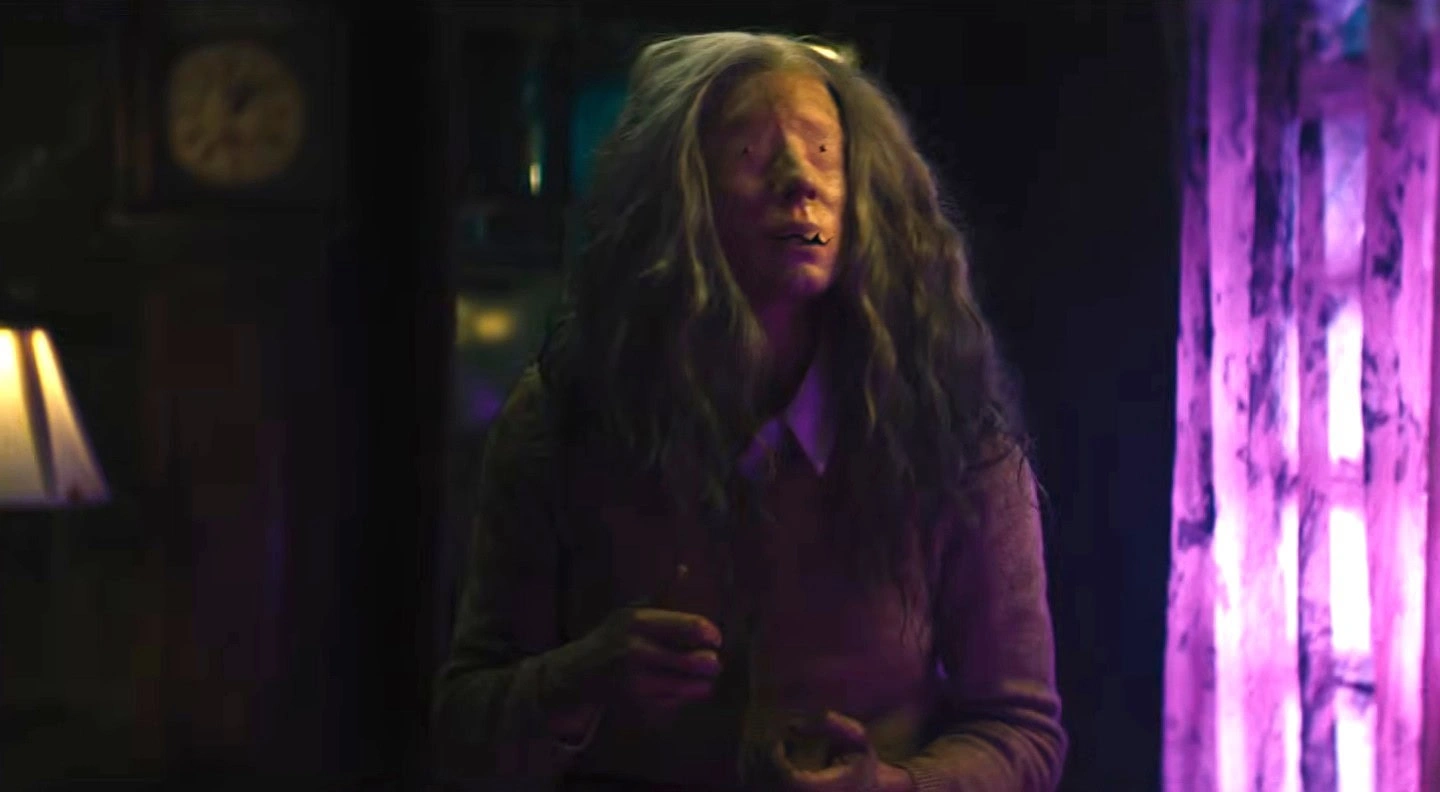
Bellisario has the cleanest tonal control in the cast. She can turn Meemaw from soft guide to unhinged occult technician in a single look, and she gives the resurrection material a comic elegance the script does not always earn. Her early botched appearance, with a face that looks gruesomely wrong before Karl and Miles try to repair the damage, is the film’s best horror gag because it is visual first, verbal second. The image does the work. The men merely worsen it.
Thomas Lennon, as neighbor Hank, enters with the bright menace of a man whose friendliness should be reported to local authorities. After Hank is transformed into a possessed or undead figure, Lennon is left with grunts, contortions, and zombie physicality. He still finds beats inside the limitation. His body becomes punctuation.
The film’s weaker jokes are louder and less disciplined. The “fart cops” sequence announces its own desperation. The phrase “METAPHORICAL DARKNESS!” lands closer to the movie’s true comic philosophy: name the symbolic threat, then trip over it. There is charm in that. There is also strain. The film wants the reckless glee of The Evil Dead filtered through a dumber cosmic buddy comedy, yet it rarely lets dread gather enough weight to make the idiocy dangerous.
Handmade Chaos Under Purple Light
The craft is stronger than the hit rate of the jokes. Working with limited resources, Klabin puts the effects in plain view rather than hiding them in embarrassed darkness. Portals glow. Objects float. Demonic shapes intrude. The imagery never aims for seamless realism, which is wise. Its surreal, handmade quality matches the film’s B-movie nervous system.
Aaron Grasso’s cinematography gives the cabin a useful split personality. Interior scenes are boxed-in and plain enough to let the actors ricochet off the rooms, while the exterior and portal material lean into movement and pink-purple lighting. That color scheme does a lot of atmospheric labor. It turns the cabin from a decaying real-estate opportunity into a comic séance chamber, the kind of place where a hose connected to another reality can float through the frame and somehow feel like a reasonable property defect.
The production design understands genre memory. The cabin is all damage, clutter, isolation, and bad decisions waiting for bodies. It recalls the classic horror house without copying a single shrine too neatly. The place feels built for impact: doors, rooms, corners, fluids, broken surfaces, and the permanent suspicion that the previous owner had plans nobody should inherit.
Beneath the stupidity, the film reaches for an idea about humiliation and the worth of a life judged from the outside. Karl is labeled by his failure. Miles hides sincerity behind momentum. The apocalypse becomes a funhouse mirror for private shame. That thread appears in flashes, then gets buried under another joke, another shriek, another blast of purple. The film has the right darkness in the room. It keeps switching on novelty lights before the eyes adjust.
The independent horror-comedy Weekend at the End of the World made its debut at film festivals in late 2025 before launching its digital release on platforms such as Prime Video and Apple TV on April 20, 2026. The storyline follows two lifelong, down-on-their-luck friends who plan a drunken getaway to flip a secluded cabin in the woods for a quick cash-out. Their hopes of getting rich quickly turn into a chaotic fight for survival when they accidentally unlock a secret portal to an otherworldly realm, forcing them to battle bizarre demons to save the world.
Where to Watch Weekend at the End of the World (2025) Online



Full Credits
Title: Weekend at the End of the World
Distributor: Hero Moves LLC, Prime Video, Apple TV
Release date: October 16, 2025 (Grimmfest), April 20, 2026 (Digital Streaming Release)
Rating: 18+
Running time: 81 minutes
Director: Gille Klabin
Writers: Gille Klabin, Spencer McCurnin, Clay Elliott
Producers and Executive Producers: Cameron Fife, Gille Klabin, June Street Productions
Cast: Clay Elliott, Cameron Fife, Thomas Lennon, Troian Bellisario, Adam Ray, Sujata Day, Jesse O’Neill, Jimmy Guidish
Director of Photography (Cinematographer): Aaron Grasso
Editors: Gille Klabin
Composer: Eldad Guetta
The Review
Weekend at the End of the World
Weekend at the End of the World has the bones of a terrific horror-comedy: wounded friendship, cosmic absurdity, a cursed cabin, and purple light doing suspiciously heavy ethical labor. Its handmade effects and committed cast give the film personality, while Troian Bellisario and Thomas Lennon sharpen several of its stranger beats. The problem is rhythm. The film fires jokes so rapidly that dread has no room to breathe, and the apocalypse becomes noise before it becomes pressure. Messy, sincere, visually spirited, and only intermittently funny.
PROS
- Strong lead chemistry
- Striking purple-lit portal imagery
- Troian Bellisario’s tonal control
- Thomas Lennon’s physical comedy
- Scrappy handmade effects
CONS
- Frantic joke rhythm
- Thin dramatic tension
- Juvenile gags miss hard
- Horror rarely gathers force
- Emotional ideas get buried







