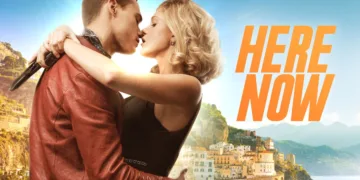

















Palermo offers its history willingly, its cathedrals and sarcophagi standing as monuments to time. But for Sophie, a young American woman shackled to a grief she cannot articulate, the past is a cage. On her final day in Italy, she rejects the curated tour for something immediate, something real.
Her small act of rebellion, a simple walk to a seaside cliff, becomes the fissure through which her entire reality will fracture. There she finds them: Giulio and his cohort, radiating a dangerous, sun-drenched charisma. They are the promise of a life lived without a safety net. The film presents this meeting as a fatalistic crossroads, the kind pivotal to any good noir.
It posits a simple question: what happens when one chooses instinct over instruction? What begins as a fleeting holiday romance under a Mediterranean sun soon bleeds into a neon-streaked, nocturnal descent, a 24-hour plunge into a chaos from which there is no easy return.
A Portrait in Free Fall
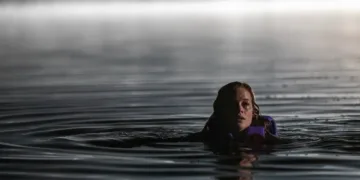
At the film’s center is Sophie’s psychological unraveling, a supposed liberation from her “emotional prison.” She begins as a study in fragility, a character so burdened by past grief that her every move is policed by a well-meaning sister. Yet, within hours, she metamorphoses into a willing agent of chaos. This is presented as an existential act of self-creation, an attempt to reclaim agency by embracing nihilism.
The timid tourist pivots to reckless accomplice with a swiftness that strains narrative credibility. One must question the screenplay’s architecture here; her newfound expertise in felonious pursuits feels less like an organic development and more like a convenience demanded by the plot’s relentless machinery. It’s a pity, as the philosophical underpinning is potent. The catalysts for this change are classic archetypes, slightly askew.
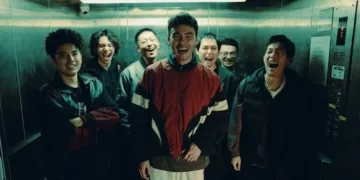
Giulio is the beautiful, simple trigger, a romanticized object of desire who functions almost as a male ‘femme fatale,’ luring the protagonist toward her doom. It is Lorenzo Richelmy’s Komandante, the laconic leader of the pack, who registers with more gravity. His world-weary silence and vacant stare speak volumes more than the incessant shouting of his peers, hinting at a depth the film is otherwise too frantic to explore.
Moments designed to manufacture this depth elsewhere, chiefly a bizarre piano duet in a deserted shopping mall, feel like heavy-handed authorial intrusions. The sudden shift to soft focus and sentimental dialogue is a clumsy attempt to weld an emotional core onto a narrative that hasn’t earned it.
An Architecture of Anxiety
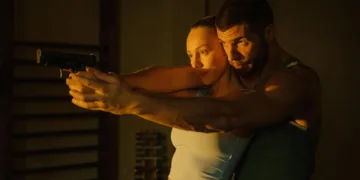
Director Gabriele Muccino’s style is nothing short of aggressively energetic, a form of cinematic maximalism where every emotional beat is amplified to its breaking point. The filmmaking eschews observation for total, agitated immersion, with a camera that seems to be a panicked character in its own right. The visual language leans heavily on expressionistic techniques to manifest inner turmoil.
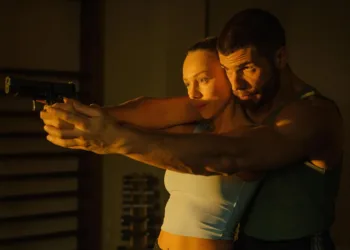
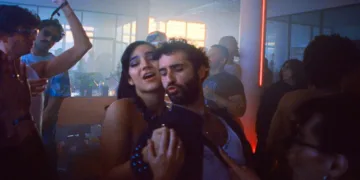
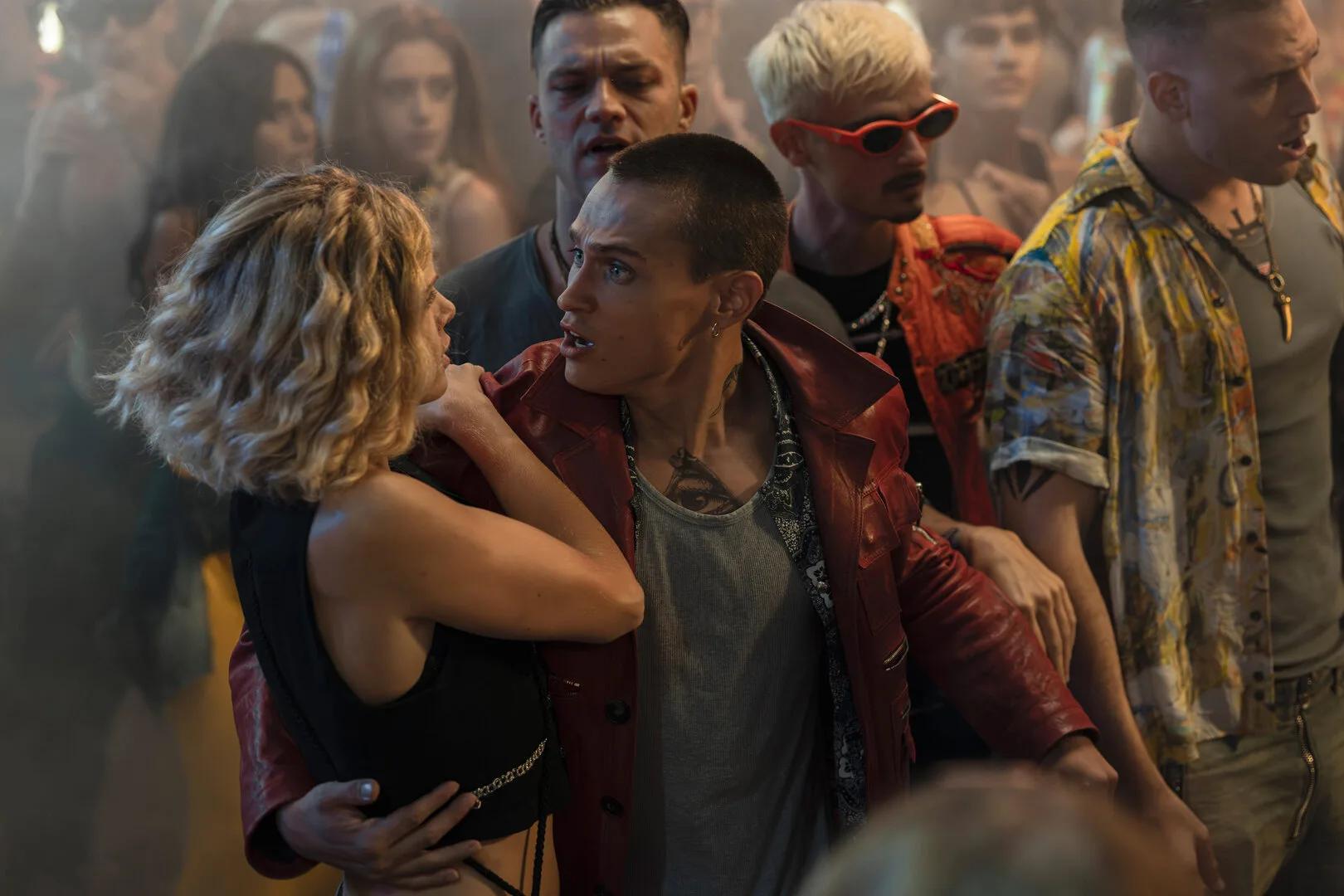
The night is a canvas of harsh, conflicting light sources: the strobing chaos of a nightclub, the cold glare of headlights carving through narrow alleys, the sickly yellow of streetlamps painting faces in hues of anxiety and moral decay. This is not the patient, creeping shadow of classic noir, but a modern, frantic interpretation of it.
The pacing operates at a constant, feverish velocity, affording few moments for reflection. This relentless momentum is mirrored by a soundscape of roaring engines, a pounding score, and dialogue delivered almost exclusively in shouts. This cacophony functions as a deliberate tool of audience psychology; it overloads the senses, discouraging critical thought and forcing the viewer into a state of pure reaction that mirrors Sophie’s own panicked journey.
The use of dynamic, disorienting camera techniques, including a dizzying 360-degree apparatus mounted inside a speeding vehicle, completes the effect. The viewer is not watching a crisis unfold; they are trapped inside of it, breathless and disoriented.
Postcard from the Abyss
The film’s entire structure rests on its protagonist’s choices, yet its narrative logic is the clear Achilles’ heel. An opening epigraph proclaims that life is the result of our choices, a theme with rich philosophical potential. Here, however, the idea serves less as a subject for genuine inquiry and more as a high-minded pretext for the next chase sequence.
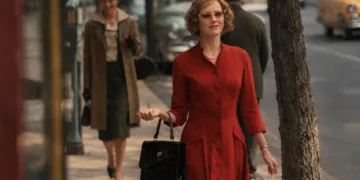
The choices Sophie makes feel less like meaningful existential acts and more like nodes on a pre-programmed path designed for maximum spectacle. This superficiality extends to the setting itself. Unlike classic noir, where the city is an oppressive, corrupting character, Palermo is rendered as a beautiful but emotionally inert backdrop.
Its ancient streets and vibrant piazzas become an interchangeable playground for mayhem rather than an integral participant in the story. It is a postcard from the abyss, not the abyss itself. The work is a burst of pure, unadulterated sensation, a shot of adrenaline that prioritizes forward momentum above all else. It succeeds in capturing a feeling of raw energy but leaves behind little resonance, the memory of a ride rather than its destination.
Full Credits
Director: Gabriele Muccino
Writers: Gabriele Muccino, Paolo Costella
Producers: Andrea Leone, Raffaella Leone
Cast: Elena Kampouris, Saul Nanni, Lorenzo Richelmy, Enrico Inserra, Francesco Garilli, Yan Tual, Ruby Kammer, Syama Rayner, Mitch Salm, Grace Ambrose
Director of Photography (Cinematographer): Fabio Zamarion
Editors: Claudio Di Mauro
Composer: Paolo Buonvino
The Review
Here Now
Here Now is a technical marvel of frenetic energy, a cinematic adrenaline shot that is both immersive and exhausting. Its relentless style and dynamic camerawork are initially thrilling, but they cannot sustain a narrative built on unbelievable character leaps and superficial philosophical musings. The result is a ride that offers potent, surface-level excitement but lacks the narrative and emotional depth to leave a lasting impression. It is a film of pure, fleeting sensation.
PROS
- An aggressively energetic and immersive directorial style.
- Dynamic, experimental camerawork that effectively creates a sense of chaos.
- Relentless pacing provides a constant sense of high-stakes action.
- Strong atmospheric visuals, particularly the expressionistic use of light and shadow.
CONS
- The narrative strains credibility with its logic and convenient plot developments.
- The protagonist's psychological transformation feels abrupt and unearned.
- Its central philosophical themes about choice are stated but never explored with depth.
- The setting of Palermo is used as a generic backdrop rather than an integral element.