































The world of 1000 Deaths is an immediate assault on the senses, a riot of color and surreal shapes that feels like a half-remembered cartoon from a bygone era. Pariah Interactive’s debut title presents a bizarre, psychedelic landscape where the laws of physics seem optional.
The game establishes its identity through this strange aesthetic, but its structure is a calculated fusion of two distinct genres. It combines a gravity-defying 3D platformer with a choice-driven narrative chronicling the lives and relationships of its peculiar inhabitants.
You are cast as a small, animate television set, tasked with entering the minds of the main characters. Inside these “headspaces,” your performance in platforming challenges directly dictates the life-altering decisions they make, creating a direct link between mechanical skill and narrative consequence.
A Tale of Four Lives
The narrative heart of 1000 Deaths is an anthology of personal struggles, told across three distinct episodes that function like seasons in a bizarre television series. We follow the intertwined lives of four main characters, each a strange caricature of a familiar archetype.
There is Vayu, a timid, ghost-like creature consumed by regret and missed opportunities; his best friend Maxie, a fiery axolotl-adjacent being whose ambition to leave their sleepy hometown of Nowherestown for the glittering metropolis of Jollywood borders on selfish exploitation.
We also meet Terry, a living plant, and Boga, a machine, who take center stage in later episodes, exploring their own complex dilemmas. The game shows these characters as they age, their physical forms evolving to reflect their life experiences. This visual progression is a clever touch, reinforcing the passage of time and the weight of the choices they, and by extension the player, have made.
The stories themselves are grounded in deeply human conflicts. Despite the alien appearances and surreal environments, the game explores themes of friendship, trust, betrayal, and the difficult compromises demanded by ambition. It asks familiar questions: should you abandon your home to support a friend’s dream, even if it means sacrificing your own?
Do you pursue a safe career or risk it all on a creative passion? This contrast between the mundane drama and the psychedelic presentation is the game’s most potent narrative device. It uses its outlandish aesthetic to disarm the player, making the eventual emotional punches land with surprising force.
Player agency is channeled through a direct and impactful choice system. At critical junctures in a character’s life, the player must complete a series of platforming levels to unlock a binary decision. Choosing one path locks the character into a specific outcome, leading to one of four possible endings for their personal arc.
If Vayu chooses to follow Maxie to Jollywood, for instance, we see the consequences play out. He may achieve a degree of vicarious excitement, but he also bears the financial and emotional burden of Maxie’s self-centered behavior. These branches feel distinct and meaningful, offering tangible narrative shifts rather than simple flavor text.
The episodic structure, however, creates a hard separation between these arcs. Choices made as Vayu have no bearing on Terry’s story, which keeps each tale focused but prevents the development of a more complex, interconnected world seen in games like The Banner Saga. This design choice also contributes to a sense of rapid, almost breathless pacing. The story leaps between major life events, a narrative shorthand that can unfortunately undercut the gravity of the decisions you are asked to make.
Jumping Through the Psyche
The mechanical core of 1000 Deaths is its precision platforming, which is cleverly integrated into the narrative through the concept of the “headspace.” When a character faces a dilemma, you enter their mind, a physical manifestation of their psychological state.
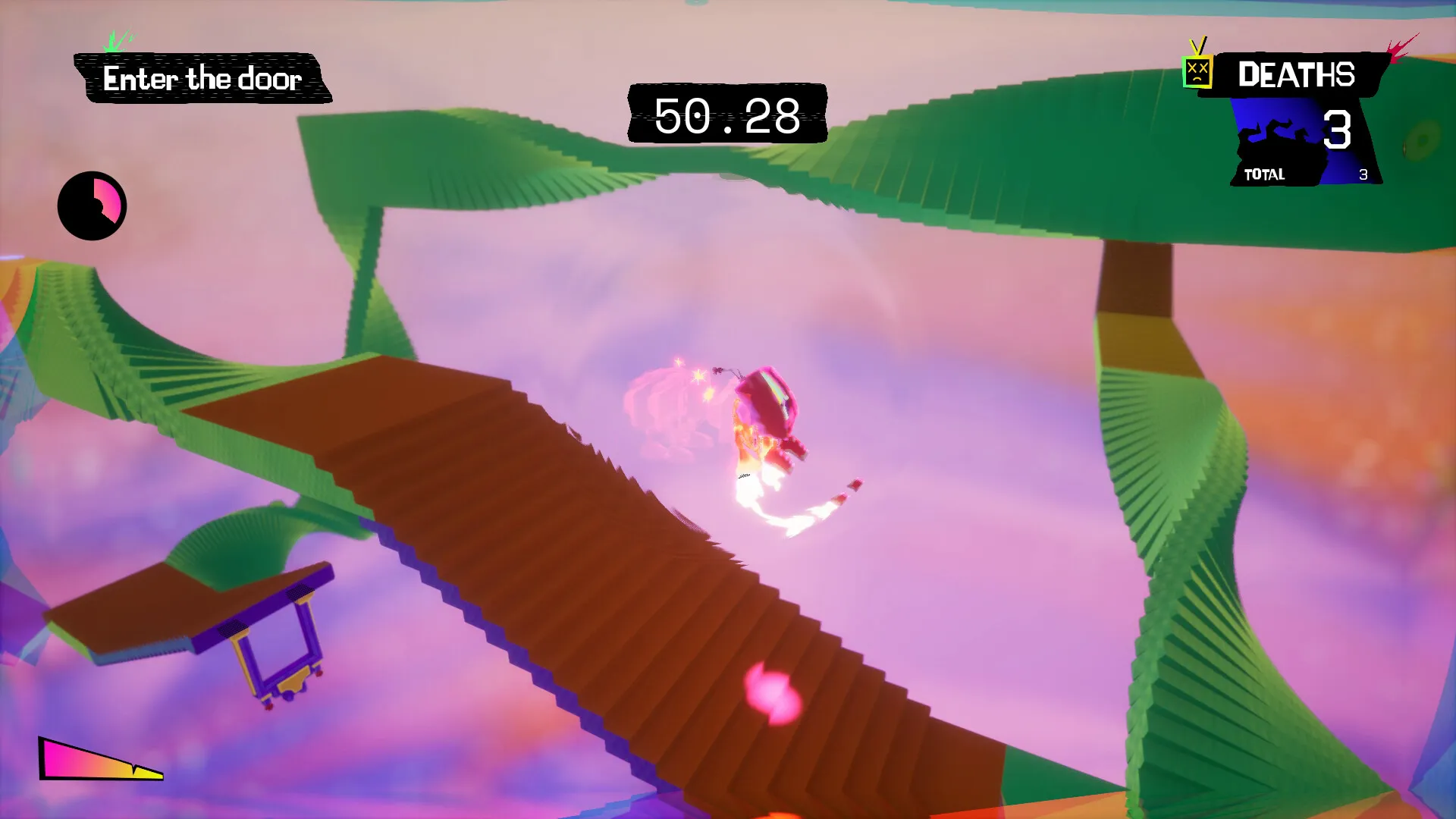
This design recalls the brilliant level design of Psychonauts, where each mental world is a playground built from a character’s hopes, fears, and neuroses. Here, these headspaces serve as hubs for short, brutally efficient platforming challenges.
The central mechanic is gravity manipulation. The levels are constructed from curved surfaces, twisted pathways, and floating structures. By simply running along these surfaces, you reorient your personal gravity, causing the entire world to spin around you. One moment you are running on a floor, the next you are on the ceiling, with “down” becoming a relative concept.
This gravity-bending mechanic is the foundation for a wide variety of puzzles. You will find yourself navigating spinning cylinders, timing jumps between platforms with opposing gravitational pulls, and dashing across paths that require you to seamlessly transition from a wall to a ceiling and back again.
The levels are bite-sized, often lasting less than a minute once you understand the solution, a design that echoes the trial-and-error loop of modern masocore platformers like Super Meat Boy or Celeste. The focus is on execution and timing.
Your moveset is deceptively simple and remains static throughout the game: a jump, a mid-air dash, and a ground-pound. There are no new abilities to unlock or character stats to upgrade. This places the entire burden of progression on player skill. You do not overcome challenges by finding a new power-up; you overcome them by mastering the fundamentals and learning the intricate layout of each level.
This fixed moveset is a bold design choice. On one hand, it ensures a pure and focused platforming experience. On the other, it can feel like a missed opportunity for expressing character growth through gameplay. The controls themselves are a highlight.
They are tight, responsive, and reliable, which is essential for a game that demands such precision. When you fail, it is almost always due to a mistake in timing or execution, not a fight with the controls. The primary technical issue is the camera. While generally competent, it can sometimes struggle during rapid gravitational shifts or on tightly enclosed, spinning structures. These moments can lead to disorienting views and frustrating deaths that feel less earned than those caused by a simple misstep.
The Race Against Time
While the narrative portion of 1000 Deaths can be completed in a handful of hours, the game reveals its true depth and longevity in its speedrunning features. This is where the simple controls and complex level design are pushed to their absolute limits. The design philosophy here shifts from narrative exploration to pure mechanical mastery.
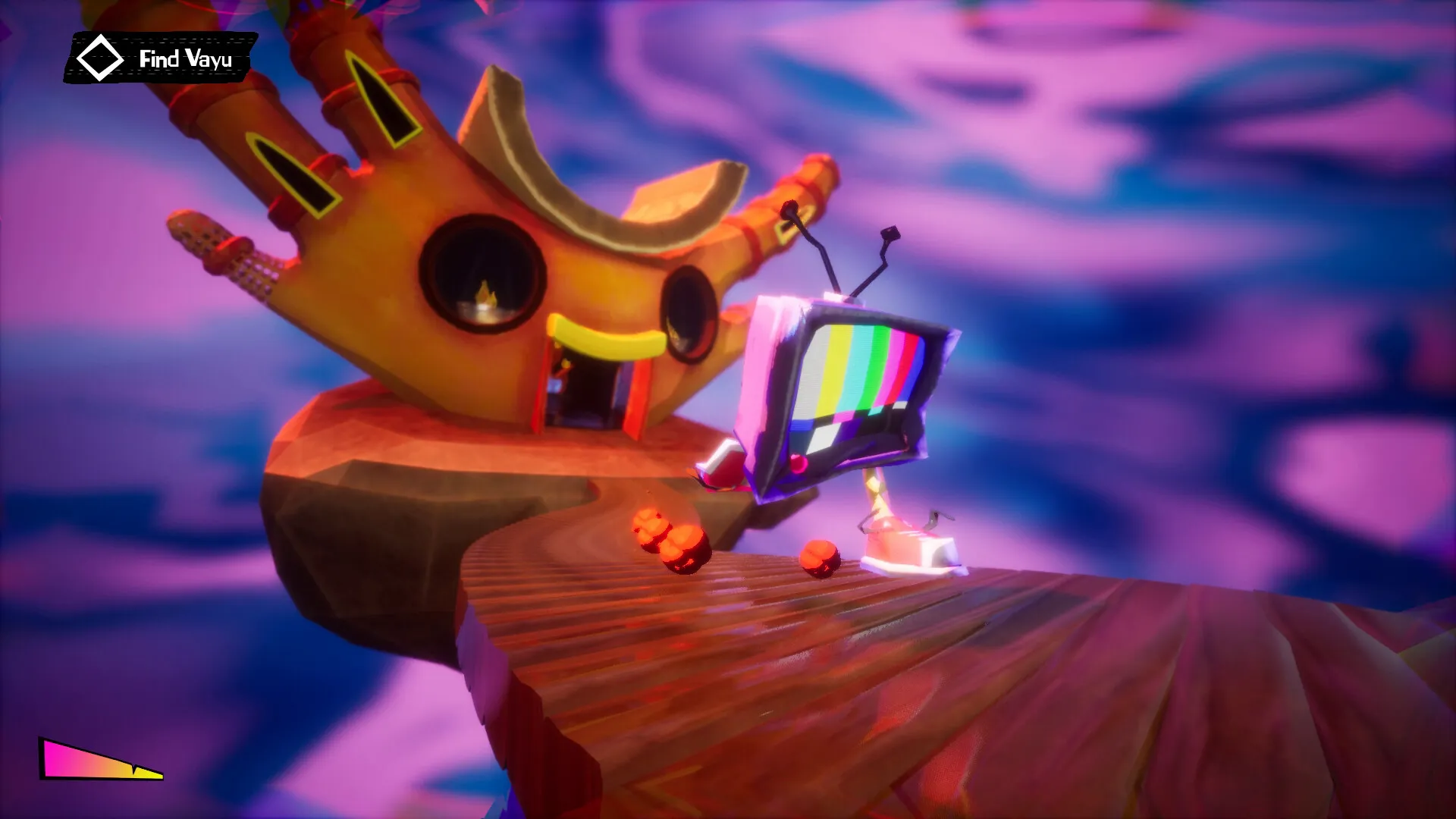
Each of the game’s 47 platforming stages has a built-in trophy system, grading your performance from bronze to a coveted platinum based on your completion time. These accolades are entirely optional for story progression, serving as an open invitation for players to engage with the game on a much higher skill level.
To facilitate this, the game includes a dedicated Arcade Mode. Here, you can select any unlocked level and attempt to perfect your run without the narrative interruptions. The mode features a ghost of your best performance, a critical tool that provides immediate visual feedback on where you are gaining or losing seconds. This is a far more intuitive system than a simple clock, as it allows you to directly compete against your past self and refine your routes in real time.
The difficulty curve for achieving the platinum trophies is steep. It requires a level of precision and route optimization that transforms the game from a quirky platformer into a demanding test of skill. Players must learn to chain dashes perfectly, find the optimal lines through gravity-bending sections, and execute flawless jumps with no margin for error.
This pursuit of perfection creates an addictive “one more try” loop that gives the game legs long after the credits have rolled on all the story branches. It’s a clear nod to the design of titles like Neon White, where the main story serves as an extended tutorial for the “real” game of chasing leaderboard supremacy.
An Acid Trip Cartoon
The presentation of 1000 Deaths is a masterclass in cohesive, if unconventional, design. The visual style is its most defining feature, a psychedelic fever dream that feels both nostalgic and utterly alien. It evokes the chunky, low-polygon models and surrealist tendencies of the N64 era, but filtered through a modern lens of extreme color saturation and impossible, shifting architecture.
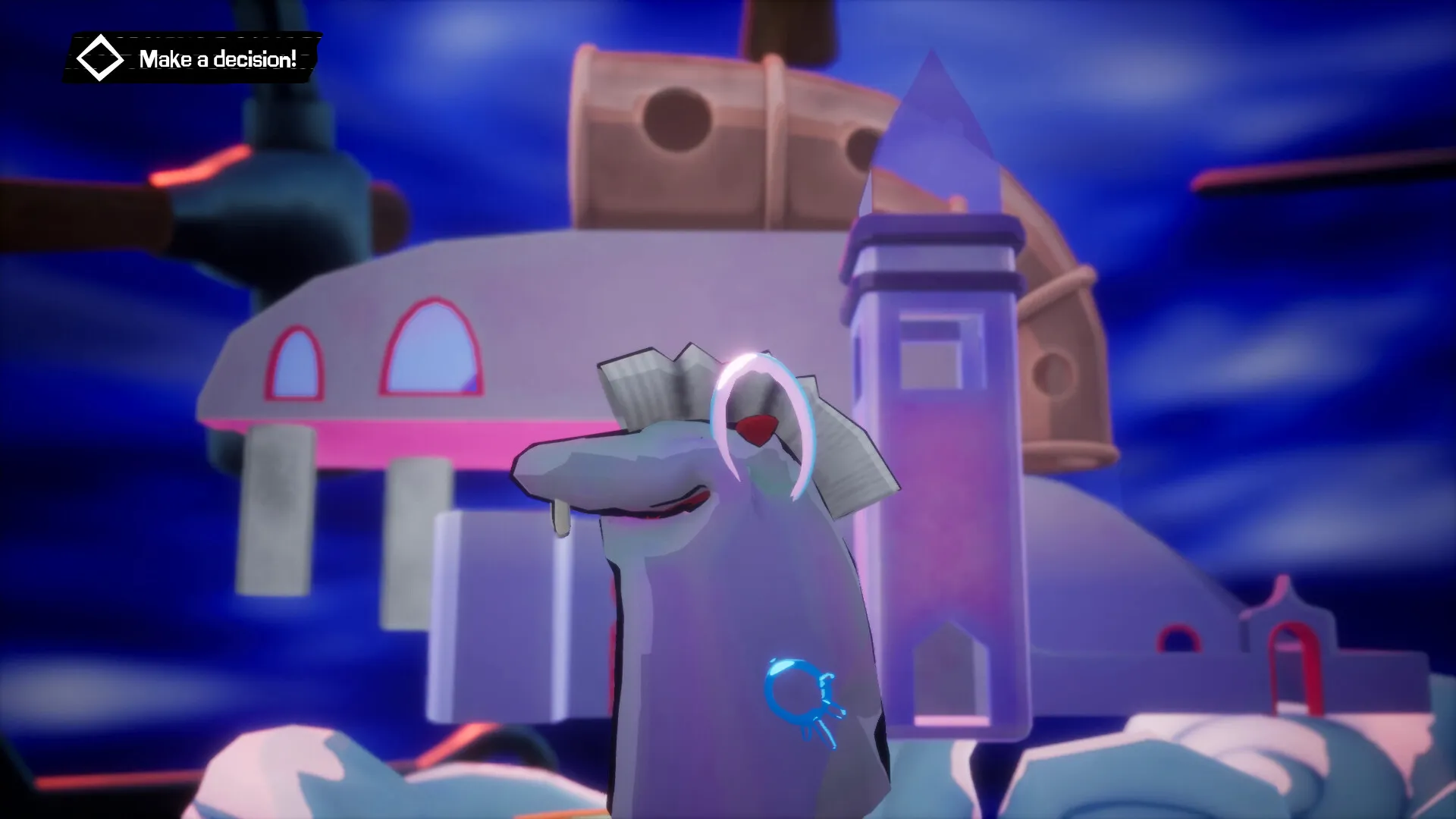
The world feels like a lost Adult Swim cartoon, where the bizarre is the norm. The character designs are wonderfully strange, from Vayu’s toothy, sheet-like form to Maxie’s vibrant axolotl features. As they age, their models change in subtle ways, adding a layer of visual storytelling that complements the narrative. The environments themselves are characters, with giant versions of the protagonists often looming in the background of the headspace levels, a constant reminder of the psychological stakes.
The game’s audio design is perfectly matched to its visual chaos. The soundtrack is a driving electronic score that shifts its tempo and mood to suit the context. In the hub worlds of Nowherestown and Jollywood, the music is calmer, with a laid-back beat that encourages exploration.
Once you enter a headspace, however, the tempo ramps up, providing an energetic, pulsating rhythm that fuels the high-stakes platforming and helps induce a state of flow during intense speedrun attempts. The rest of the soundscape is more minimalist. Sound effects for actions like jumping and dashing are present but often understated, sometimes getting lost beneath the powerful soundtrack.
There is no conventional voice acting. Instead, characters communicate through text accompanied by charming, gibberish-like sounds, a technique popularized by games like Banjo-Kazooie. This choice reinforces the game’s quirky, offbeat personality and works surprisingly well to give each character a distinct vocal identity without a single spoken word.
The Review
1000 Deaths
1000 Deaths is a bold and imaginative fusion of genres. It successfully pairs a surprisingly heartfelt narrative about friendship and ambition with demanding, gravity-bending platforming. While its rapid pacing can undercut emotional moments and the static moveset feels like a missed opportunity, the tight controls, impactful choices, and deep speedrunning content make it a remarkable and memorable experience. It's a strange trip worth taking for fans of unique indie games and challenging platformers alike.
PROS
- Clever integration of narrative choice and platforming skill.
- Tight, responsive controls and a satisfying core mechanic.
- Deep replayability through a well-designed speedrunning mode.
- Striking and cohesive audiovisual presentation.
CONS
- Narrative pacing feels rushed, lessening emotional impact.
- Player's moveset is static and does not evolve.
- Camera can be disorienting during intense sequences.
- Hub worlds feel somewhat empty and underutilized.