







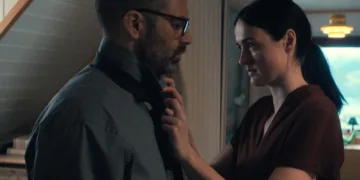
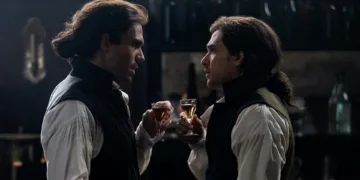



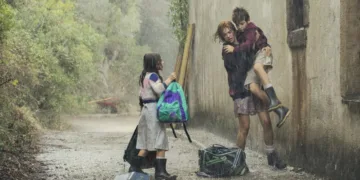
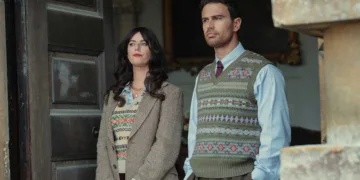

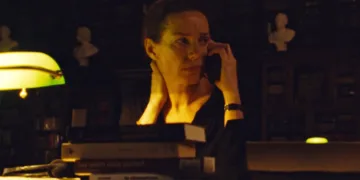










Graham Swon’s An Evening Song (for three voices) transplants a story of East Coast intellectual decay to the stark, open spaces of the American Midwest in 1939. The film introduces Barbara, a celebrated poet now creatively silent, and her husband Richard, a writer of popular pulp fiction.
Their hermetic world is breached by the hiring of Martha, a quiet, pious local woman who becomes the focal point of their conflicting desires. The film establishes its meditative mood immediately, functioning less as a traditional narrative and more as a dreamlike state.
A strange triangle of fascination forms, pulling the three into a shared space of spiritual and intellectual longing. This is an American story filtered through a European art-house sensibility, exploring the ghosts that haunt the nation’s psyche.
A Trinity of American Archetypes
The film’s power originates in its three central figures, each representing a distinct facet of American identity locked in a state of flux. Barbara, played by Hannah Gross, is the story’s spiritual center. A former child prodigy inspired by the real writer Barbara Newhall Follett, she is now afflicted with a profound ennui that feels less like sadness and more like a philosophical rejection of her own physical existence.
She yearns for a form of transcendence, to dissolve into pure narrative, an idea she voices in poetic monologues about girls who live among the stars. Her husband Richard, portrayed by Peter Vack, acts as her grounded counterpoint. A writer of disreputable pulp, he represents a strain of pragmatic, commercial American art.
His fascination with Martha is analytical; he is drawn to her burn-scarred skin and quiet piety with a writer’s eye for macabre detail, seeing her as a compelling riddle to be solved. Martha herself, brought to life by Deragh Campbell, is the enigmatic catalyst. Initially a symbol of the pious, stoic heartland, she becomes a living canvas for the couple’s projections.
She also undergoes her own quiet transformation, gradually shedding her strict religious dogma as she finds a new sense of freedom within their strange household. The narrative structure, built from the distinct yet overlapping voice-overs of all three, brilliantly mirrors this psychological merging. It creates a fluid, unreliable reality where their memories and desires bleed together, replacing a conventional plot with a shared consciousness.
A European Lens on the American Prairie
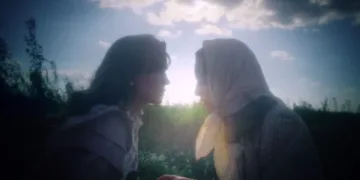
The film’s style is a deliberate departure from the conventions of American cinematic realism, instead adopting a visual language more common in European art cinema. Cinematographer Barton Cortright, using a custom camera rig, creates a hazy, ethereal aesthetic that makes the familiar Iowa landscape feel alien and subjective. The visuals are often out of focus, partially obscured, or layered with superimpositions, giving the impression of watching a fragmented memory.
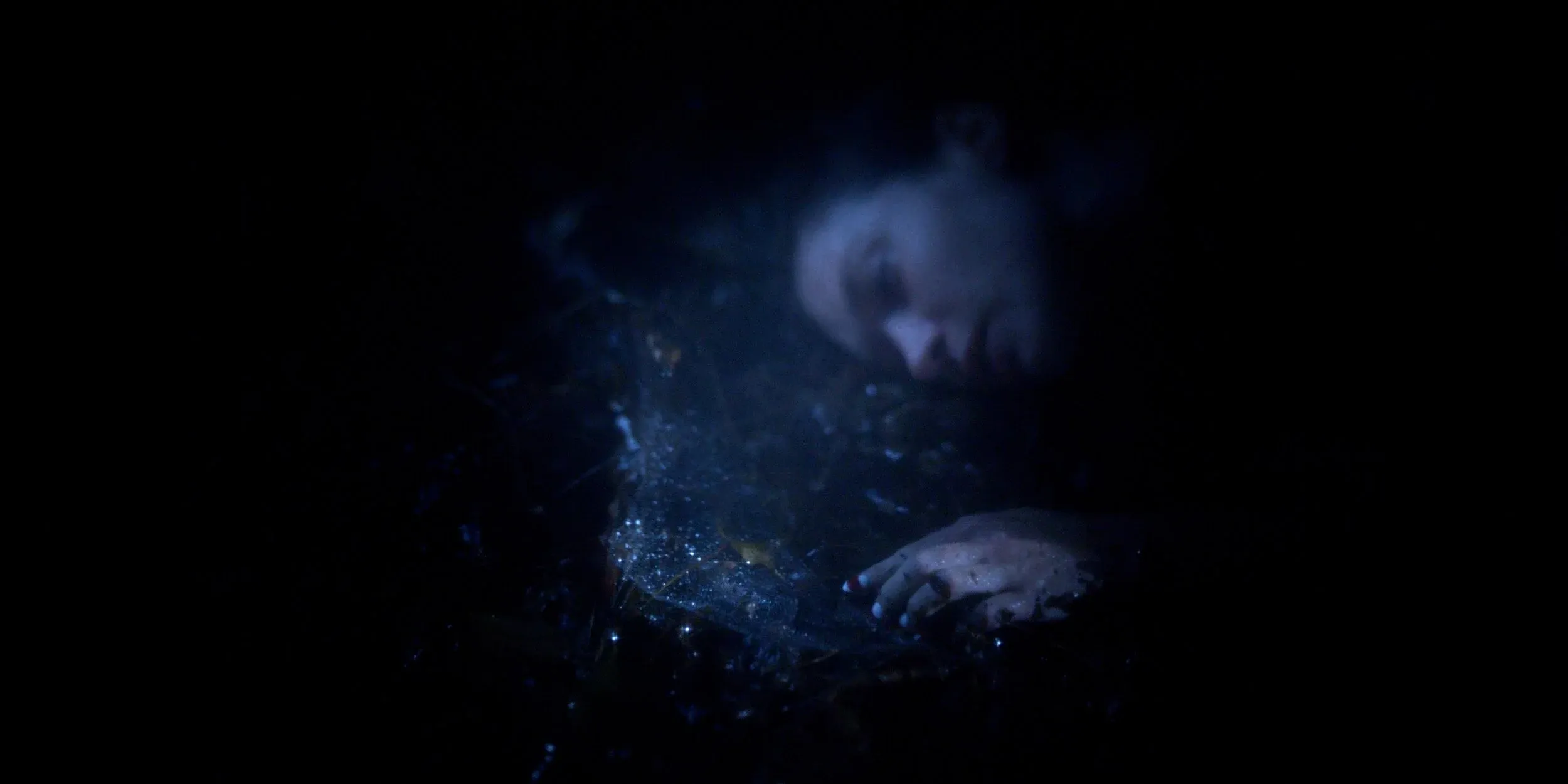
The effect is painterly, recalling the pastoral works of N.C. Wyeth filtered through the surreal dream logic of a director like David Lynch. This impressionistic approach turns the setting into a psychological space, where the open prairie symbolizes both freedom and an agoraphobic dread. The atmosphere is intensified by Alex Lane’s sound design, which blends naturalistic farm sounds with unsettling, almost supernatural undertones.
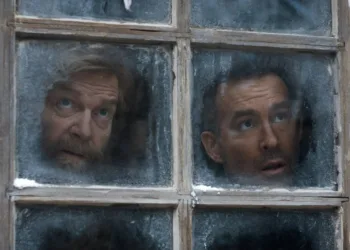
This tension is further amplified by a subtle gothic subplot involving a creature known as the “Hairy Man,” a piece of local folklore that externalizes the characters’ internal anxieties. The editing reinforces this subjective experience, using slow dissolves to visually merge characters and landscapes, making it unclear whose perspective we are inhabiting at any given moment.
The film’s deliberate, meditative pace forces the viewer to engage on a sensory level, experiencing the world as the characters do: as a beautiful, terrifying, and ultimately unknowable dream.
The Lingering Resonance of Disappearance
The cast navigates this challenging material with remarkable precision, delivering the poetic, monologue-heavy script as if it were a piece of chamber music. Peter Vack gives Richard a 1930s leading-man charm that is constantly undercut by a modern, intellectual neuroticism. Hannah Gross fully embodies Barbara’s ethereality, making her abstract longing feel palpable.

The film, however, belongs to Deragh Campbell as Martha. She conveys a universe of meaning through subtle physicality, beginning with a posture of “wilting recoil” that gradually gives way to a quiet, enigmatic strength. Her performance provides a necessary human anchor to the film’s abstract explorations of existence. These performances serve a story centered on the theme of disappearance, a concept with deep roots in the American mythos.
It speaks to the idea of vanishing into the vast frontier to erase one’s past, a dark inversion of the nation’s promise of self-reinvention. The film’s unconventional structure challenges a global audience to look beyond plot and embrace ambiguity.
Its refusal of easy resolutions aligns it with international “slow cinema,” which prioritizes mood and philosophical inquiry. The power of An Evening Song is in the haunting feeling it creates, a mystifying and resonant experience of existential drift that remains long after the screen goes dark.
An Evening Song (for three voices) is a 2023 drama film directed by Graham Swon. It premiered in France at the Festival international de Cinéma de Marseille on July 6, 2023, and in the United States on October 29, 2023.
Full Credits
Director: Graham Swon
Writers: Graham Swon
Producers and Executive Producers: Graham Swon, Lio Sigerson, Jeremy Ungar, Mustafa Uzuner
Cast: Deragh Campbell, Hannah Gross, Peter Vack
Director of Photography (Cinematographer): Barton Cortright
Editors: Graham Swon
Composer: Rachel Evans
The Review
An Evening Song (for three voices)
An Evening Song (for three voices) is a demanding piece of cinema that rewards patient viewers with a profound, lingering experience. It functions more as a moving painting or a piece of chamber music than a conventional film, using its impressionistic style to explore complex ideas about identity, art, and existence within an American context. While its deliberate ambiguity may not be for everyone, its masterful performances and haunting atmosphere make it a significant, unforgettable work of art.
PROS
- A unique, dreamlike visual style that perfectly captures the film's psychological mood.
- The entire cast is excellent, with Deragh Campbell delivering a particularly powerful and subtle performance.
- Explores profound themes of disappearance, identity, and consciousness with intelligence and nuance.
- Creates a haunting, unsettling, and completely immersive atmosphere.
CONS
- The deliberate, slow pacing can feel alienating to viewers accustomed to traditional narratives.
- The story is highly subjective and lacks a clear, conventional resolution, which may frustrate some.
- Its intellectual and artistic approach can create a distance between the film and the viewer.