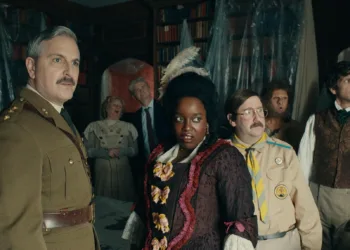
















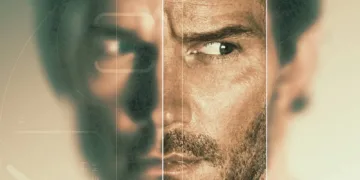













In Umata, the apocalypse has already happened, and people have responded by doing something almost quaint: they have started making movies. Damien Hauser’s Memory of Princess Mumbi imagines 2093 as an era living among the remains of technological excess.
A war in the 2070s followed mass depression and media addiction, technology was outlawed, and African kingdoms rose from the wreckage. Yet filmmaker Kuve still arrives with a camera, searching for survivors whose suffering can become his documentary. He expects trauma. The people smile instead.
That smile becomes one of the film’s sharpest images because Kuve and his collaborator Damien refuse to accept it. They use artificial intelligence to alter interview footage, darkening expressions and manufacturing the despair their project requires. Mumbi, played by Shandra Apondi, objects. The filmmakers have discovered people who survived history, then decided those survivors were expressing survival incorrectly. There is a strange sadness buried inside that joke. Cinema can preserve a face. It can falsify one just as easily.
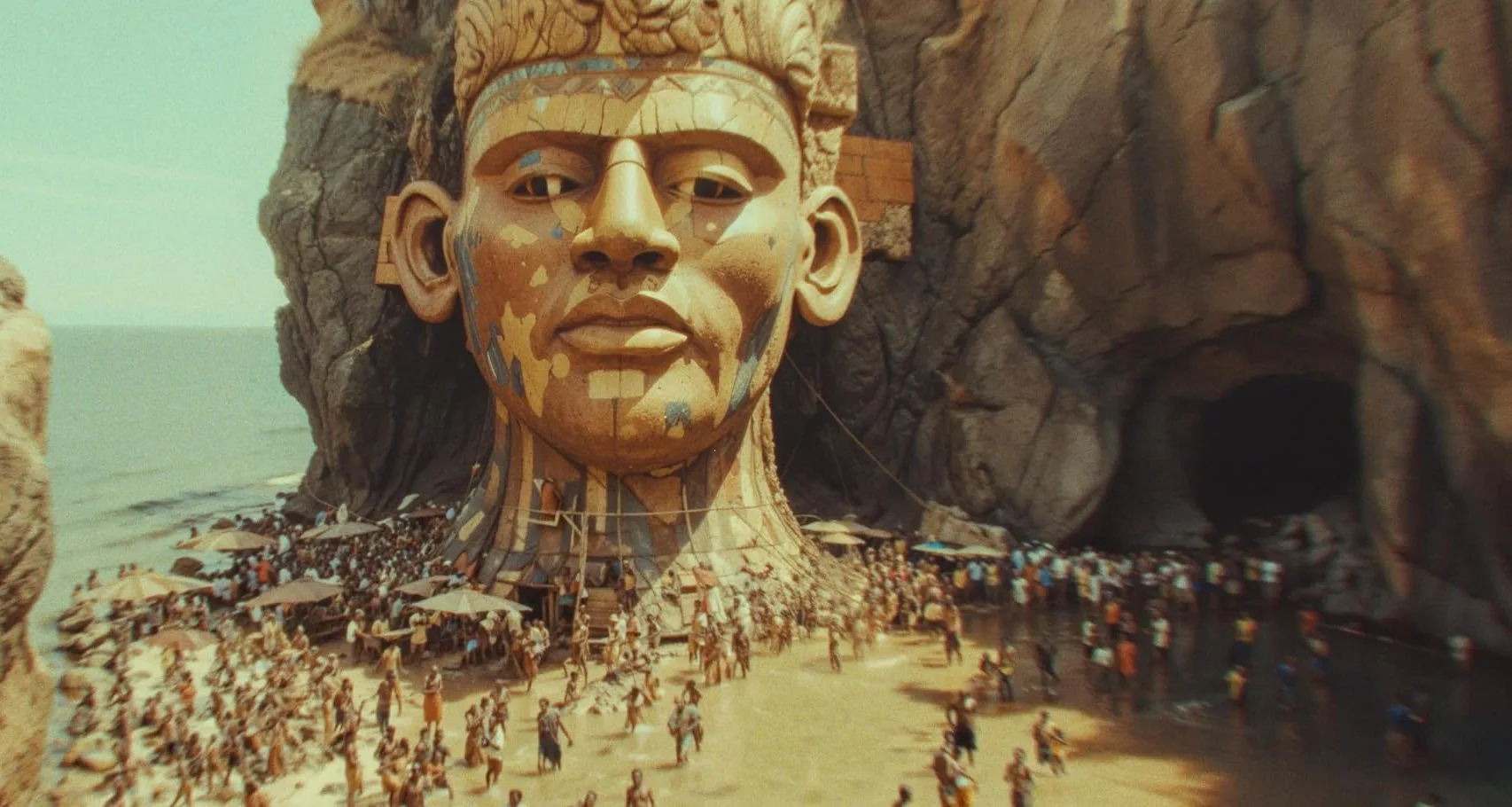
Hauser builds this future with the same technology his characters mistrust. AI-generated cities rise behind human bodies, often beautiful, sometimes visibly synthetic. Buildings stack upward with the logic of dreams. Colours glow with the exaggerated richness of an old epic, while occasional black-and-white passages seem to pull the film backward toward silent cinema. The future keeps remembering obsolete forms.
Love Inside the Edit
Mumbi enters Kuve’s production as an actress and gradually changes what the production itself is allowed to become. The documentary about depression begins slipping toward fiction. Rehearsals become flirtation. Interviews give way to performance. Kuve and Mumbi fall in love while another story waits patiently outside the frame: when Mumbi turns twenty-one, she is expected to marry Prince.
Their relationship works best in the smaller exchanges, when Apondi and Joseph are allowed to behave like two young people rather than figures trapped inside Hauser’s architecture. Apondi carries herself with an ease that makes Mumbi’s objections to Kuve feel spontaneous rather than written toward an argument. Joseph answers her with an exposed, slightly clumsy sincerity. Their scenes have enough looseness to suggest improvisation, and that looseness gives the film oxygen. Then the story begins folding in upon itself.
Kuve and Mumbi flee, Damien finishes the film without them, and Mumbi discovers that her own face has been replaced using AI. The cruelty is almost absurdly precise. A technology capable of preserving her image has removed her from that image.
Years later, Kuve encounters Mumbi again. She has married Prince, and the enthusiasm that once animated her has thinned into something harder to name. Prince joins the film production himself, transforming a private wound into another performance. Kuve eventually responds by making yet another film, this time about Mumbi.
The layers accumulate until authorship starts to resemble possession. Everyone keeps filming Mumbi, rewriting Mumbi, casting Mumbi, remembering Mumbi. The woman herself risks disappearing beneath the archive.
The Machine That Makes the Dream Possible
Hauser’s use of AI is impossible to separate from what the film says about it. That contradiction gives Memory of Princess Mumbi much of its unease. The artificial landscapes allow a tiny production to imagine kingdoms, monumental skylines and impossible spaces that its resources could never physically construct.
Hauser does not always hide the seams. Some backgrounds have the smooth strangeness associated with generated imagery. Certain contours appear too perfect, surfaces too dreamlike. Human figures occasionally seem to occupy spaces that belong to another reality.
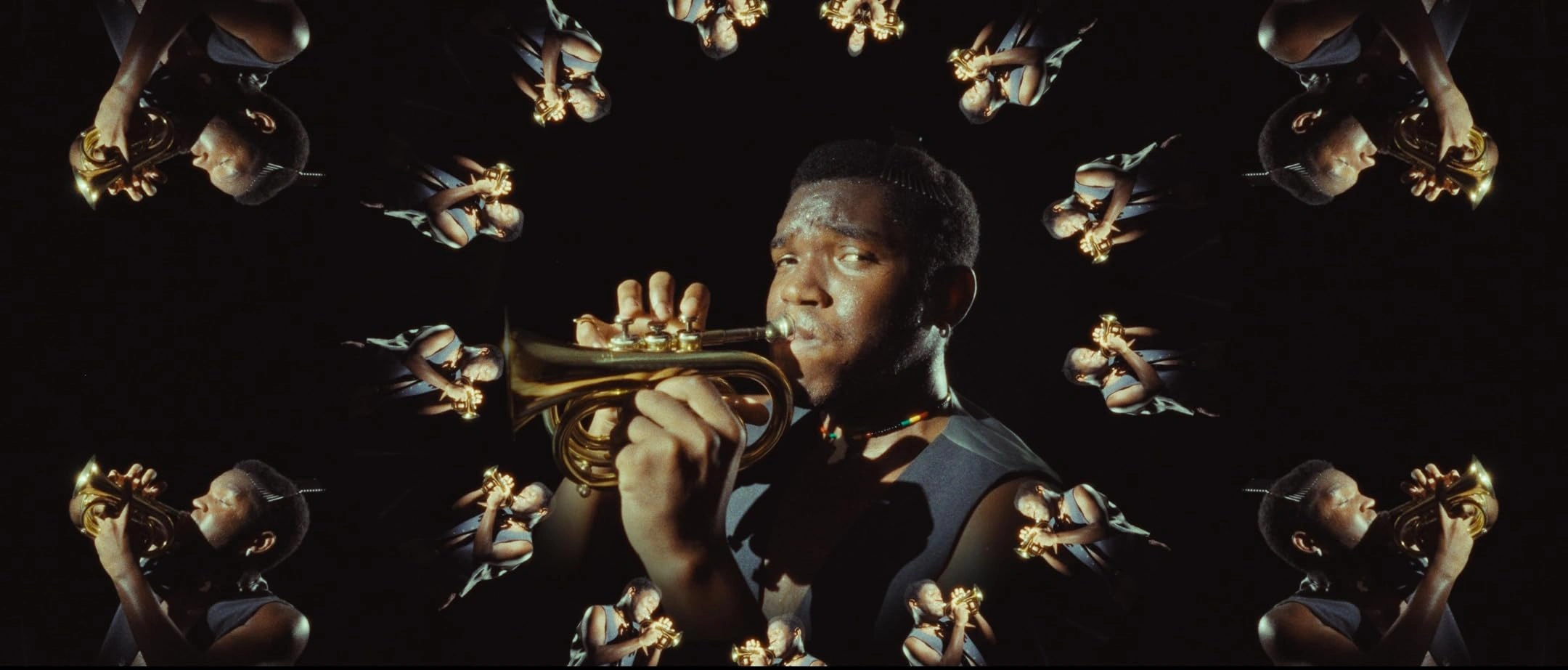
Yet hiding those fractures might have weakened the film. Umata should feel unstable. Its people inhabit a civilisation created after technology supposedly destroyed the old one, while their story reaches us through technology again. They watch futuristic films on devices that resemble relics. Silent-film imagery sits beside synthetic vistas. Kenyan music and a choreographed musical sequence erupt inside a science-fiction framework that keeps changing its own rules.
The paradox grows darker whenever Kuve uses AI to control meaning. Changing cheerful interview subjects into mournful ones turns editing into an ethical violation. Replacing Mumbi’s face extends the same impulse. The machine does what human filmmakers ask of it. The disturbing part is how quickly they learn to ask.
Hauser never resolves this argument, and resolution would probably diminish it. His own film exists partly because the technology gives a young filmmaker access to images once guarded by enormous budgets. The same tool can erase labour, identity and truth. That tension remains visible in every synthetic horizon.
Cinema Refusing Permission
The most revealing confrontation arrives when Mumbi rejects the documentary crew’s hunger for misery. Kuve and Damien want wounded subjects because pain fits the film they already imagined. Mumbi pushes toward another possibility: make something people in this place might actually want to watch.
From there, Hauser behaves as though every cinematic form has become available at once. Mockumentary slips into romance. Romance gives way to speculative history. Musical performance interrupts realism. Animation, fictional biographies and films nested inside other films keep arriving without asking permission from a neat genre label.
Some of it buckles. The time jumps weaken the romance, and Prince enters a relationship already carrying too many narrative functions. The stacked productions can make cause and effect difficult to track. There are moments when the film seems to lose Kuve and Mumbi inside its fascination with filmmaking itself. Apondi keeps finding them.
Watch her during Mumbi’s early arguments with Kuve, then compare that brightness with the later version of the character he meets after marriage. The change is carried through posture and diminished energy rather than some grand declaration. Against Hauser’s enormous artificial cities, that quiet human contraction becomes painful.
Perhaps that is why the film’s roughness feels strangely appropriate. Its machines can invent kingdoms in seconds. Its people remain difficult, contradictory, resistant to revision. Cinema may keep changing their faces. They keep trying to remain themselves.
Memory of Princess Mumbi premiered at the 2025 NBO Film Festival. Set in a retro-futuristic version of Africa in 2093, the film follows a filmmaker named Kuve as he navigates a complex love triangle involving an aspiring actress and a prince, ultimately searching for peace within the remnants of a speculative war.
Where to Watch Memory of Princess Mumbi (2026) Online


Full Credits
Title: Memory of Princess Mumbi
Release date: 2025
Running time: 88 minutes
Director: Damien Hauser
Writers: Damien Hauser
Cast: Abraham Joseph, Shandra Apondi
The Review
Memory of Princess Mumbi
Memory of Princess Mumbi feels like cinema dreaming past its own means. Damien Hauser lets artificial landscapes shimmer with visible unreality while Shandra Apondi and Ibrahim Joseph keep pulling the film back toward touch, longing, disappointment, and human error. Its nested films and shifting timelines sometimes loosen into confusion, and the romance cannot always carry the weight placed upon it. Yet the roughness belongs to a work alive with curiosity. Here, technology creates beauty while quietly threatening the people whose stories it claims to preserve.
PROS
- Shandra Apondi’s magnetic performance
- Remarkably imaginative production design
- Rich Kenyan cultural texture
- Thoughtful AI contradictions
- Fearless formal experimentation
CONS
- Occasionally confusing narrative layers
- Uneven central romance
- Visible AI limitations
- Some abrupt structural transitions