
















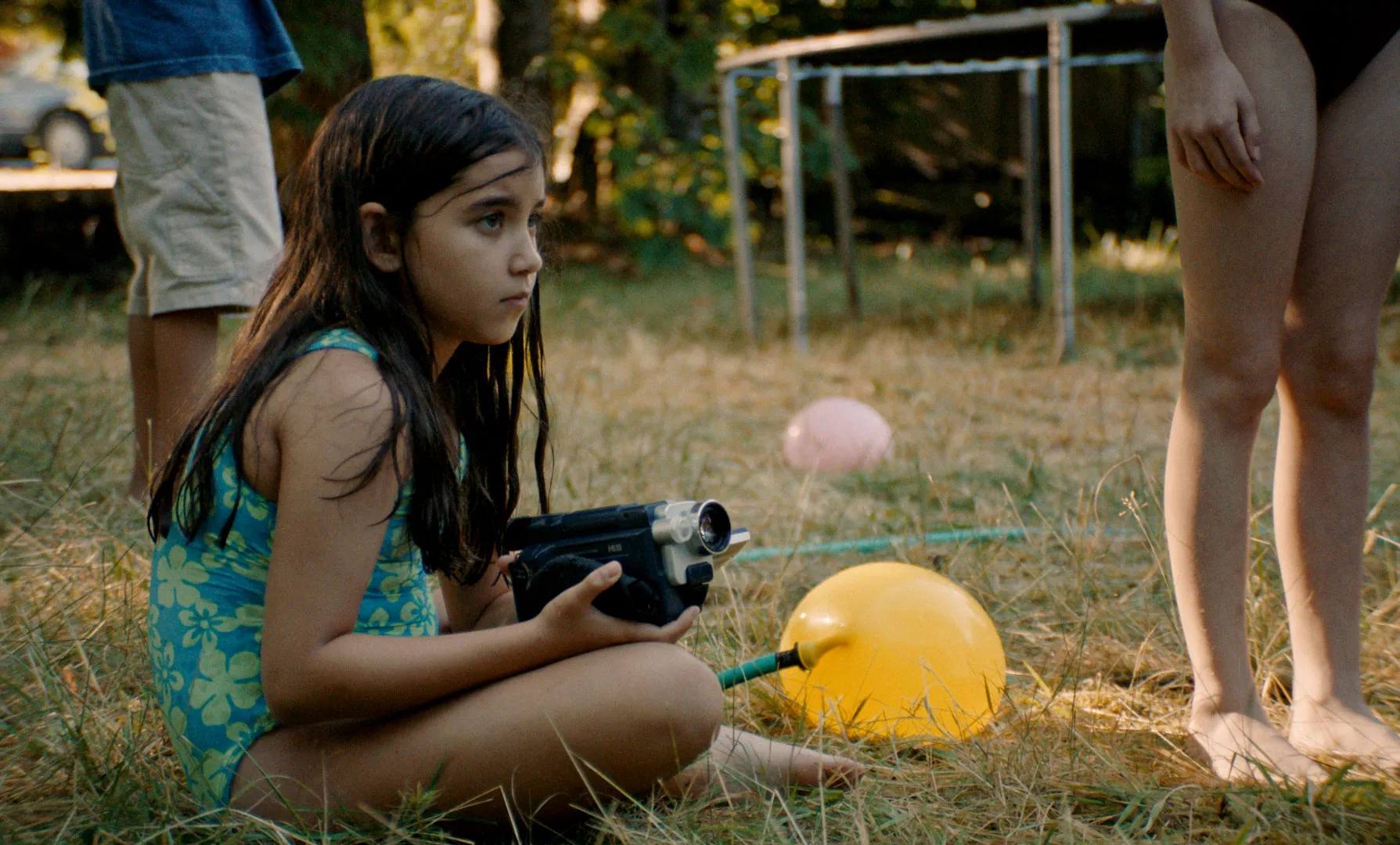

The world of Blue Heron is built from the sounds you almost forget. The hum of a refrigerator, the digital bleeps of a Gameboy, a lawnmower droning in the distance—these ambient noises form the texture of memory in Sophy Romvari’s feature debut. We are introduced to a Hungarian immigrant family settling into a new home on Vancouver Island in the late 1990s.
Their attempt to build a normal life is unsettled by a quiet, persistent tension. This anxiety centers on Jeremy, the teenage stepbrother, an enigmatic figure whose withdrawn nature and unpredictable behavior create ripples of concern throughout the household. The initial story is filtered through the innocent eyes of his youngest sister, Sasha. Her perspective, free of adult judgment, shapes our early understanding of a family drama where the most significant events happen in the periphery, just out of focus.
Observing from the Outside
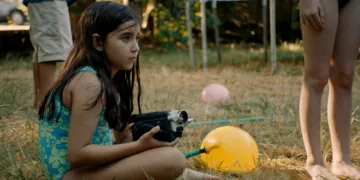
The film’s first half commits to Sasha’s limited viewpoint with remarkable discipline. Her acceptance of her brother’s strangeness, articulated through the wonderfully unaffected performance of Eylul Guven, stands in stark contrast to her parents’ concealed panic. For them, the pressure to assimilate in a new country magnifies every problem; Jeremy’s behavior is not just a family issue but a potential source of social shame that threatens their fragile standing.
They retreat into their native Hungarian to discuss their fears, creating a linguistic barrier that sequesters the children from their anxiety. Jeremy, played with a receding stillness by Edik Beddoes, is almost a phantom in his own home. He is a character defined by distance. A rare moment of connection, his gift of a small blue heron trinket to Sasha, is a fragile gesture of affection in a sea of disconnect.
Romvari’s cinematic technique reinforces this separation with a visual grammar reminiscent of the observational patience seen in Indian Parallel Cinema. The camera is often positioned outside a window or lingering in a doorway, observing the family with an almost ethnographic detachment.
This framing turns the audience into watchers, mirroring Sasha’s own position as a witness to things she cannot fully process. Cinematographer Maya Bankovic uses long-lens shots that flatten the space and isolate figures within the frame. Sporadic, hesitant zooms feel less like a confident directorial choice and more like a desperate attempt to breach the emotional distance, to get closer to a subject who internally recedes the more he is watched.
Also Read




When the Filmmaker Becomes the Detective
The film fractures its own timeline with a sudden, disorienting leap 20 years into the future. Here, an adult Sasha (Amy Zimmer), now a filmmaker herself, shifts from passive observer to active investigator. This structural pivot is where Blue Heron shows its most inventive qualities, joining a global cinematic conversation around auto-fiction where artists like Sarah Polley use the medium to dissect their own histories.
Sasha turns her camera on her past, attempting to assemble the puzzle of her brother’s tragically curtailed life. The film begins to blend genres with disarming sincerity. One sequence, which feels like pure documentary, shows Sasha consulting with real-life social workers. She presents them with Jeremy’s old case files, and their clinical, detached language about diagnoses and prognoses creates a chilling contrast to the deep, messy, and personal grief the family experienced.
The search yields no simple answers. The film’s most striking formal device involves a collapse of time, where adult Sasha’s present-day understanding seeps into her childhood memories. She imagines herself back in her childhood home, able to see her parents not as infallible guardians but as worried, helpless people.
This blending of reality, memory, and imagination underscores the film’s central idea: the past is not a fixed point but a landscape that is constantly reshaped by our present knowledge. This self-reflexive exploration of memory and recorded images finds a kinship with the work of Canadian-Armenian director Atom Egoyan, whose films also grapple with how technology mediates and complicates our relationship with personal and cultural history.
The Catharsis of the Unanswered Question
Blue Heron uses its unconventional form as a language for grief. The mix of fiction, documentary, and personal reflection is a necessary and deeply honest method for exploring the fragmented nature of memory. The film’s considerable power comes from its emotional restraint. In a manner that recalls the quiet devastation of a Satyajit Ray film, Romvari avoids melodrama.
She trusts the audience to feel the weight of what is left unsaid and unseen. The film is more potent because it respects the mystery of Jeremy’s pain and the family’s silent sorrow, never attempting to pathologize him with a simple explanation. This approach transforms the film into a meditation on cinema itself. It questions the medium’s ability to truly capture a person or reclaim a lost moment, even as it serves as a powerful tool for seeking catharsis.
It functions as a work of personal archaeology, a delicate excavation of the past where the filmmaker digs for truth while knowing the act of digging can alter what is found. The film offers no easy resolutions or grand emotional releases. Instead, it finds its profound feeling in the gaps and silences of a family’s history. It suggests that peace is found not in getting answers, but in learning to live with the questions. The result is a shared experience of looking back, one that feels both scorchingly private and universally understood.
Blue Heron is a Canadian-Hungarian drama film directed by Sophy Romvari. It premiered at the 78th Locarno Film Festival in Switzerland on August 8, 2025, and is also scheduled to be screened in the Centrepiece program at the 2025 Toronto International Film Festival. The film is in English and Hungarian.
Full Credits
Director: Sophy Romvari
Writers: Sophy Romvari
Producers and Executive Producers: Ryan Bobkin, Sara Wylie, Sophy Romvari, Gábor Osváth (Producers); Riel Roch Decter, Lauren Melinda, Neil Champagne, Veronica Diaferia, Sara Eolin, Jasmin Karibzhanova, Sam Sutcliffe (Executive Producers)
Cast: Eylul Guven, Iringó Réti, Ádám Tompa, Edik Beddoes, Amy Zimmer, Liam Serg, Preston Drabble
Director of Photography (Cinematographer): Maya Bankovic
Editors: Kurt Walker
The Review
Blue Heron
Sophy Romvari's Blue Heron is a masterful work of personal filmmaking. It uses an inventive blend of fiction and documentary to explore the elusive nature of memory and grief. With powerful emotional restraint and a patient, observant eye, the film forgoes easy answers, instead finding a profound catharsis in the act of questioning the past. It is a deeply intelligent and moving cinematic inquiry into a family's silent sorrow, marking a significant achievement in autobiographical cinema.
PROS
- An inventive structure that thoughtfully blends fiction and documentary elements.
- Emotionally powerful due to its deliberate restraint and avoidance of melodrama.
- Intelligent and deep exploration of complex themes like memory, grief, and family dynamics.
- Patient, observant cinematography that creates a distinct and meaningful visual language.
- Strong, naturalistic performances that feel authentic.
CONS
- The deliberately slow pace and quiet tone may not appeal to all viewers.
- Its non-linear, fragmented narrative could be challenging for those accustomed to conventional storytelling.
- The lack of clear resolutions is a central artistic choice but might leave some unsatisfied.