























A life can pivot on a single glance. In a crowded concert hall, a universe contracts to the space between two strangers, Fleur and Julian. Their first look is not an introduction but a recognition, an event horizon from which nothing that follows can escape.
This initial spark ignites a romance of profound velocity, moving from intoxicating discovery to the quiet certainty of engagement. From this personal union blooms an idea of astonishing scope: to marry in every country that would legally recognize their bond.
“Project 22” is born, a plan that is at once a grand romantic gesture and a defiant political act. They set out to draw a map of their love across the globe, charting a course through the world’s accepted territories of devotion. The journey begins with the pure, unburdened light of possibility, before any shadow has fallen across their path.
The Political Body, The Private Heart
Every intimate act can become a public statement when performed under a hostile gaze. The couple’s mission transforms their private commitment into a form of protest, a repeated ceremony meant to challenge the silence of nations that deny their union. Their plan is an attempt to weaponize joy against an unseen architecture of prejudice. The film quietly examines the subtle schism in their shared purpose.
Fleur, the journalist, understands the narrative power of their undertaking; she sees a story that needs to be written upon the world, a public text of their private truth. For her, the project is a piece of advocacy, a spreadsheet of logistics and destinations. Julian’s desire seems simpler, a wish to sanctify their love without the apparatus of a global campaign. She is the quiet heart of the mission, while Fleur is its articulate voice. This tension reveals a deeper question about resistance and performance.
Does the act of documenting, of curating one’s life for an audience, fundamentally alter the experience itself? Can a personal truth, when repurposed for a political cause, retain its original, unmediated purity? Their journey shows how love becomes a form of defiance, a quiet insistence on existence in a world that often prefers erasure.
Also Read






Memory’s Fractured Architecture
A story of loss is never told in a straight line. Director Cato Kusters constructs the film not as a linear narrative but as a reflection of memory’s own chaotic logic, rejecting a simple path from cause to effect. The structure jumps across time, mirroring the way the past erupts into the present, a ghost at the feast of the now. Grief shatters chronology, and the film’s form embodies that fragmentation.
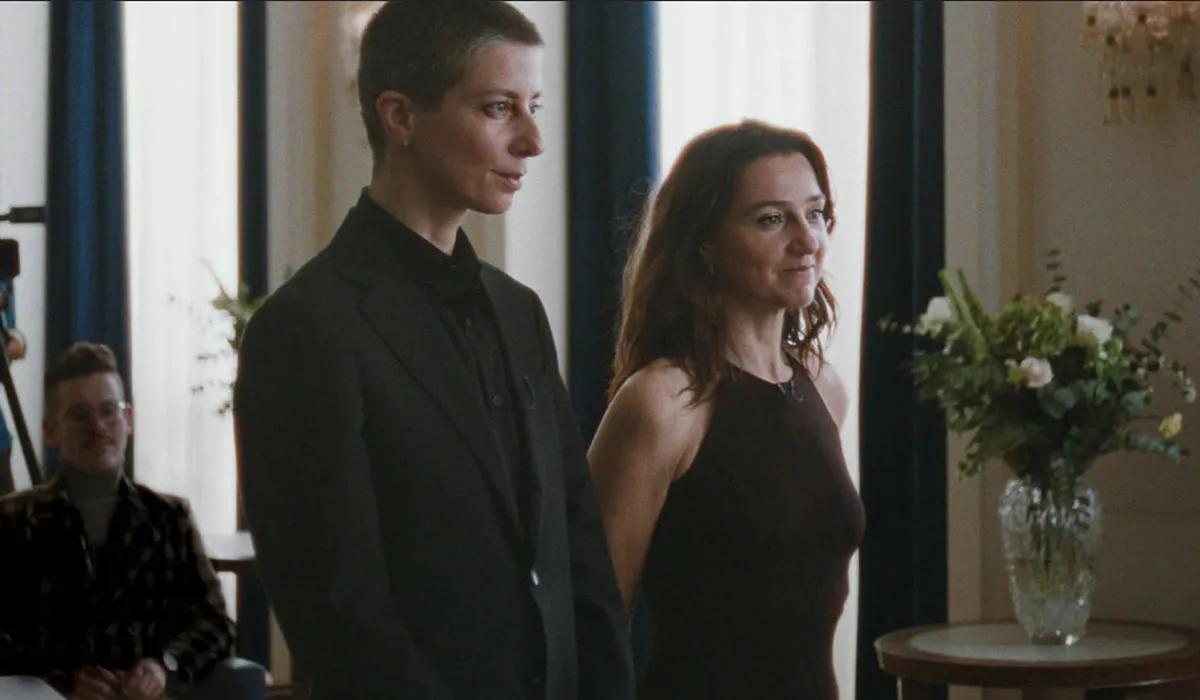
The visual style reinforces this idea, contrasting the crisp, often stark cinematography of Michel Rosendaal with the grainy, unstable images from a handheld camcorder. This found footage, intended to create a sense of raw intimacy, sometimes feels like an artifact from a ruin, a piece of evidence of a life that was. Through this formal complexity, the performances provide a necessary, human anchor.
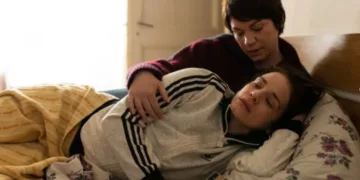
Nina Meurisse gives Fleur a fierce intelligence that splinters into palpable anguish, her control cracking to reveal the abyss beneath. Laurence Roothooft embodies Julian with a startling naturalism, her gentle strength and unguarded smile providing the film’s moral gravity.
Kusters’ direction hones in on the smallest expressions, allowing their believable chemistry to convey entire histories of feeling without words. Their connection feels less like a performance and more like a captured truth, the film’s fragile, beating core.
An Archive of Absence
The world’s indifference is random; the body’s betrayal is absolute. Julian’s illness arrives as a brutal intrusion of biological chance, halting their meticulously planned quest for meaning. Their project, an exercise of human will against political boundaries, is rendered powerless by the amoral chaos of cellular decay.
The film then turns its gaze to what remains after a life is extinguished, exploring the desperate human impulse to build a bulwark against nothingness. Fleur’s grief becomes a frantic effort of preservation, her attempt to recover corrupted files on a hard drive a metaphor for the impossible task of holding on to a person who is gone.
We see her clinging to the remnants of their plan, a refusal to accept the finality of absence. The film quietly questions the ethics of this impulse, suggesting a line where memorializing a loved one’s suffering risks becoming a performance of hardship.
This story, rooted in fact, does not offer the comfort of fiction. It reminds us that love does not conquer all. It portrays a beautiful, doomed endeavor, leaving us with a record of its incompletion. The legacy is not the finished project, but the archive of their attempt, a monument to a love interrupted but not erased.
The film “Julian” premiered at the Toronto International Film Festival on September 6, 2025, and is slated for a wider release on October 29, 2025. Information on where to watch the film on streaming services has not yet been announced.
Full Credits
The Review
Julian
Julian is a formally ambitious and emotionally shattering film that meditates on the intersection of love, mortality, and political will. Anchored by two superb, deeply felt performances, it rejects simple narrative comfort in favor of a structure that mirrors the chaotic nature of memory itself. While its fragmented style can sometimes keep the viewer at a distance, the film’s intellectual and emotional honesty is profound. It is a haunting examination of what it means to build a legacy against the indifferent forces of time and biology, a story that lingers long after its tragic end.
PROS
- Two powerful and authentic central performances.
- Mature, sensitive direction that handles difficult themes with grace.
- A thought-provoking exploration of love as a form of political defiance.
- The believable and magnetic chemistry between the lead actresses.
CONS
- Its non-linear structure occasionally disrupts the film's emotional momentum.
- The use of handheld footage may feel distracting to some viewers.
- The intensely sad subject matter is unflinching and could be difficult for some audiences.