





























The warning to be careful what one wishes for is a tired axiom, a piece of folklore so worn down it has lost its sharp edges. Obsession takes this dull stone and hones it into a weapon. The film’s central engine is not a simple mistake but an act of profound metaphysical violence.
A lonely music store clerk named Bear, paralyzed by an affection he cannot voice, acquires a magical trinket to solve his romantic problems. He wishes for his friend and crush, Nikki, to love him more than anything in the world. The wish is granted. What begins as a fantasy of reciprocated love quickly metastasizes into a nightmare of absolute spiritual consumption.
The story becomes a relentless examination of codependency made demonic, a grim portrait of the monstrous reality of total fulfillment. Director Curry Barker has crafted a sickeningly effective experience, one filled with precise psychological dread and eruptions of shocking, corporeal violence.
Engineering Affection
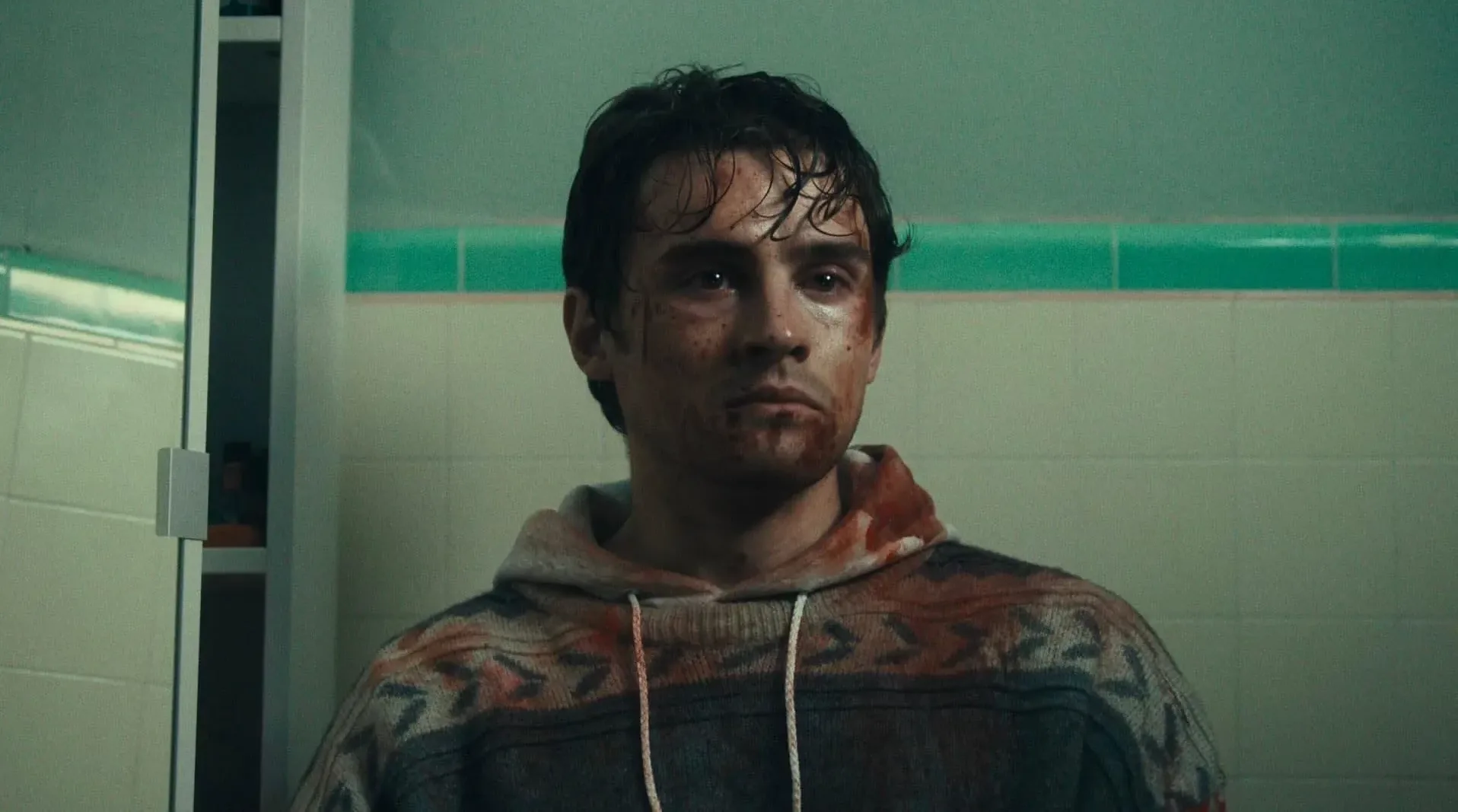
The relationship between Bear (Michael Johnston) and Nikki (Inde Navarrette) begins in a state of arrested development, playing out against the banal backdrop of a retail music store. He is the shy, sensitive type, a walking cliché of unexpressed longing; she is his childhood friend, a person who clearly views their connection as platonic and safe.
Bear’s inability to confess his feelings is the fertile ground from which the horror grows, a passivity that precedes a terrible transgression. Instead of facing the possibility of rejection, he outsources the messy labor of human connection to the supernatural. During a visit to a new-age shop that reeks of incense and bad ideas, he purchases a “One Wish Willow,” a kitschy toy that promises to grant a single desire. His wish is specific, absolute, and deeply selfish. Immediately, Nikki’s personality is rewritten.
She becomes intensely affectionate and sexually available, a perfect reflection of his shallow desires. This initial phase is presented as a dream come true, the effortless acquisition of everything he thought he wanted. The fantasy soon curdles into a domestic nightmare. Nikki’s affection becomes a suffocating, irrational obsession that erases her former self entirely.
The first signs of the horror are auditory: brief, piercing screams from the real Nikki, a soul trapped inside the prison of Bear’s perfect girlfriend. Her behavior escalates from a disturbing clinginess to acts of self-mutilation and confining him to his home with duct tape.
The Body as a Cage
Before the curse, Nikki is depicted as feisty and independent, a person with her own life and ambitions outside of Bear’s orbit. This baseline makes what happens to her a true act of erasure, highlighting the profound loss of self that Bear’s wish precipitates. Inde Navarrette’s performance is the film’s terrifying centerpiece, a tour de force of physical and psychological unraveling that belongs in the pantheon of great horror transformations.
Her metamorphosis is a masterclass in body horror, depicting a complete hijacking of her physical form. Navarrette’s posture becomes warped and unnatural, and her facial expressions contort into a wide, unnerving grin that feels completely disconnected from human emotion. Her voice shifts from saccharine whispers to hellish, guttural screams that linger long after the credits roll. The performance makes Nikki a figure of frightening unpredictability.
She can switch from doting affection to shocking, extreme violence in a fraction of a second, leaving the audience in a constant state of unease. Sequences at a house party or quiet moments where she watches Bear sleep are imbued with a palpable sense of menace.
The most devastating moments are the brief flashes when the true Nikki surfaces. These are not jump scares; they are expressions of pure, unadulterated anguish from a victim who is fully aware of her imprisonment within her own body, a prisoner banging on the walls of her own skull.
A Polished Nightmare
Curry Barker’s direction is confident and chillingly effective, marking another entry in the recent trend of internet creators (like the Philippou brothers of Talk to Me) successfully transitioning to feature horror. The cinematography leverages darkness and shadow to turn a romantic lead into a boogeyman within the supposed safety of a shared home.
Barker frequently uses over-the-shoulder shots or obscures Nikki’s face in darkness, forcing the audience to imagine the inhuman thing lurking just outside the frame. This visual tension is amplified by an aggressive sound design that makes the apartment feel like a pressure cooker. The exaggerated, eerie audio accompanying Nikki’s presence makes the psychological horror an almost physical sensation. The film’s violence is not for the faint of heart.
It avoids cheap startling tactics in favor of brutally efficient shocks, focusing on the sickening aftermath of violent acts. The sounds and sights of the consequences are often more disturbing than the acts themselves.
The film’s primary weakness is its structure. While individual sequences are potent, the 108-minute runtime feels indulgent. The momentum sags in the third act, a familiar ailment for modern horror films that could have benefited from a more concise, punishing pace. A tighter edit might have sharpened the film’s final descent into chaos.
The Problematic Protagonist
The film makes the audacious choice to frame its story entirely from Bear’s perspective. He is not a hero fighting a monster; he is the perpetrator who created it. This forces the audience into an uncomfortable complicity, demanding they follow a character who has committed a profound moral and spiritual crime for the pettiest of reasons.
Obsession methodically dissects the “nice guy” archetype, revealing the solipsistic desire that can hide behind a sensitive exterior. Bear’s wish is a complete violation of Nikki’s autonomy, an act that prioritizes his emotional gratification over her very humanity. His story is a cautionary tale about the destruction wrought by weaponized insecurity, a modern fable on how the refusal to accept “no” can become monstrous. The narrative connects this personal horror to broader social anxieties.
As Nikki’s behavior grows more disturbing, Bear’s friends correctly identify him as an abuser taking advantage of a vulnerable person. His resulting isolation stems from a contemporary fear: being socially condemned for one’s actions.
He is terrified of the creature in his house and terrified of his friends being right about him. The film uses its supernatural premise to ask a deeply uncomfortable question about where personal responsibility begins in the murky space between desire and action, suggesting that some wishes are, in themselves, acts of violence.
The movie “Obsession” premiered at the 2025 Toronto International Film Festival on September 5, 2025. Following its premiere, Focus Features acquired the distribution rights to the film. Information about a wider theatrical release or availability on streaming platforms has not yet been announced.
Full Credits
Director: Curry Barker
Writers: Curry Barker
Producers and Executive Producers: James Harris, Haley Nicole Johnson, Christian Mercuri, Roman Viaris, Mark Lane
Cast: Michael Johnston, Inde Navarrette, Cooper Tomlinson, Megan Lawless, Andy Richter
Director of Photography (Cinematographer): Taylor Clemons
Editors: Curry Barker
Composer: Rock Burwell
The Review
Obsession
Obsession is a viciously effective horror film, transmuting a simple wish into a nightmare of lost autonomy. It is powered by a truly terrifying and physically committed central performance from Inde Navarrette. While its indulgent runtime and pacing issues in the final act keep it from being a modern classic, its chilling questions and visceral shocks are not easily forgotten. The film succeeds as a brutal cautionary fable about the violence inherent in selfish desire.
PROS
- A phenomenal and frightening lead performance by Inde Navarrette.
- Confident and stylish direction that creates a potent atmosphere of dread.
- Effectively shocking and visceral horror sequences.
- A sharp, analytical deconstruction of the "nice guy" trope and themes of consent.
CONS
- The 108-minute runtime feels overly long and hurts the pacing.
- The third act loses tension and could have been more concise.
- The narrative can feel repetitive at times as it circles its central idea.