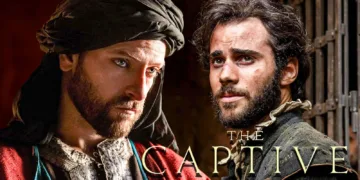



























Before the windmills, there was the man. Alejandro Amenábar’s The Captive shears Miguel de Cervantes of his literary mythos, recasting him as a young, desperate soldier trapped in the gears of history. This is not the study of a celebrated author; it is a granular portrait of a man cornered.
We are plunged into the sun-scorched labyrinth of 16th-century Algiers, a brutal marketplace where freedom is the highest-priced commodity. Here, a captive’s life is a flickering candle. Cervantes, armed with a useless limb and a sharp mind, learns that his only true currency is the story.
He must spin tales to survive, a task that draws the unnerving attention of his captor, the formidable governor Hasan. Their ensuing relationship becomes the film’s dark, ambiguous heart, an imaginative leap into a chapter of history where the ink has long since dried, leaving only speculation.
A Tale for a Tyrant
The film posits that narrative is not merely an escape; it is a weapon and a shield. Cervantes begins by weaving stories for his fellow captives, simple threads of hope in a lightless space. The camera frames these moments with an almost theatrical intimacy, the faces of hardened men illuminated by the glow of a shared fiction, the sound design isolating Cervantes’s voice from the ambient despair.
This talent soon becomes a command performance for Hasan, a Scheherazade dynamic played for the highest stakes. It is here the film’s visual grammar becomes most compelling. Amenábar uses elegant dissolves and clever match cuts to collapse the space between Cervantes’s narrated fictions and the prison’s grim reality.
An imagined escape across rooftops flows seamlessly into a shot of cell bars, purposefully disorienting the viewer and mirroring the protagonist’s own psychological flight. This is an act of existential defiance, the creation of a private reality as a bulwark against annihilation. He is not just telling stories; he is authoring a self that can withstand his circumstances.
Less successful are the on-the-nose allusions to his future masterpiece; the two ransom-collecting friars appear as if they have wandered directly out of a Gustave Doré illustration. This wink to the audience feels a touch too convenient, momentarily breaking the carefully constructed tension by reminding us that our hero’s survival is a foregone conclusion.
A Dangerous Dance – Character and Performance
The film’s core is a psychological duel, a tense pas de deux between prisoner and warden, shot with the claustrophobic intensity of a classic noir interrogation. Julio Peña portrays Cervantes with a wiry intelligence, his arc tracing the path from frightened soldier to calculating artist. His vulnerability slowly hardens into a tool of manipulation.
We watch him learn to weaponize his charisma, a man discovering the power he wields even in chains. His performance is a study in calculated submission, a tightrope walk of appeasement and quiet rebellion. Against him, Alessandro Borghi offers a monumental Hasan, a figure of sophisticated cruelty. Borghi avoids the trap of the simple sadist, presenting a tyrant who is also a connoisseur of art, a man intrigued by his prisoner’s mind before his body.
His gaze is both an act of possession and a sign of his own intellectual captivity. Their scenes together hum with the charge of a high-stakes interrogation, a seduction built on power, intellect, and profound moral ambiguity. Amenábar’s camera often frames them in tight two-shots, forcing the audience into their shared, perilous space.
Around them, the supporting cast of captives forms a chorus of weathered faith and simmering despair. Figures like the hypocritical priest Blanco de Paz are not mere set dressing; they represent the spectrum of moral compromise, the various ways a soul can break or bend under pressure.
An Ornate, Troublesome Fable
Amenábar’s commitment to aesthetic polish is undeniable, extending even to the film’s score, which he also composed. The music subtly shifts from tense, minimalist strings in the prison to more lyrical arrangements during the storytelling, guiding the audience’s emotional journey. The film is a handsome creation, with Juan Pedro De Gaspar’s production design rendering a tactile, immersive Algiers.
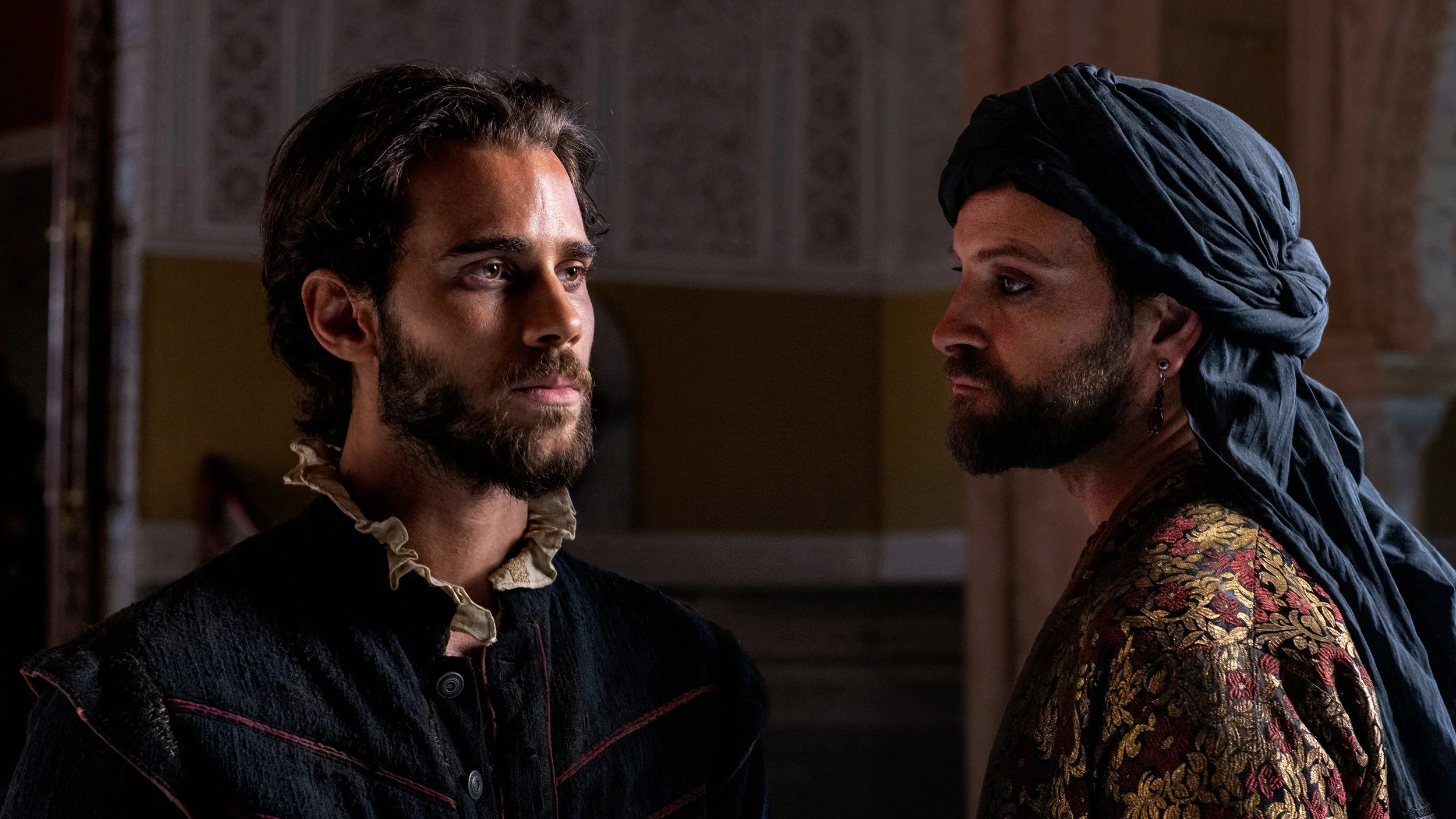
Cinematographer Alex Catalán lenses the city’s exteriors with a hazy, golden light that contrasts sharply with the expressionistic shadows of the prison interiors. Yet, this visual richness serves a deeply speculative narrative. The film’s boldest stroke, its depiction of a homoerotic relationship between Cervantes and Hasan, transforms a historical rumor into the story’s central pillar. This choice creates a compelling exploration of power dynamics, yet it threatens to become the film’s sole preoccupation.
At times, the depiction of Algiers itself leans toward a polished exoticism, a beautifully curated vision of the “other” that serves the narrative’s needs while sidestepping messier truths. This is a deliberate, if problematic, choice. The film is not a historical document but an ornate fable, one less concerned with the facts of a life and more with the fundamental truth that we are all captives of the stories we tell ourselves to survive.
The Captive is a 2025 adventure drama film directed by Alejandro Amenábar. The movie, which premiered at the Toronto International Film Festival on September 7, 2025, is a Spanish-Italian co-production that tells the story of Miguel de Cervantes’ time in captivity in Algiers. It is scheduled to be released in Spain on September 12, 2025, and will also be available for streaming on Netflix at a later date.
Full Credits
Director: Alejandro Amenábar
Writers: Alejandro Amenábar, Alejandro Hernández
Producers: Alejandro Amenábar, Fernando Bovaira, Simón de Santiago, Urko Errazquin
Cast: Julio Peña, Alessandro Borghi, Miguel Rellán, Fernando Tejero, Luis Callejo, José Manuel Poga, Roberto Álamo, Albert Salazar, Juanma Muniagurria, César Sarachu, Jorge Asín, Mohamed Said, Walid Charaf, Luna Berroa, Khaled Kouka
Director of Photography: Álex Catalán
Editors: Carolina Martínez Urbina
Composer: Alejandro Amenábar
The Review
The Captive
Alejandro Amenábar's The Captive is a visually sumptuous and intellectually provocative fable, anchored by commanding performances from Julio Peña and Alessandro Borghi. While its speculative history can feel heavy-handed and its lush visuals sometimes veer into exoticism, the film succeeds as a tense, psychological exploration of storytelling as the ultimate tool for survival. It is a handsome, intelligent, yet flawed meditation on the power of narrative to reshape reality.
PROS
- Commanding lead performances with potent chemistry, particularly from Alessandro Borghi.
- Stunning cinematography and immaculate production design create an immersive world.
- A compelling and intelligent central theme exploring the power of storytelling.
- Tense, psychological direction that masterfully builds ambiguity and suspense.
CONS
- The speculative central relationship, while bold, can feel heavy-handed and overshadow other plot elements.
- Certain allusions to Cervantes's future work are overly convenient and disrupt the tension.
- The depiction of 16th-century Algiers occasionally slips into a polished, exotic caricature.
- Its deliberate, introspective pace may not engage all audiences.