

























“The world is asleep, let’s misbehave.” The Cole Porter tune that opens Stella: A Life is an ironic overture to a story of misbehavior on a monstrous scale. The film immediately confronts its audience with a profound and disturbing paradox: the story of a Jewish woman who, to save her own skin, became one of the Gestapo’s most effective hunters of other Jews.
Director Kilian Riedhof bypasses the conventions of many Holocaust dramas to create an intimate portrait of moral corrosion. Set in 1940s Berlin, the film introduces Stella Goldschlag as a young woman whose identity is tied to her aspirations of jazz stardom, not her Jewish heritage. When she is captured and faced with the choice between deportation and collaboration, the narrative eschews a simple survival story. It becomes instead a haunting examination of a soul’s capitulation, questioning how deep self-preservation runs and what is left of a person when they choose to survive at any cost.
The Anatomy of a Betrayal
Stella’s transformation is presented as a gradual poisoning of the spirit. In the film’s early scenes, she is a figure of defiant vivacity, steeped in the rebellious subculture of Berlin’s “Swing Kids.” Her love for American jazz is more than a musical preference; it is an act of personal secession from the grim reality of the Reich. This rebellion, however, is purely aesthetic.
When faced with the news of transports to Auschwitz, her reaction is not one of collective horror but a petulant whimper: “I’m still so young.” Her world is pathologically small, and the film establishes this self-absorption as the core vulnerability that the Nazi regime will exploit. The turning point is her interrogation, a sequence of brutal psychological and physical realism. It is not a single moment of decision but a meticulous process of being broken down, where her identity as a singer, daughter, and dreamer is systematically dismantled and replaced by a singular, animalistic need to survive.
From there, her descent is swift. As the “Blond Poison,” she uses her Aryan features and confident charm to move through the city, identifying friends and strangers with chilling efficiency. The film charts her psychological numbing, showing a woman who becomes increasingly adept at compartmentalizing her actions, embracing her horrific role with a brassy, performative zeal that marks her final sociopathic state.
An Uncomfortable Gaze
Riedhof’s direction creates a profoundly unsettling viewing experience by contrasting the story’s ugliness with a stylish, almost seductive, visual language. The cinematography is fluid, the period details are impeccable, and the color palette is rich, giving the film a sophisticated veneer. At times, the brisk pacing and suspenseful sequences evoke the feeling of a spy thriller, making the viewer a complicit observer in Stella’s manhunts.
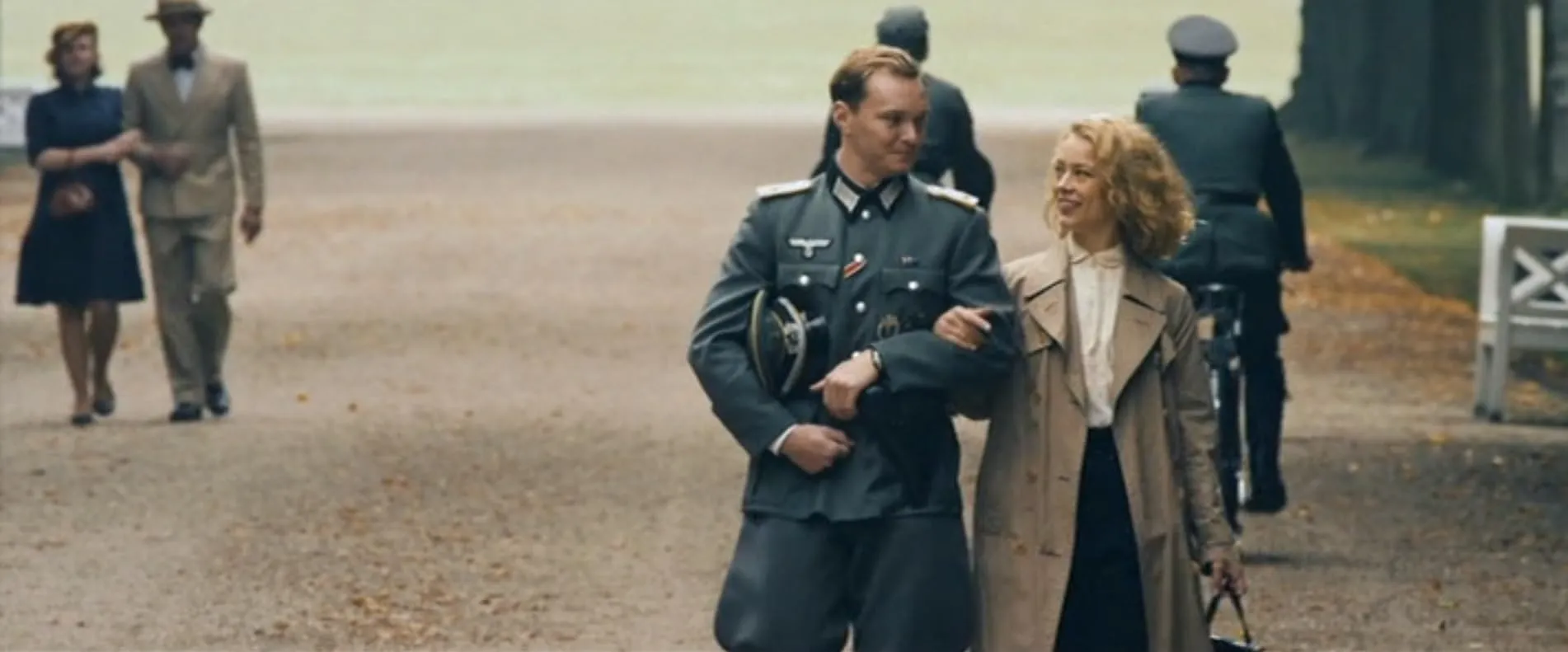
This tension between an alluring surface and a repugnant subject is a powerful cinematic tool, one that finds parallels in global cinema’s attempts to frame national traumas. The opulent formalism of certain historical Indian films, for instance, creates a similar friction, beautifying the past to make its horrors bearable, yet simultaneously more disturbing. The film’s most challenging aspect is its refusal to offer a clear moral verdict. It presents Stella’s actions without justification or condemnation, positioning her as both victim and executioner.
This non-judgmental stance is a hallmark of modern European filmmaking, and it finds echoes in the morally ambiguous worlds of Indian neo-noir, where characters are often inescapable products of a corrupting system. By withholding judgment, the film forces the audience out of its comfortable role as a moral arbiter and into the deeply uncomfortable position of a witness.
A Fearless Performance, A Haunting Legacy
The film’s entire weight is carried by Paula Beer, who delivers a fearless and unforgettable performance. She navigates Stella’s complex journey with astonishing precision. We see the spark in her eyes during the early jazz club scenes, a light that is methodically extinguished and replaced by a cold, appraising gaze as she becomes a predator.

Beer does not ask for the audience’s sympathy; she asks for its attention. Her portrayal is a masterful study in narcissism, capturing a woman so committed to her own narrative of victimhood that she becomes blind to her role as a villain. This is never clearer than in the flashes of the older Stella on trial, where her self-pity remains stubbornly intact. The film’s structure reinforces this unsettling portrait.
The narrative employs abrupt time jumps, particularly in its depiction of her post-war life, suggesting that everything that followed was merely an epilogue to the choices she made during those few horrific years. There is no catharsis, no redemption, only the lingering question of a life defined by its worst acts. Stella: A Life is a film designed not to be enjoyed, but to be wrestled with, leaving the audience haunted by its unflinching look at the darkness of human complicity.
Stella: A Life is a 2023 German biographical drama, based on the true and controversial story of Stella Goldschlag, a young German Jew who became a “grabber” for the Gestapo during World War II, betraying hundreds of fellow Jews in hiding to save herself and her parents. The film, directed by Kilian Riedhof and starring Paula Beer in the title role, premiered in September 2023 at the Zurich Film Festival and was released in Germany in January 2024. The movie has been screened at various international film festivals and is available to rent or buy on streaming platforms such as Prime Video in select regions.
Full Credits
Director: Kilian Riedhof
Writers: Marc Blöbaum, Jan Braren, Kilian Riedhof
Producers and Executive Producers: Michael Lehmann, Katrin Goetter, Ira Wysocki
Cast: Paula Beer, Jannis Niewöhner, Katja Riemann, Lukas Miko, Joel Basman, Damian Hardung, Bekim Latifi, Maeve Metelka
Director of Photography (Cinematographer): Benedict Neuenfels
Editors: Andrea Mertens
Composer: Peter Hinderthür
The Review
Stella: A Life
Stella: A Life is a deeply unsettling and necessary film, anchored by a masterful, fearless performance from Paula Beer. It foregoes the conventions of historical drama to offer a chilling and morally complex character study. By refusing to either condemn or absolve its protagonist, the film forces a profound examination of survival, complicity, and the terrifying ease of a soul’s collapse under pressure. It is a haunting, stylish, and unforgettable piece of cinema that will linger long after the credits roll, designed to be wrestled with rather than simply watched.
PROS
- A powerful and fearless lead performance by Paula Beer.
- A complex, non-judgmental approach to a difficult historical subject.
- Stylish cinematography and direction that create a sharp contrast with the grim narrative.
- A haunting and thought-provoking character study of moral corrosion.
CONS
- The subject matter is deliberately unsettling and can be a difficult viewing experience.
- Its refusal to provide clear moral answers or catharsis may leave some viewers unsatisfied.
- The narrative's abrupt time jumps in the final act can feel fragmented.