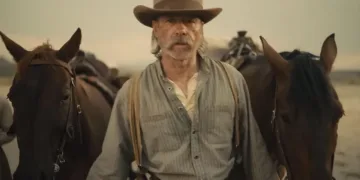

























The film opens not on a hero, but on a doomed man’s hands. Hazy plains stretch into an amber infinity as a camera pulls back to reveal a desperado in a cage, bloodied, shuffling a deck of cards. He begs God for mercy. “It ain’t God you got riled up,” his captor replies before firing a bullet. “It’s worse.” This opening serves as the story’s core design principle.
Killing Faith is a Western that has stacked its own deck with tarot cards, dealing a hand of supernatural horror and existential dread into a genre built on clear-cut morality. The setting is a mid-19th century American West where a plague ravages the land, an affliction that feels entirely secondary to the moral sickness of its people. The narrative’s engine is a desperate pilgrimage.
Sarah, a formerly enslaved woman, must transport her daughter—a silent child whose touch means death—across this blighted frontier. Her only help is Dr. Bender, a man of medicine so consumed by grief that he uses ether to sever his connection to the world. Their journey is the film’s central, brutal mechanic, a slow crawl through a hostile world that pits raw faith against shattered reason.
The Skeptic, The Saint, and The Sin
The story’s emotional resonance is built upon the dynamic between its three central figures, a trio of outcasts who form a fascinating narrative system of conflicting ideologies. Dr. Bender is a character defined by his intellectual armor. Guy Pearce gives him the weary posture of a man whose rationalism has become a prison.
His cynicism is not just an attitude; it is a rigorous, ongoing effort to reject any sense of pattern or meaning in a universe that took his family. His nightly ether habit is a key mechanic of his character, a ritualistic act of erasing memory and consequence, which makes him an incredibly unsteady narrator for the supernatural events unfolding around him. His journey feels like that of a protagonist in a psychological horror game, one who starts by dismissing glitches as errors in the code before being forced to accept that the game itself is haunted.
Sarah provides the necessary counterbalance. Her faith is not a passive comfort but an active survival strategy. In a world that has subjected her to the systemic horror of slavery and now a metaphysical curse, her belief is a tactical choice. DeWanda Wise portrays her with a compelling stillness, a resilience born from enduring the unimaginable. Her maternal drive to find a cure for her daughter is what propels the narrative forward, providing the forward momentum that Bender’s nihilism resists at every turn.
At the heart of their conflict is The Girl, a silent, walking enigma. She is more than a simple plot device; she is the source of the story’s ambient dread. The ambiguity of her power—is it demonic, divine, or something else entirely?—forces every character, and the viewer, to project their own beliefs and fears onto her. She is a living Rorschach test in a sun-bleached landscape, a perfect catalyst for the film’s philosophical war between faith and reason.
A Landscape of Nightmares
Killing Faith excels at using its environment and pacing to create a palpable sense of unease. The film’s greatest strength is its commitment to atmosphere, turning the journey itself into the primary source of tension.

The visual language is crucial. The shallow-focus, amber-toned cinematography renders the vast American frontier as a suffocating, dream-like space. Distant horizons are always hazy, as if seen through the fog of Bender’s ether-soaked perception. This aesthetic choice makes the world feel both beautiful and deeply malevolent, a landscape that is actively watching the characters.
This oppressive mood is reinforced by the film’s episodic, almost meandering structure. The narrative progresses in fits and starts, punctuated by surreal encounters that feel like random events in a brutal tabletop game. The meeting with a diseased, unnervingly hospitable family led by Joanna Cassidy’s matriarch plays out like a self-contained folk horror short.
Later, the appearance of an erudite Native American guide who calls himself William Shakespeare is a Jarmusch-esque touch that deliberately disrupts genre expectations. This structure intentionally sacrifices traditional narrative momentum. Instead of a relentless forward drive, the pacing forces the viewer to sit with the characters in their moments of paranoia and exhaustion, making the weight and distance of their journey emotionally tangible. It is a bold choice that aligns the viewer’s experience with the characters’ grueling ordeal.
Confronting the American Curse
The film uses its supernatural elements to deliver a sharp allegorical critique of the American frontier myth. The Girl’s deadly power is not a random affliction; it is presented as an inherited curse with a specific origin.

Born from the rape of Sarah by a white sheriff, the child’s touch becomes a supernatural manifestation of that foundational sin. The violence of her conception has become a literal, communicable plague. This turns the story from a simple horror Western into a potent allegory about the generational trauma embedded in the nation’s history.
The arrival of Preacher Ross in the final act brings these themes to a head. He is the story’s final boss, but he represents the danger of rigid, patriarchal order, not just pure evil. He sees the child not as a person to be saved but as a demonic impurity to be vanquished, a symbol of a chaos that threatens his worldview. His zealotry is just as dangerous as the bandits in the wilderness.
The climax forces Bender’s scientific materialism to its breaking point. His journey ends not with a clean conversion to faith, but with the complete demolition of his intellectual defenses. He is left confronting a horror that his reason cannot explain away. The film’s refusal to provide a neat resolution is its final, and most affecting, choice. It denies the comfort of an easy answer, leaving the nature of evil ambiguous and resonant.
Killing Faith is a supernatural thriller film released in 2025, written and directed by Ned Crowley. The movie, which stars Guy Pearce and DeWanda Wise, tells the story of a recently freed slave in 1859 who believes her mysterious daughter is possessed, and convinces a widowed physician to take them on a journey to find a distant faith healer. The film premiered at Beyond Fest on September 26, 2025, and was released in the United States on October 3, 2025. It is distributed by Shout! Studios.
Full Credits
Director: Ned Crowley
Writers: Ned Crowley, David Martin
Producers and Executive Producers: Ned Crowley, David Martin, Zori Davidkova, Wes Hager
Cast: Guy Pearce, DeWanda Wise, Raoul Trujillo, Jamie Neumann, Jack Alcott, Joanna Cassidy, Emily Ford, Bill Pullman, Josh McDermitt, Charlie Talbert, Keith Jardine, Andrew J. West, Gail Cronauer
Director of Photography (Cinematographer): Justin Hamilton
Editors: Thijs Bazelmans
Composer: Brooke Blair, Will Blair
The Review
Killing Faith
Killing Faith is a masterclass in atmospheric dread, a slow-burn anti-Western that confidently trades action for a potent, allegorical horror. Anchored by phenomenal performances from Guy Pearce and DeWanda Wise, the film uses its supernatural premise to explore a grim American landscape poisoned by its own history. Its deliberate pacing is a challenging but ultimately rewarding design choice, creating a haunting fever dream that lingers long after the credits. This is a bleak, intelligent, and beautifully crafted piece of genre-bending cinema.
PROS
- Stunning, atmospheric cinematography that creates a powerful sense of dread.
- Compelling lead performances from Guy Pearce and DeWanda Wise.
- An intelligent script that effectively blends the Western with supernatural horror.
- Rich thematic depth, functioning as a powerful allegory for historical trauma.
CONS
- The deliberately slow, episodic pacing may not appeal to all viewers.
- Its narrative ambiguity, while thematically fitting, may frustrate those seeking clear resolutions.