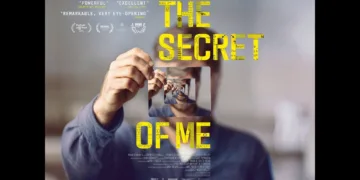






























A life built on an institutional concealment supplies a strong premise for close psychological scrutiny. Grace Hughes-Hallett’s The Secret of Me approaches that premise with frankness and forensic patience, dismantling a sustained deception with clarity. The opening frames set a procedural tone, a clinical mood that treats identity as the subject of an investigation overseen by professional authority.
The film centers on Jim Ambrose, an intersex man raised as Kristi in Baton Rouge, Louisiana. The story orbits a medical decision: an infant operation, subsequent removal of testes, and a culture of silence that insulated the family and the clinical establishment. Hughes-Hallett arranges the material like a case file.
Jim’s own line—”This is not a transgender story”—redirects the terms of the discussion toward bodily autonomy and historical medical error. Contemporary testimony and archival records combine to build the film’s forensic record.
The Subjective Camera and the Scarred Self
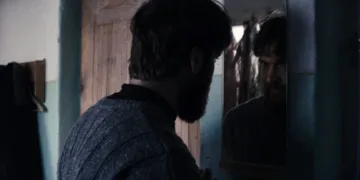
Jim Ambrose carries the screen with the heavy calm of a neo-noir lead whose path had been mapped long before the camera arrived. His testimony functions as the film’s emotional fulcrum, a steady point amid the medical evidence it presents. The camera often holds him in close-up, favoring austere framings that allow facial detail to register like topography.
Lighting choices emphasize a spare vulnerability; faces sit against controlled, shadowed backgrounds that recall chiaroscuro techniques from classic noir. Tight compositions and slow, deliberate camera moves produce a focused intensity.
A moment of recognition—finding his condition described in a college textbook—lands with abrupt clarity, a sudden anagnorisis that reconfigures memory and record. His medical files disclose XY chromosomes, atypical genitalia at birth, the infant surgery and testicular removal. Jim’s language calls the operation mutilation, a term that names both bodily violation and the compounded injury of secrecy by parents and physicians.
Later procedures, including a double mastectomy, figure in his account as steps toward alignment with his identity as an intersex man. He speaks with an unusual candor that shifts private trauma into a public meditation on ownership of the body.
The Architect of the Shadows: Money’s Influence
The film widens its lens, moving from individual trauma to a historical anatomy of medical practice in the United States from the 1960s onward. Dr. John Money, the Johns Hopkins psychologist, appears as a central architect whose theories about gender plasticity provided an intellectual rationale for early surgery on infants with atypical anatomy. Those theories argued for gender identity formation through early intervention.
The documentary presents cases and patterns that reveal real consequences of that doctrine. The David Reimer account is shown as a pivotal example: a child reassigned after a botched circumcision became, in Money’s reports, evidence for the model. The film traces the tragic results: profound distress and Reimer’s eventual suicide. The selective use of cases to sustain a hypothesis registers in the film as ethical malpractice.
Interview subjects such as Tiger Devore and John Colapinto bring activist and journalistic perspective, adding informed context that transforms personal testimony into an indictment of a professional history. The film asserts that these interventions derived from social anxiety about difference and an effort to impose a strict binary on bodies that fell outside it. The procedures privileged parental reassurance and medical doctrine over the autonomy of the child to come.
Chiaroscuro and the Ambiguity of Apology
Hughes-Hallett, who produced Three Identical Strangers, favors a methodical style that balances evidence and emotion. The film’s visual grammar is exact: compositional geometry contains the narrative, low-key lighting heightens psychological intensity, and interview framings often isolate speakers to emphasize confession.

Archival material integrates cleanly, and graphics that translate jargon into plain terms aid comprehension. At moments the film resorts to faceless re-enactments that read like cable documentary shorthand and risk undercutting the testimonies’ power; the choice feels unnecessary against the strength of firsthand accounts. The narrative arranges a confrontation sequence between Jim and Dr. Carter, the surgeon responsible for the infant operation.
The scene is staged for resolution. The exchange arrives as a study of ethical impasse. Dr. Carter’s apology is immediately framed by reference to the prevailing doctrine at the time, which leaves closure ambiguous and forgiveness tentative. The film stages accountability as a difficult conversation that yields no tidy narrative closure.
Hughes-Hallett’s documentary acts as a corrective to a clinical record that ignored future autonomy. It asks for an honest reckoning. The Secret of Me pairs technical control with moral urgency and asks viewers to consider how cinematic form can render institutional wrongdoing visible. At times the film’s aesthetic choices falter; for the most part it remains disciplined, illuminating, and morally alert.
The documentary film The Secret of Me premiered at the SXSW Film Festival on March 9, 2025. It has since screened at numerous festivals globally, including CPH:DOX and Sheffield DocFest. It had a limited theatrical release at Bertha DocHouse in London in October 2025. For television audiences in the UK, the film is scheduled to be broadcast on Channel 4 in 2026. Specific streaming availability following the broadcast has not yet been announced.
Full Credits
Director: Grace Hughes-Hallett
Writers: Grace Hughes-Hallett
Producers and Executive Producers: James Rogan, Flora Stewart, Ollie Madden, Ben Coren, Nicholas Franklin, Soleta Rogan, Sacha Mirzoeff, Mark Thomas, Mark Hedgecoe
Cast: Jim Ambrose, Tiger Devore, John Colapinto, David Reimer
Director of Photography (Cinematographer): Julian Schwanitz
Editors: Esther Gimenez Sanchez, Jamie Hartland, Daniel Taylor
Composer: Scott Twynholm
The Review
The Secret of Me
The Secret of Me is a meticulous, indispensable documentary that frames a deeply personal tragedy within a massive failure of medical ethics. Jim Ambrose’s unflinching candor provides the necessary emotional core, while Hughes-Hallett’s forensic style connects his story to the historical injustices perpetuated by figures like Dr. John Money. While some aesthetic choices, such as the staged climax, briefly undercut its otherwise rigorous authenticity, the film stands as a powerful, essential call for autonomy and a sobering reminder of systemic deception.
PROS
- Jim Ambrose’s courageous first-person narrative serves as an exceptional, emotionally resonant anchor for the entire film.
- The forensic depth of the medical and historical exposé regarding Dr. John Money's detrimental influence and the history of intersex surgeries.
- Scholarly and controlled direction that manages a delicate subject with both authority and profound empathy.
- Its function as a vital corrective to historical misinformation, strongly advocating for bodily autonomy.
CONS
- The occasional use of faceless re-enactments feels generic and distracts from the powerful authenticity of the testimony.
- The climactic meeting with the surgeon feels too overtly managed for the camera, resulting in an anti-climax that slightly strains the film’s documentary rigor.
- The frequent shifts between Jim’s past and the historical context sometimes contribute to a slightly disjointed narrative rhythm.