








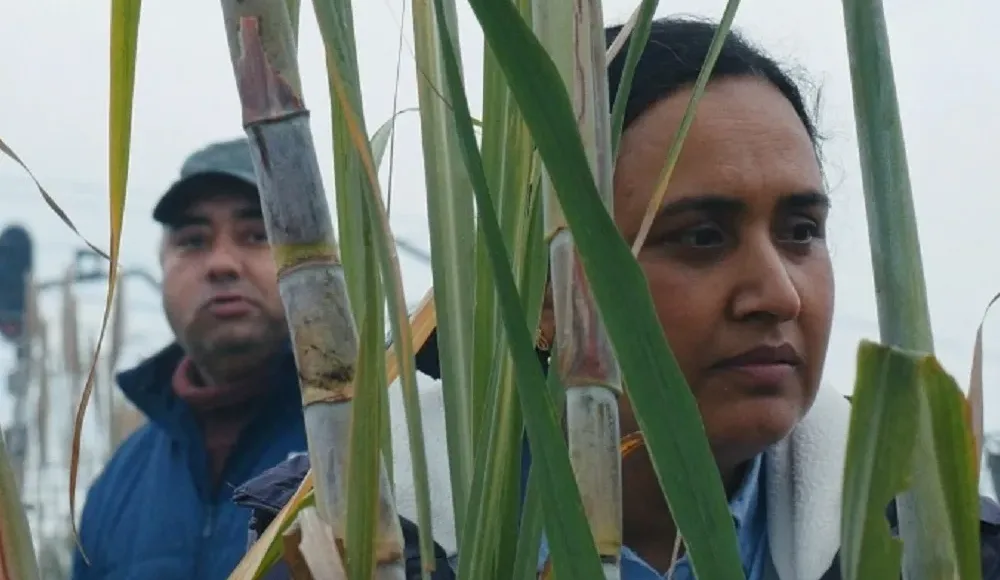

José Luis Guerín returns to Barcelona’s edge with Good Valley Stories (Historias del buen valle), reaffirming his role as a patient cartographer of precarious urban life. The film functions as a spiritual sequel to In Construction, shifting attention from the central Raval to the northern district of Vallbona. The method remains a precise alloy of documentary observation and a fiction filmmaker’s compositional sense, a practice he refined in works like In the City of Sylvia.
Vallbona reads as a case study in peripheral geography. It is a working-class island, a pocket of residual greenery and old homes separated from the opulent city by three hard lines, river, rail, and motorway. The film declares its approach with a graceful, almost pedagogical sequence.
Grainy black-and-white Super-8, exploratory and tactile, lays the ground as a memory image. Then the contemporary document appears, a casting call poster that signals the project’s guiding device. The label “work in progress” states a plain truth about a subject in motion, the drift from rural and agrarian memory toward a crowded, diverse, complicated present. It becomes a portrait of a place that is being built over in real time.
Custodians of the Fragmented Narrative
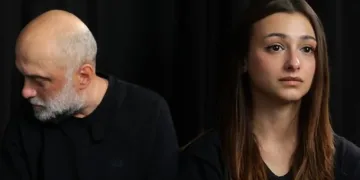
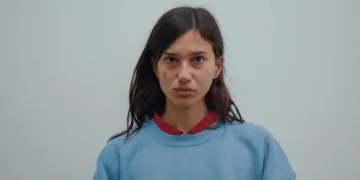
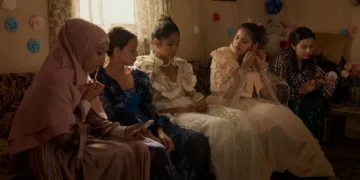
Guerín’s most striking resource is his non-professional cast, a constellation of eloquent presences drawn from the casting process. They carry the archive of the neighborhood, their stories combining into a mosaic that holds the texture of the locale.
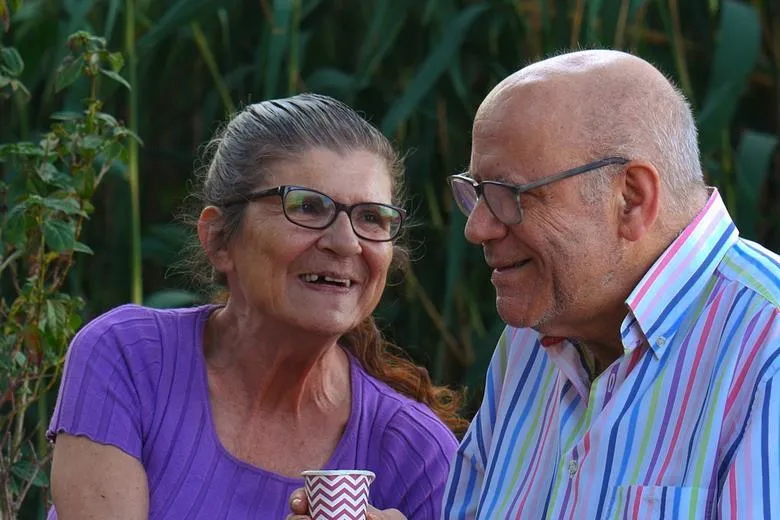
The elders form the philosophical core, purple-clad caretakers of the soil. In a sunlit lot they speak with steady calm, voices that seem to measure time at a different scale. Topics range from the intelligence of plants to the arrogance of real estate. A dry historical aside summons Danton and Robespierre, an index to the long genealogy of privilege. Loss shadows these conversations. The passing of one elderly man before the film ends reads as an emblem of a fading ancien régime, a reminder that bodies hold memory and that memory has a clock.
Also Read





The old guard shares the frame with newer migrant communities. Families from India tend allotments. Women from Russia speak while the war in Ukraine sits at a distance that feels both near and far. Newcomers arrive from central Barcelona, displaced by the gentrification the film studies with clear eyes. Languages flow in a multilingual current, Catalan, Spanish, African dialects, Russian. Vallbona becomes a small-scale politics of global migration. A procession of neighbors carries almond trees uprooted by construction. The gesture functions as agrarian rite and civic record, a calm refusal that plants time back in the earth.
The Crafted Gaze and the Spy’s Perspective
The humanist regard here rests on a crafted structure. Guerín, also the editor, keeps a stance of alert curiosity and evident respect, and he builds scenes that stand for lives in motion, representative moments in the best sense.
Alicia Almiñana’s camera lands on sly artifices at times, like a bowl of tomatoes that takes on the polish of a 17th century still life. The apartment blocks receive special attention. Layered frames capture several families at once and recall the watchful geometries of Rear Window, a quiet thesis on architecture as a soft machine that shapes daily choices. This is documentary written with the grammar of melodrama.
Dialogue scenes use multiple cameras and the shot reverse shot of dramatic fiction. The result is a charged intimacy for conversations that remain organic. Guerín’s voice enters the soundscape without concealment, a frank acknowledgment of the exchange between filmmaker and subject. Community scenes arrive through intentional staging, a flamenco gathering, river bathing. Call it performative authenticity, a useful coinage here. These interludes aim at a larger truth embedded in practice. The sudden intervention that halts the river bathers makes jurisdiction visible on screen, a crisp image of how much space a community can actually claim.
The Cyclicality of Ruin and Resistance
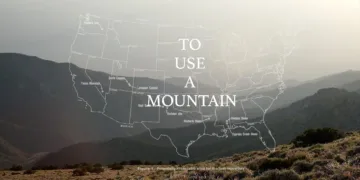
Good Valley Stories uses a small map to trace a world-scale pattern, the steady reduction of lived quality under the banner of progress. In Vallbona, the local history condenses both Spanish and global urban stories. A rural haven yields to a trinity of highway, railway, and sprawl. Nature that once felt like a shared commons now inhales smog and listens to noise.
History here moves in loops. Real estate speculation, loss of land, displacement, these are present-tense episodes with deep antecedents. Current gentrification mirrors earlier Spanish migrations, each wave shaped by the same economic gravity. Images do the arguing. New blocks arrive with sonic intrusion. Nearby, graffiti-covered ruins keep a different silence. The juxtaposition reads as an index of memory, archived in walls and erased in schedules.
A central theme emerges with clarity, resistance. The people of Vallbona set their resistance in daily acts. Farming. Music. A defiant flamenco that treats rhythm as common property. Personal philosophies stated without performance, steady and precise. The camera finds people living, singing, dancing with a view of an opulent Barcelona that keeps them outside its official story. The film’s potential cultural reach comes from the way these local histories translate into parables of displacement. Belonging and identity take shape in contact with contested ground, the literal soil underfoot that still records lines of care.
Good Valley Stories is a Spanish-French co-production that premiered at the 73rd San Sebastián International Film Festival on 25 September 2025. The documentary, directed by José Luis Guerín, is set in the peripheral Barcelona neighborhood of Vallbona, a working-class area isolated by urban infrastructure. The film explores the community’s daily life, focusing on the tension between its rural past and its modern, multinational present, effectively documenting the social, generational, and identity conflicts brought by urban transformation. It is scheduled for a theatrical release in Spain on 6 February 2026, distributed by Wanda Visión.
Credits
Title: Good Valley Stories (Historias del buen valle)
Distributor: Wanda Visión
Release date: 25 September 2025 (Zinemaldia), 6 February 2026 (Spain)
Running time: 122 minutes
Director: José Luis Guerín
Writers: José Luis Guerín
Producers and Executive Producers: Javier Lafuente, Jonás Trueba, Gaëlle Jones, José Luis Guerín
Cast: The film features a large, diverse cast of non-professional actors, often identified by their community roles, including Antonio, Makome, Norma, Tatiana, Elderly Men, Dominican Children, Indian Family, Russian Women
Director of Photography (Cinematographer): Alicia Almiñana
Editors: José Luis Guerín
Composer: Anahit Simonian
The Review
Good Valley Stories
Good Valley Stories functions as a vital piece of urban archaeology, meticulously documenting the Vallbona district's transition from an agrarian past to a globally connected present. José Luis Guerín’s observational approach is deeply compassionate, lending dignity and eloquence to a diverse community with encroachment and memory loss. The film is a visually rich, strong examination of resilience and displacement, transforming a local struggle against gentrification into a universal statement on the fight for belonging. It stands as a significant cinematic portrait of resistance.
PROS
- Profound, humanist portrait achieved through meticulous observation.
- The non-professional cast exhibits stunning eloquence and authenticity.
- Highly sophisticated cinematic craft, effectively using framing and composition to convey structural oppression.
- Strong thematic relevance to global issues of migration, urban identity, and real estate speculation.
- Successful blending of documentary research with the visual depth of fiction cinema.
CONS
- The focus on loss and urban degradation presents a sobering, painful view of reality.
- The structured, highly crafted nature of some scenes may sacrifice a purely spontaneous feel.