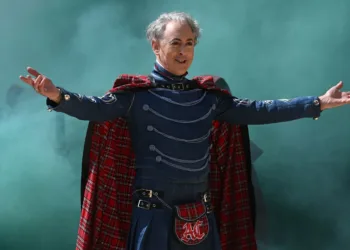







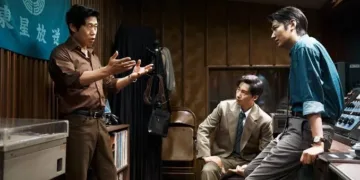























Nice to Not Meet You presents romantic comedy as an occupational hazard, where careers misfire and emotional fallout follows like a workplace accident report written by Cupid. The series opens with Lim Hyeon-jun, an actor who has lived inside the image of “Good Detective Kang Pil-gu” for years. His success is stable and glittering, yet he moves through it with the air of someone trapped in a role that long ago stopped feeling like a choice.
He keeps chasing a form of artistic freedom that his long-running persona quietly denies him. Opposite him stands Wi Jeong-sin, a political reporter whose serious investigation into a political conspiracy ends with sudden professional exile. She is reassigned to the entertainment desk, a punishment she reads as a personal insult and a structural dismissal of hard news.
The series follows the chain reaction that occurs once an actor exhausted by fame collides with a reporter ordered to chronicle that fame against her will. The tone stays light and heightened, stretching reality just enough to underline how ridiculous their predicament feels.
The Mechanics of Professional Wreckage
The narrative frame uses an enemies-to-lovers structure powered by recurring work disasters. The show treats their relationship as a case study in what might be called “Aversion Friction,” where two people are pressed together by circumstance yet recoil because of their jobs. Each early encounter escalates into larger and more public embarrassment. A chaotic car ride, with a drunk Jeong-sin misreading the situation as kidnapping, establishes mutual hostility as their default setting.
The bathroom escape sequence turns that hostility into full physical comedy. Jeong-sin scrambling through a men’s room vent and crawling over Hyeon-jun becomes a visual diagram of miscommunication, the human body standing in for crossed signals and professional panic.
This prepares the ground for the red carpet incident, where the glamour of celebrity culture collides with the ethical instincts of journalism. When Hyeon-jun interrupts Jeong-sin as she tries to confront a company chairman, his attempt at intervention leads to public embarrassment and a viral spectacle that trades in humiliation.
From there, the antagonism converts into organized professional warfare. Jeong-sin’s assignment to interview Hyeon-jun becomes a duel rather than a routine profile. He exposes her lack of preparation, and that single moment becomes the pretext for escalation. Her editor publishes old dating gossip, weaponizing tabloid material against him.
Hyeon-jun responds by removing Jeong-sin from a donation ceremony in public view. Their feud feels constant, a conflict that needs external intervention to pause, so the narrative introduces a neutral setting in the form of a hospital. His medication scare and her surgery place them in shared, medically enforced proximity; the aggression slows, yet the tension remains active in every interaction.
The final, elegantly contrived move belongs to the younger siblings, whose matchmaking plans produce the blind date reveal and turn coincidence into something that looks very much like narrative destiny.
The Mask and the Motivator
Hyeon-jun’s story examines the psychological weight of typecasting. His career rests on a detective figure that audiences cherish, yet he carries a clear sense of creative stagnation. He wants roles that stretch him, while his professional life circles back to the same heroic mask.

That restlessness sits alongside deeper vulnerabilities, shaped by an earlier scandal involving his ex-girlfriend Se-na and by his relationship with his mother, a former actress who lives with regret about her own compromises. The show treats his image as a kind of armor that no longer fits, yet he continues to wear it because the industry and his history demand it.
Jeong-sin, by contrast, is defined by purpose. Her identity as a reporter forms around high-stakes political work, particularly the Woo Young-suk cover-up. The transfer to entertainment is not simple reassignment; it functions as a symbolic stripping of status, a ritual of professional demotion that she feels in every assignment.
Her sharp hostility toward Hyeon-jun operates as a shield for her damaged pride. She works in a space she despises, interviewing a star she associates with everything trivial. Yet the review notes a quiet tension inside that stance: a private fondness for the fictional world of Kang Pil-gu that sits beside her contempt for celebrity culture, a contradiction that gives her character an interesting fault line.
The chemistry between Lee Jung-jae and Lim Ji-yeon holds the show steady amid its excesses. Their scenes feel chaotic and exact at the same time, like two egos locked in combat while performing a precisely timed dance. Hyeon-jun’s emotional fragility meets Jeong-sin’s unwavering focus, and the mix generates both comedy and conflict. They commit fully to the heightened tone; the physical gags, no matter how exaggerated, gain credibility because the performers treat each pratfall as serious business.
Media Ecology and Perceived Value
The series functions as a sly portrait of contemporary media culture. Hyeon-jun’s crisis centers on identity: the fear that a performer can vanish inside a role that audiences refuse to release. Jeong-sin meets a related problem from another angle.

She must confront a beat she believes sits at the bottom of the journalistic hierarchy, a subject she considers professionally shallow. The show pairs them to map out a hierarchy of value, where political reporting sits at the top and celebrity coverage hovers near the bottom, then tests how stable that hierarchy really is.
Fame in this series behaves like a malleable substance. Hyeon-jun’s image suffers after the red carpet incident and the churn of gossip, only to swing back toward admiration once clips of him rescuing Jeong-sin at the hospital circulate online. Public perception moves with whiplash speed. A single, plain act of kindness rewrites weeks of anxious reputation management. The show sketches a culture that treats moral judgment as a constantly updated feed, where the most recent clip carries the greatest weight.
Industry figures such as Hyeon-jun’s manager, CEO Hwang, and Jeong-sin’s editor, Yun Hwa-yeong, mark the ethical gray zones of this system. They treat news as something pliable, a resource that can serve corporate image or ratings depending on the day. The boundaries between journalism and publicity blur into each other, and the audience watches how easily professional ideals bend to commercial pressure. Hyeon-jun’s lingering history with Se-na functions as a visible scar in this environment, a reminder that old scandals and past sacrifices still write the rules of current career choices.
Aesthetic and Formal Choices
The show leans into familiar K-drama devices such as fated encounters and grand misunderstandings, yet it does so with a clear sense of self-awareness. Reality feels heightened, like a world tuned a few degrees away from the everyday so that emotional stakes and slapstick can coexist comfortably.

Early episodes divide their attention between Hyeon-jun’s celebrity routine and Jeong-sin’s political investigation. That structural split gives the narrative texture, letting the series establish two separate worlds before linking them. At times, the pacing loses sharpness; some early passages stretch longer than they need to, a regular issue for serialized storytelling that must serve both character development and episode counts.
The comedy leans heavily on physicality. Slapstick, body-based gags and staged chaos form the backbone of the show’s humor. This stylistic choice will speak strongly to viewers who enjoy broad comedy, while others may find the reliance on such gags less appealing. Visually, the production maintains a high polish. The settings convey glossy glamour around the entertainment industry while still making room for the untidy, stressful spaces of newsrooms and daily work.
The Unresolved Currents
The ensemble around the leads sets up storylines that feel rich and unfinished, ready to complicate the central pairing. New CEO Lee Jae-hyeong and editor Yun Hwa-yeong share a charged past that bleeds into their current professional dynamic, laying the ground for intersecting corporate and romantic tensions.
The younger siblings, Hong-sin and Sun-woo, act as cheerful agents of chaos. Their blind date scheme becomes an explicit intervention in the romantic plot, pulling private matchmaking into the same social world that already feeds gossip and viral scandal. Se-na, the former partner who helped precipitate Hyeon-jun’s earlier downfall, stands at the edge of the story as both emotional history and professional threat, particularly through the shared script that links them.
The ongoing Woo Young-suk political murder investigation stays present underneath all of this, a serious thread that anchors Jeong-sin’s sense of mission beneath the glitter of celebrity reporting and promises further conflict between public spectacle and the quieter work of uncovering power.
Nice to Not Meet You is a South Korean romantic comedy series that premiered on November 3, 2025. It centers on the chaotic relationship between Lim Hyeon-jun, an A-list actor frustrated by being typecast in a detective role, and Wi Jeong-sin, a respected political journalist who has been forcibly demoted to the entertainment desk. The series airs on the tvN network in South Korea and is available for international streaming across more than 240 countries and territories exclusively on Prime Video, with new episodes released weekly.
Credits
Title: Nice to Not Meet You
Distributor: tvN, Prime Video
Release date: November 3, 2025
Running time: 70 minutes (per episode)
Director: Kim Ga-ram
Writers: Jeong Yeo-rang
Producers and Executive Producers: Studio Dragon, Studio&NEW, Artist Company
Cast: Lee Jung-jae, Lim Ji-yeon, Kim Ji-hoon, Seo Ji-hye, Choi Gwi-hwa, Jeon Sung-woo, Oh Yeon-seo, Na Young-hee, Kim Hyun-jin
The Review
Nice to Not Meet You
Nice to Not Meet You is a self-aware romantic comedy that finds energy in the collision of two disparate worlds: the typecasting trap of celebrity and the wounded pride of serious journalism. While the humor occasionally leans too heavily into slapstick and the pacing sometimes falters, the series succeeds on the strength of its chaotic lead chemistry and its clever commentary on fame's fickle nature. It's a light, sharp, and enjoyable watch that deftly uses familiar tropes to explore genuine issues of professional identity.
PROS
- The dynamic between Hyeon-jun and Jeong-sin is sharp, messy, and intensely engaging.
- Effectively explores the psychological toll of typecasting and the fluid nature of public perception.
- Uses classic romantic comedy tropes with a knowing, playful touch.
- Successfully balances the high-stakes political subplot with the chaos of the entertainment industry.
CONS
- The narrative occasionally slows down, particularly in the middle segments.
- The reliance on exaggerated, physical comedy may not appeal to all viewers.
- While self-aware, the plot adheres closely to familiar 'enemies-to-lovers' conventions.