





























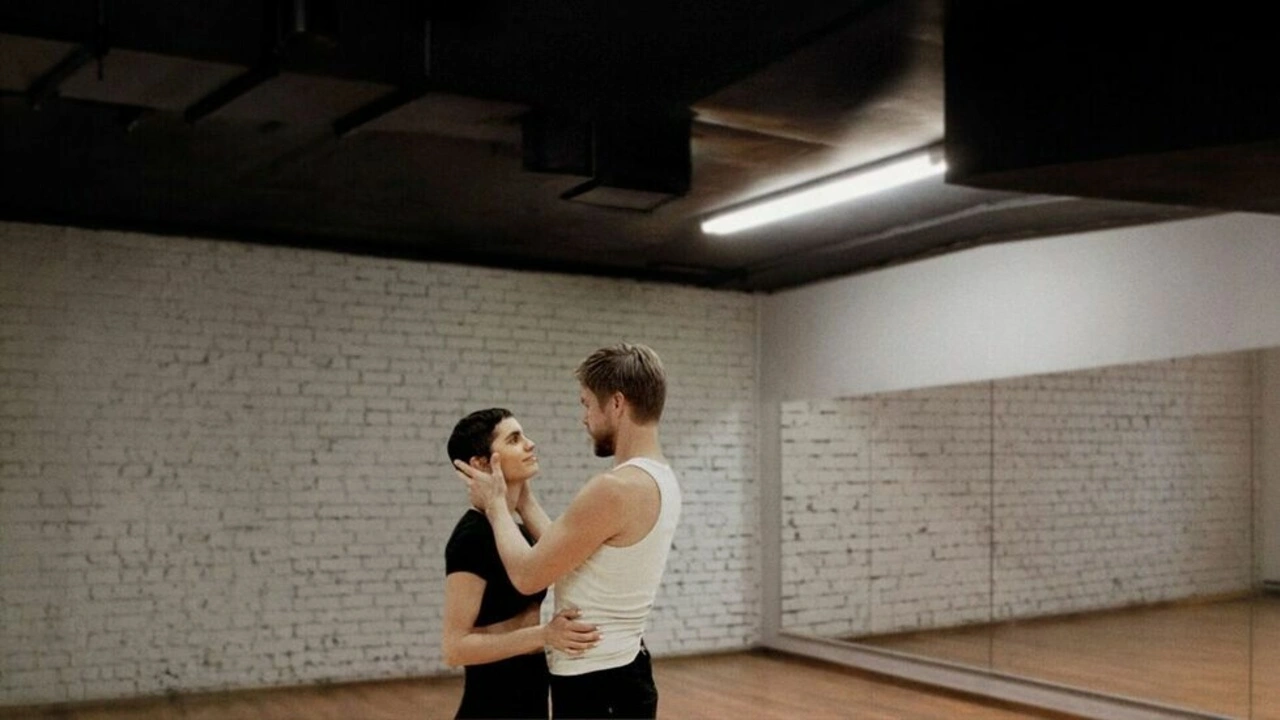

The Symphony of Dance finds Derek Hough and Hayley Erbert Hough at a moment when private love, public performance, and physical terror collide with startling force. Newly married and touring a stage show built around movement, romance, and theatrical polish, the pair seem to be living inside the kind of entertainment-world fairytale that invites soft lighting and swelling strings. Then the body interrupts the myth.
During the 2023 tour, Hayley suffers a traumatic brain injury after a head collision during a performance. What follows is a documentary about recovery, marriage, fear, and the strange violence of losing trust in one’s own body.
Director Jason Bergh frames the film through the title of Derek’s show, yet the phrase gradually gathers a second meaning. The symphony here is no longer simply music, choreography, and stagecraft. It becomes a search for coordination after rupture.
The film carries real emotional weight, especially when it stays with Hayley’s uncertainty. It also bears the sheen of a celebrity documentary, a surface so polished that pain sometimes seems arranged for the best possible camera angle.
Recovery as a Second Language
Hayley’s injury is presented with enough medical clarity to convey its severity without turning her suffering into spectacle. After the onstage collision, she develops a severe headache, collapses backstage, and has a seizure. Doctors diagnose a subdural hematoma, leading to emergency surgery that removes part of her skull to give her brain space to swell. The details are stark, and the film’s restraint in handling them matters.
The hospital footage gives The Symphony of Dance its most vulnerable material. Hayley wearing a protective helmet, undergoing therapy, and confronting basic questions about speech, movement, motherhood, and independence creates a portrait of recovery shaped by dread and hope in equal measure. For a dancer, the body is archive, instrument, vocabulary, and home. A turn of the wrist can hold decades of training. A lift can contain trust, timing, and the memory of every rehearsal that made it seem effortless.
That is where the film finds its richest cultural and emotional charge. Dance is often sold to audiences as grace made visible, a fantasy of control. Here, grace has to be rebuilt from fear. Hayley’s return to movement is athletic, yes, but it is also psychological. Her muscles may remember, but her brain has to be persuaded.
The film’s limitation is its tidiness. Recovery is allowed to frighten us, then it is hurried toward uplift. The harder medical questions around returning to the stage after four months receive too little scrutiny. Bergh seems drawn to resilience as an image, sometimes at the expense of recovery as a messy, uneven process.
Marriage Under Stage Lights
The documentary becomes sharper whenever it treats Derek and Hayley’s relationship as a set of overlapping roles rather than a simple romance. Derek is husband, choreographer, employer, caretaker, stage partner, and anxious witness. Hayley is wife, patient, dancer, collaborator, and the person most determined to prove that injury has not stolen her artistic self. Those roles do not sit neatly together.
The rehearsal room is the film’s most revealing arena. Every lift carries a second story. Every hesitation has weight. Derek’s body stiffens when Hayley mentions pain, while Hayley pushes toward the next sequence with a discipline that feels both admirable and unsettling. Love, in these scenes, is not soft-focus reassurance. It is logistical, physical, sometimes tense. Someone has to count. Someone has to catch. Someone has to decide how much risk a dream can absorb.
Julianne Hough’s observation that Derek is used to control lands with quiet force. Performance culture rewards mastery, precision, and the illusion of effortlessness. Hayley’s injury breaks that illusion, forcing Derek into an unfamiliar posture of fear. The film understands this, yet it also drifts too often toward Derek’s biography. His childhood, career, ambition, and artistic drive add context, but they also pull attention away from Hayley’s more urgent story.
That imbalance matters. Hayley’s recovery is the film’s emotional core, and every detour from it feels like a missed chance to sit longer with the person whose body has become the site of the film’s deepest questions.
The Polish and the Pulse
Jason Bergh gives The Symphony of Dance a glossy, carefully composed visual language. The style suits ballroom spectacle and celebrity stagecraft: bodies slide through rehearsal rooms, promotional images glow with curated elegance, and the camera often knows exactly how beautiful its subjects are. That beauty is not empty. Dance deserves to be filmed with reverence. Movement can express fear, intimacy, and survival with a directness speech cannot match.
Still, the polish cuts both ways. The film’s sleekness can soften the jagged edges of trauma, making some moments feel pre-arranged rather than discovered. Its music leans hard into uplift, and its emotional climaxes arrive with such frequency that the viewer can begin to feel managed. Sentiment is not the enemy here. A story like this earns tears. The issue is repetition, the sense that the film occasionally presses too firmly on feelings already present in the material.
The editing is strongest when it follows process: Hayley testing movement, rebuilding timing, relearning trust, and approaching the stage with a body that has survived catastrophe. The eventual return to performance has power because each step now carries memory. Yet the documentary talks about dance as healing with greater insistence than it shows dance in full flow. Longer performance passages would have allowed the body to make the argument.
Even with its soft edges and celebrity-documentary instincts, The Symphony of Dance remains affecting. Its finest moments suggest that recovery is not a return to the old rhythm, but the creation of a new one under lights that suddenly feel less decorative and far less forgiving.
The Symphony of Dance is an intimate American documentary film that celebrated its official world premiere at the Tribeca Festival on June 7, 2026. Directed by filmmaker Jason Bergh, the narrative follows Dancing with the Stars veterans and married partners Derek Hough and Hayley Erbert Hough during their nationwide stage tour. The chronicle shifts unexpectedly into a harrowing medical crisis when Hayley suffers a sudden, life-threatening cranial hematoma, capturing her grueling road to recovery as she attempts to walk and dance again. Audiences hoping to view the film can track its status as it screens at select New York festival venues, with digital platform distribution and wider broadcast releases under development.
Full Credits
Title: The Symphony of Dance
Distributor: Tribeca Festival (Initial Premiere Market Platform)
Release date: June 7, 2026 (Tribeca Festival World Premiere)
Running time: 109 minutes
Director: Jason Bergh
Writers: Jason Bergh
Producers and Executive Producers: Jason Bergh, Derek Hough, Hayley Erbert Hough
Cast: Derek Hough, Hayley Erbert Hough, Julianne Hough
The Review
The Symphony of Dance
The Symphony of Dance is a moving, polished documentary that finds its greatest strength in Hayley Erbert Hough’s recovery and her attempt to reclaim trust in her body through dance. Its emotional force is clear, especially during the rehearsal and hospital passages, but the film sometimes smooths trauma into inspirational packaging and gives Derek Hough’s story too much space. Still, its portrait of love, fear, artistry, and physical resilience carries genuine power.
PROS
- Hayley Erbert Hough’s recovery gives the film real emotional weight
- Rehearsal scenes are tense, intimate, and revealing
- Strong visual treatment of dance and movement
- Thoughtful look at identity, fear, and artistic return
- Derek and Hayley’s relationship creates a strong dramatic core
CONS
- Too much focus shifts toward Derek’s biography
- Recovery process can feel overly neat
- Medical concerns could use deeper examination
- Sentimental music and phrasing become repetitive
- More complete dance footage would have strengthened the film