





















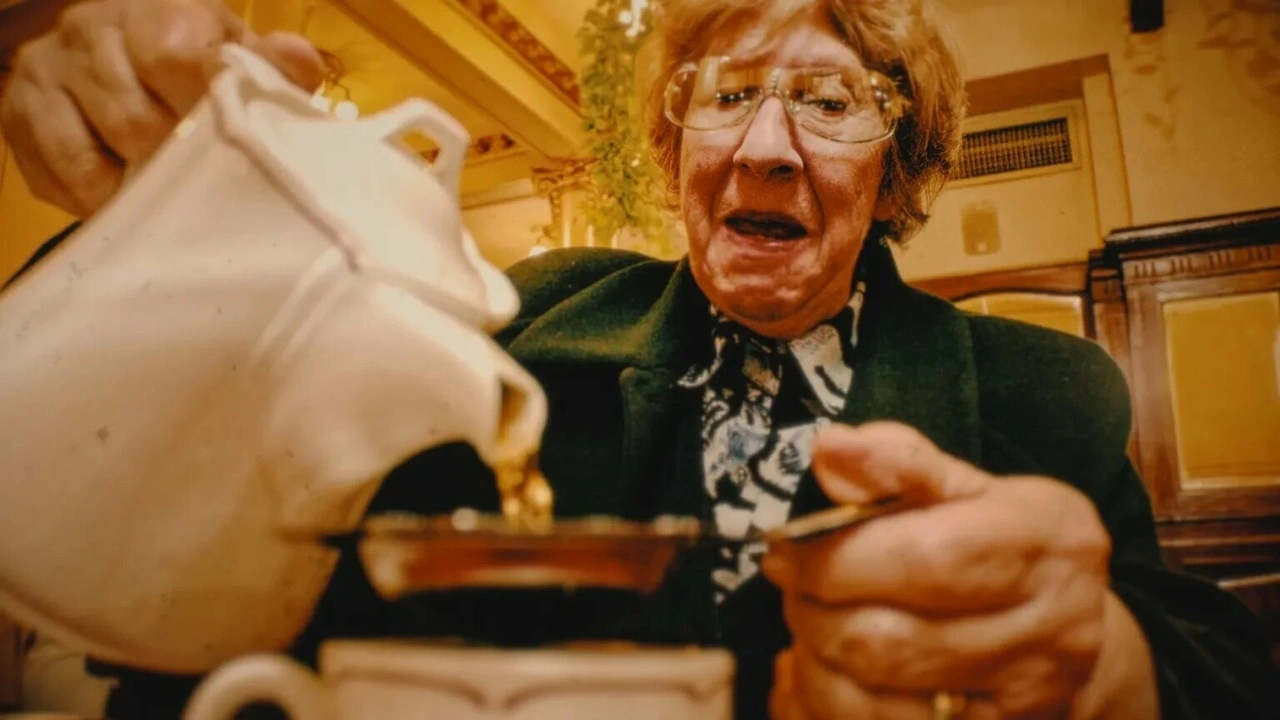
A woman serving tea should be the mildest image imaginable, which is exactly why Yiya Murano’s story still carries such a sour charge in Argentine popular memory. Alejandro Hartmann’s Yiya Murano: Death at Tea Time returns to María de las Mercedes Bolla Aponte de Murano, the Monserrat homemaker convicted of poisoning three women with cyanide in 1979, and treats her less as a hidden criminal than as a public invention.
That angle gives the Netflix documentary its strongest pull. The murder case is horrific, yet the afterlife of the case is stranger: a convicted killer who became a talk-show guest, a comic reference, a piece of merchandise, a name people could say with a nervous smile.
Hartmann has rich material here. Nilda Adelina Gamba, Lelia “Chicha” Formisano de Ayala, and Carmen Zulema “Mema” del Giorgio de Venturini were close to Yiya, had entrusted her with money, and died within weeks of one another. The accusation was chilling in its domestic precision: pastries, tea, cyanide, missing promissory notes. The film understands the power of that ritual. Where it struggles is in deciding how far to push the theatricality that surrounded Yiya without becoming part of it.
Class Fantasy and Easy Money
The documentary is sharpest when it places Yiya inside the Argentina that made her scams legible. During the military dictatorship and a period of financial instability, promises of high returns could sound plausible enough to catch people who wanted safety, status, or a little miracle. Yiya used that climate like a stage. She lived in a cramped one-bedroom apartment with her husband Antonio, her son Martín, and a maid, yet carried herself like a grande dame of Buenos Aires society.
That mismatch is the film’s most revealing social detail. Martín says his mother convinced herself she belonged to high society, and the testimony around her supports the idea of a woman performing class with ferocious commitment. The Castelar Hotel waiter remembers her elegance and the attention she attracted. The dramatized scenes of Yiya receiving cash from a lover over a restaurant meal are unsubtle, yet they point to the same cultural tension: she wanted luxury without the structure that usually protects it.
In another national setting, Yiya might read as a familiar con artist archetype. In Argentina, her story carries a particular bitterness because the scam sits inside a society already trained to distrust institutions, banks, courts, and official truth. Hartmann’s film gestures toward that history with useful brevity. It could have gone deeper into how the era shaped her victims’ choices, but the connection is present enough to make Yiya’s fraud feel rooted rather than decorative.
The Case Beneath the Legend
The procedural material gives the film its cleanest narrative spine. Mema’s death on March 24, 1979, first appeared to be a heart attack and fall, until her family pushed back. The medical exam revealed cyanide, and that discovery forced investigators to revisit the earlier deaths of Gamba and Chicha. The repetition of circumstances made the case hard to ignore: Yiya had debts to the women, she had been with them before they died, and poison turned the apparent natural deaths into a pattern.
Retired homicide officer Horacio Romeo is one of the documentary’s best presences. His description of the cyanide level in Mema’s body gives the case a forensic shock that no reenactment can match. His memories of Yiya in custody are better still, especially the claim that solitary confinement seemed to energize her. That detail cuts through the mythology because it shows charisma in a place where charisma should have no audience.
The legal path is less clean. The film moves from arrest to acquittal to conviction, then to release, without always making the judicial mechanics clear. For a case so dependent on public misunderstanding, that vagueness matters. Hartmann seems far more interested in the performance of guilt than in the architecture of prosecution, which leaves gaps where a viewer may want firm ground.
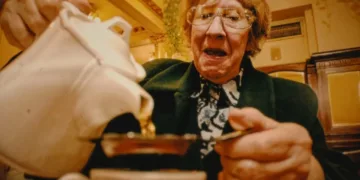
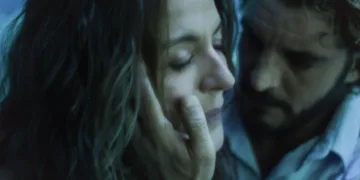
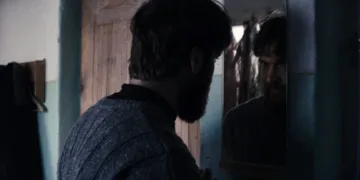
The black-and-white recreations become part of that problem. Gabriela Bocalandro gives the reenacted Yiya a vivid physical presence, particularly in the hotel and dining scenes, but the staged material often tips toward telenovela texture. It is not poorly mounted. It is too eager. Each dramatic glance and ominous cup of tea risks turning murder into décor.
Martín and the Inherited Spotlight
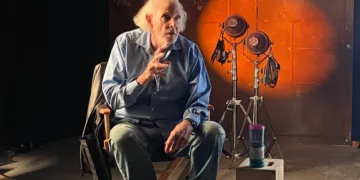
Martín Murano gives the film its most unstable emotional current. His testimony is painful, theatrical, contradictory, and impossible to dismiss. He describes a mother who insulted him, treated him as a nuisance, displayed her affairs in front of him, and once brought him to a meeting with Héctor Cantón, where the lover allegedly told the boy to call him father. These memories make the home feel like an annex of Yiya’s public performance.
The documentary is careful enough to let doubts remain. Martín says Yiya privately confessed to the murders and told him Antonio was not his biological father. Romeo and several journalists question the confession story. Lía Salgado’s skepticism gives the film a needed corrective, since Martín has his own history with attention, including the book Mi madre, Yiya Murano and later media appearances with his mother.
Their relationship turns into a distorted mirror of Yiya’s fame. He wants separation from her and remains attached to the only story that made the public know his name. The late scene in which he is handed an old photograph of himself being held by Yiya feels especially uncomfortable. It has the grammar of emotional revelation, but Martín’s dry response refuses the breakdown the scene appears designed to capture. The moment says more about the filmmakers than about him.
A National Scandal on a Global Platform
For viewers outside Argentina, the film’s most valuable thread is Yiya’s transformation from criminal defendant to pop-cultural figure. The 2008 lunch-show appearance with Mirtha Legrand, where pastries become a joke before an apology arrives, is grotesque in exactly the way media history often is. The gag depends on everyone remembering the victims and then behaving as if memory itself were entertainment.
That is where Hartmann’s documentary finds its best argument. Yiya’s infamy traveled from courtrooms to television, from newspapers to musicals, from horror to camp. Netflix now sends that local myth outward, where global true-crime audiences may receive it as another lurid case file. The film has enough cultural specificity to resist that flattening, mainly through its Argentine journalists, victim relatives, and the strange social codes around Yiya’s celebrity.
Yet the victims remain too thinly drawn. Their relatives appear, their photos are held up, their names are spoken, but Gamba, Chicha, and Mema never receive the same density granted to Yiya’s wardrobe, lovers, television bookings, and quarrels with Martín. A documentary about a woman who consumed attention should be more alert to its own distribution of attention. Hartmann sees the trap. He still steps close to it.
The Argentinian true-crime documentary film Yiya Murano: Death at Tea Time premiered globally on Netflix on April 23, 2026, and is available for streaming exclusively on their platform. The investigative non-fiction feature details the chilling case of a charming Buenos Aires housewife who poisoned her close friends with cyanide during afternoon tea to cover up a series of fraudulent financial scams in the late 1970s.
Where to Watch Yiya Murano: Death at Tea Time (2026) Online


Full Credits
Title: Yiya Murano: Death at Tea Time (also known as Yiya Murano: Muerte a la hora del té)
Distributor: Netflix
Release date: April 23, 2026
Rating: TV-MA
Running time: 1 hour 44 minutes
Director: Alejandro Hartmann
Writers: Lucas Bucci, Tomás Sposato
Producers and Executive Producers: Vanessa Ragone, Carolina Urbieta, Alejandro Hartmann, Mariana Bomba
Cast: Gabriela Bocalandro, Martín Murano, Virginia Messi, Gonzalo Abadie, Benjamin S. Bruni, Ricardo Larrama, Pablo Flores Maini, Fernando Malfitano
Director of Photography (Cinematographer): Alejandra Martín
Editors: Manuel Margulis Darriba
Composer: Leo Sujatovich
The Review
Yiya Murano: Death at Tea Time
Alejandro Hartmann’s film understands Yiya Murano as an Argentine media artifact: killer, con artist, social climber, television performer. Its strongest value lies in watching a local criminal case become pop folklore through talk shows, merchandise, and jokes about poisoned tea. The film weakens that insight with melodramatic reenactments, legal gaps, and victim portraits that arrive too late. A sharp subject survives messy treatment.
PROS
- Horacio Romeo’s vivid testimony
- Strong cultural context
- Clear portrait of Yiya’s self-mythology
- Martín’s conflicted interviews
CONS
- Heavy soap-opera reenactments
- Messy timeline
- Thin victim portraits
- Unclear legal details