




























Forty years of refusing Stradivariuses gives Fei’s violin the weight of an archive: wood as witness, string as scar tissue. The Violinist, directed by Ervin Han and Raúl García, begins from a question asked in 1982 by a Spanish journalist who cannot understand why a celebrated Singaporean virtuoso has remained loyal to the same instrument for decades. The answer sends the film back to 1932 Singapore, where childhood talent, class protection, orphaned hunger, and music meet before history tears the room apart.
The frame is old-fashioned in the cleanest sense. A photograph of young Fei and Kai with their violins opens a sealed chamber of memory. Fei’s recollection becomes the film’s real structure, moving from private lessons in a comfortable home to occupation, espionage, requisitioned rooms, resistance networks, and a sonata left unfinished by time. The film wears its sincerity without disguise. Sometimes that purity deepens it. Sometimes it leaves the drama too exposed.
A Childhood Tuned Too Early
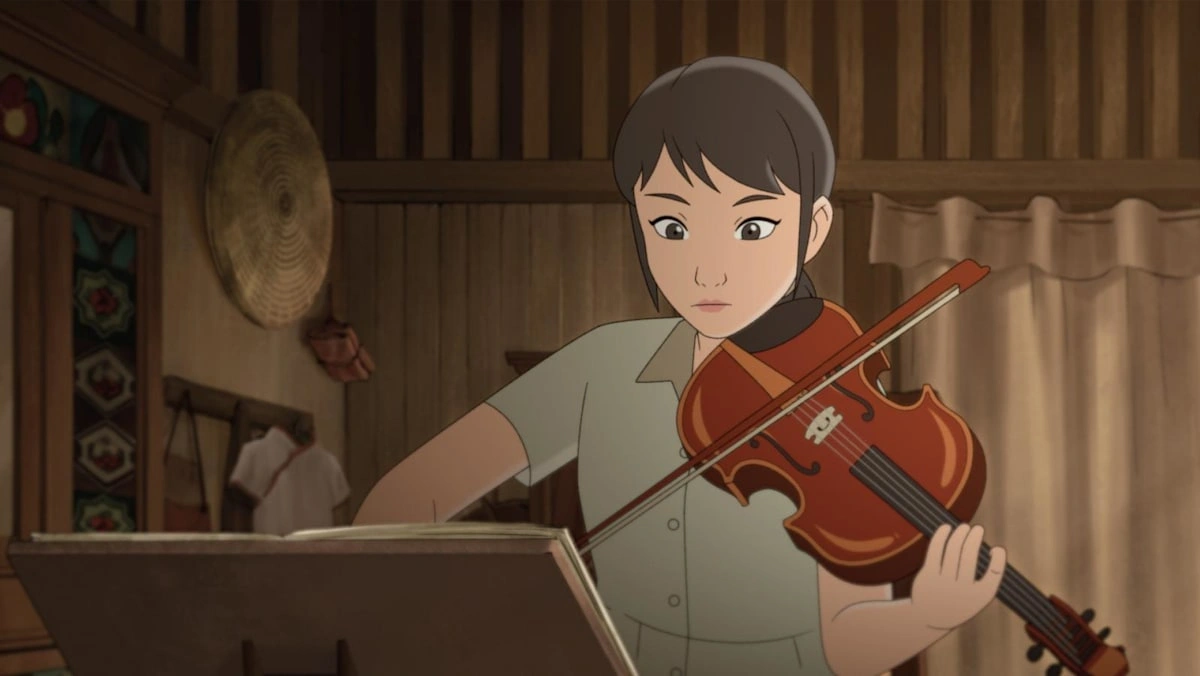
Fei’s early world is built from safety. Her family home has the quiet abundance of a place where shelves can hold treasures instead of rations, where a child’s talent can be fed by private instruction, where music is treated as a future rather than an escape. The film’s background work matters here. The objects in the room, the disciplined posture at the lesson, the clean space around Fei as she practices, all show privilege without needing a speech about it.
Kai enters from another weather. He is an orphan taken in by Ying Jie, the household maid, and his first relationship with music comes through listening while he works. The image of him absorbing Fei’s practice during chores gives his gift a quiet ache. He has no institutional pathway, no arranged lesson, no family mythology of genius prepared for him. He hears, he follows, he learns. When his perfect ear reveals itself and he begins to play, the film lets wonder sit beside unfairness.
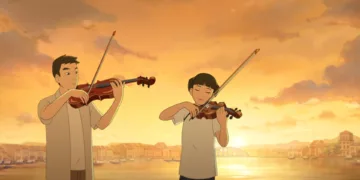
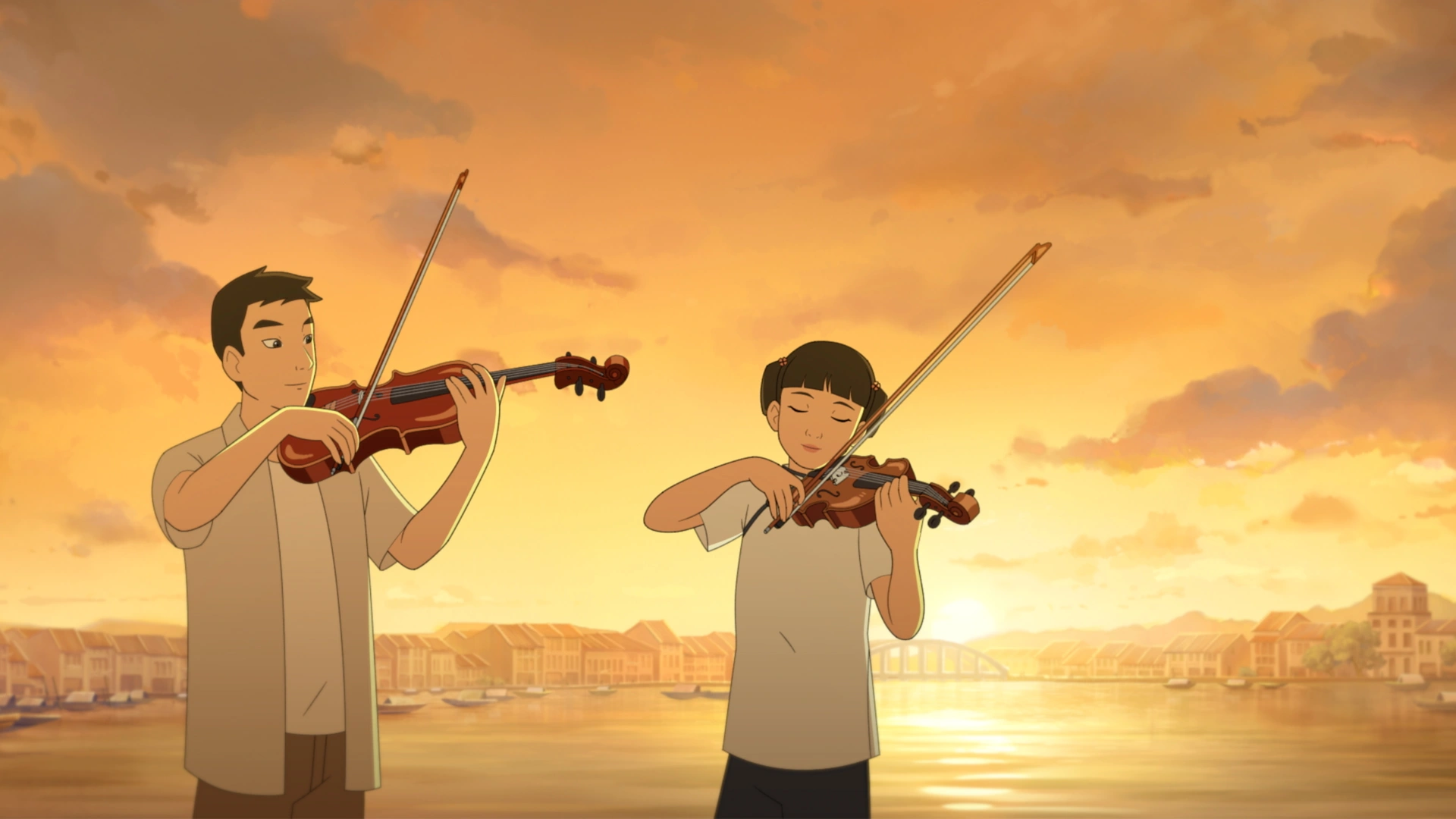
Their bond grows through duets, which is the right choice. Fei and Kai are most persuasive when the film lets the violins speak for them: rehearsals, small concerts, shared attention, the unfinished “Sonata of the Setting Sun in D Major” that Kai begins composing before war remakes the meaning of every promise. Their affection does not need heavy declaration. It lives in timing, breath, and the tension between two bows trying to move as one.
Occupation as a Change in Air
The Japanese invasion breaks the film’s musical line with brutal clarity. The bombing that precedes the occupation does not simply alter the plot; it changes the atmosphere. Singapore contracts. Rooms become unsafe. Homes become property for soldiers. A violin no longer suggests refinement alone. It becomes a portable remnant of a life that may no longer exist.
Kai’s path into the resistance under Lim Bo Seng gives the film a sharper historical spine. His work in Ipoh, the spy activity, the danger of the Kempeitai, the sabotage efforts against Japanese targets, all pull The Violinist away from pure melodrama. The film understands that history does not stand behind Fei and Kai like painted scenery. It enters their bodies, separates them, decides what they can risk, what they must hide, who gets to survive with music intact.
Fei’s wartime arc is stronger because it is less heroic in the usual sense. After her family home is seized, she survives in reduced circumstances, takes in two orphans, and accepts orchestra work under Takeshi Inoue, a Japanese officer whose love of music complicates the film’s moral field. He feeds the children, shows tenderness, and becomes painful to watch precisely because the uniform never disappears. His kindness cannot cleanse the occupation. His death hurts because the film allows the contradiction to remain human.
That contradiction is where the film finds some of its darkest intelligence. War does not permit clean categories for those trapped inside daily need. Fei working with a Japanese orchestra is not framed as betrayal in any simple register; it is food, shelter, calculation, dread, and the stubborn refusal to let sound vanish. Survival has a poor ear for purity.
The Hand-Drawn Wound
The animation carries both the film’s beauty and its most visible weakness. The period backgrounds are often lovely, especially in the 1930s scenes where Fei’s home feels researched down to the shelves. The near-contemporary Singapore prelude, with its moped race through sleek architecture, has a polished sweep, yet the flashbacks carry richer feeling. The city of the past seems touched by hands rather than rendered by memory alone.
Character design is expressive, and the color palette gives the wartime passages a bruised gravity. The discreet CG work in the final concert, where the surrounding audience seems to fall away until Fei and Kai become the only presences that matter, creates a hushed emotional chamber. For a moment, the film finds a visual equivalent for memory: the world remains, yet grief edits it out.
Movement is less secure. Several character scenes have a choppy rhythm that weakens the emotional acting. The faces and bodies cannot always carry the pressure the writing places on them. Some framing choices appear to protect the animation from difficult motion, which makes the protection visible. For a film so committed to musical precision, the uneven movement can feel like a bow scraping when it should glide.
The Sonata That Survives
Music is the film’s deepest language. Tchaikovsky, Paganini, Mendelssohn, and other classical pieces set emotional temperatures across Fei’s life, but Ricky Ho and Isabel Latorre’s work matters most when the score seems to breathe with the characters rather than decorate them. The violin is repeatedly treated as the instrument closest to the human voice, and the film earns that idea through scenes where Fei cannot say what the bow can carry.
Kai’s unfinished sonata becomes the wound that refuses to close. In childhood it is a promise. During separation it becomes a message without a messenger. When Fei performs it decades later, the piece gathers everything the final act has struggled to organize: orphaned talent, occupied streets, vanished rooms, a boy in the resistance, a woman who turned absence into discipline. The film’s late stretch runs too long, and the mystery around Kai’s fate is held after it has lost much of its tension. Still, that performance has force because music makes time collapse without asking permission.
The final encounter between Fei and Kai, staged across distance rather than reunion, is the film’s most honest gesture. Lives have continued. Damage has taken shape. The sonata does not repair the lost years. It lets them be heard.
The critically acclaimed animated historical drama The Violinist celebrated its historic world premiere in June 2026 at the Annecy International Animation Film Festival, where it made history by winning the prestigious Cristal for a Feature Film and the SACEM Award for Best Original Soundtrack. The film is scheduled to launch its theatrical distribution in Singapore in September 2026 ahead of an international cinematic rollout overseen by its co-producing partners at Robot Playground Media, TV ON Producciones, and Altri Occhi. Spanning decades across British colonial Singapore and Malaya, the beautifully hand-drawn 2D narrative follows a gifted Peranakan girl named Fei as she grows into a celebrated concert artist while spending decades touring Southeast Asia to search for her long-lost childhood friend and fellow musician, Kai, who disappeared into the anti-Japanese resistance during the 1941 World War II occupation.
Full Credits
Title: The Violinist
Distributor: Robot Playground Media, TV ON Producciones, Altri Occhi
Release date: June 2026 (Annecy International Animation Film Festival Premiere), September 2026 (Singapore Theatrical Release)
Running time: 114 minutes
Director: Ervin Han, Raúl García
Writers: Ervin Han, Jordan K. See
Producers and Executive Producers: Paloma Mora, Justin Deimen, Leonard Lai
Cast: Tan Kheng Hua, Fang Rong, Adrian Pang, Ayden Sng, Kazuya Tanabe
Editors: Solveig Cornelisen
Composer: Ricky Ho, Isabel Latorre
The Review
The Violinist
The Violinist carries history like a wound pressed into wood. Its strongest passages let Fei and Kai’s music survive occupation, hunger, separation, and the slow violence of memory. The animation sometimes stumbles, especially in character movement, and the final stretch holds the note past its natural decay. Still, the film’s sincerity is hard to dismiss. When Fei performs Kai’s unfinished sonata decades later, the film finds the voice it has been chasing all along.
PROS
- Rich wartime Singapore setting
- Fei’s affecting emotional arc
- Beautiful musical throughline
- Detailed period backgrounds
- Takeshi’s morally complex role
CONS
- Choppy character animation
- Overlong final act
- Kai feels thinner than Fei
- Some framing hides visual limits