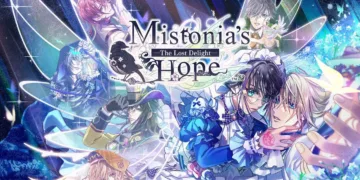

















Mistonia’s Hope: The Lost Delight is an otome visual novel that places players in the fae-blessed kingdom of Grand Albion in the late 19th century. The setting revolves around the elegant rule of the Purefae Queen Tia, supported by five noble houses of Demifae, where magic and political power hold a fragile balance between light and shadow. The narrative follows Aprose Randolph, working under the alias Rose. Eight years ago, the queen’s decree wiped out her noble family.
She returns to Albion with a single objective: vengeance. To pursue it, she forms an alliance with the exiled Faerie King Oberon and infiltrates the Bernstein noble house as a maid. Her assignment involves collecting information on the noble houses and Queen Tia before a grand social celebration. The story frames this as a deliberate gamble, where the search for truth and retribution constantly risks entanglement with genuine emotion.
Systems of Espionage and Emotional Consequence
Mistonia’s Hope quickly establishes a tone that feels different from many otome visual novels. The game sheds the feel of a cozy life simulation early and leans into espionage and revenge. The plot carries significant density, shaped by Rose’s focused mission and the constant pressure of being discovered. She functions as an active, strategic lead. Her apparently invisible status as a servant becomes a tactical advantage, letting her plan each movement, observe her targets, and collect incriminating details.
This agency directly informs the structure of the common route. Early decisions do more than bump affection values. They emphasize trust-building with the mansion’s support staff, including head butler Nicholas and maids Evelyn and Charlotte. These scenes sit alongside secret meetings with her childhood friend John and the information broker Goneril, which reinforce the feeling that Rose is running a dangerous covert operation from inside enemy territory.
Faesight, the signature mechanic tied to Rose’s Demifae blood, gives the investigation a clear systemic backbone. During exploration segments, the player gathers scattered information “shards.” Faesight lets the player examine these shards in detail, turning loose snippets into organized clues. Through this analysis, the player uncovers key perspectives on the Randolph family tragedy and on the attitudes of the involved noblemen. Mechanically, Faesight behaves like a dedicated investigation screen that keeps the central conspiracy moving forward and prevents crucial information from getting lost in the flood of text.
The Betrayal system is the standout device that links player choice with the story’s themes. Once Rose commits to a specific character route, the interface presents a main affection meter and a smaller secondary meter for a rival love interest. If the player concentrates on the secondary meter, the route branches sharply. This shift allows Rose to abandon her original target in favor of the rival. The mechanic turns emotional waffling into a concrete choice that reorients the plot, and it visually reinforces the tension between Rose’s desire for revenge and the possibility of sincere affection.
Also Read



Character Dynamics and Complicated Attachments
The romance structure revolves around six potential love interests. Five are the heads of the noble Demifae houses: Edward Bernstein, Alfred Creswell, Linus Ward, Lucas Sullivan, and Ascot Lindel. The sixth is John, Rose’s only surviving ally. Access to these routes is carefully controlled. The game initially opens paths to Alfred, Lucas, and Linus. Clearing two of these unlocks Edward and Ascot. Reaching a good ending with either Edward or Ascot then opens John’s final route.

Each nobleman represents a distinct approach to power, loyalty, and emotional risk. Edward often feels driven by idealism and duty. Linus stands firmly in defense of Queen Tia. Ascot presents himself as flirtatious and intentionally elusive, which keeps his motives hard to pin down.
Romance sits in constant tension with espionage. Rose’s feelings never exist in a vacuum; they share space with her commitment to revenge. The writing is at its strongest when affection grows by accident from the existing mission structure. Quiet conversations, moments of shared vulnerability, or small acts of kindness emerge from the infiltration work and slowly complicate her calculations. Rose begins by treating attraction as another tool for manipulation, something she can wield against targets, and the story takes interest in how that perspective is challenged.
Among the routes, John’s storyline stands out as the most cohesive emotional arc. The relationship between Rose and John feels convincing and ties together the main thematic strands of vengeance, personal growth, and love in a single, satisfying throughline. Other routes have rougher edges. Alfred’s and Ascot’s paths occasionally struggle with pacing, where the romantic developments arrive too abruptly or feel sidelined by the larger web of worldbuilding and political maneuvering.
Outside the central love interests, the cast remains a strong point. The mansion staff operates as a supportive emotional anchor, while Queen Tia and King Oberon serve as chilling, distant figures whose moral detachment gives the antagonistic side of the story a memorable presence.
Visual Presentation and Replay Value
Mistonia’s Hope presents itself with a high degree of visual polish. Character sprites and CG illustrations look appealing and sit comfortably within the late 19th-century fantasy frame. Magical effects rely on relatively simple visual tricks, and some of the fantasy wardrobe choices reach for ornate detail that may divide opinion. The art still stays colorful and expressive, giving emotional charge to character interactions and key story beats.

The sound design complements the visuals. The soundtrack offers catchy background tracks that support both quiet intrigue and dramatic confrontations. Japanese voice acting carries scenes with strong performances, and the vocal tracks, especially the opening theme, lend a distinct emotional punch that helps anchor the tone.
On the mechanical side, the game layers exploration stages into its first half to break up the standard flow of text boxes and choices. During these segments, Rose moves across maps of the manor and the surrounding city, speaking with characters to gather information.
These sequences provide a welcome sense of spatial context and investigative routine. At the same time, they reveal a notable design issue: once the player commits to replays for alternate routes or endings, these exploration stages cannot be skipped. That limitation slows repeat runs and can make route-hunting feel more laborious than necessary.
Replay systems receive much more care. The game includes a detailed flowchart that tracks progress with clarity. It marks which scenes the player has already seen and which branches remain untouched. With multiple Dawn Endings, several Bad Endings, and the specialized Betrayal Endings, the structure actively invites players to chase every branch.
The combination of branching meters, locked routes, and clearly presented flowchart data supports long-term engagement and experimentation with different choices. A minor localization quirk, such as the term “humaines” used for humans, stands out on occasion, yet it never interferes with following the story’s complex web of relationships and conspiracies.
The Review
Mistonia's Hope: The Lost Delight
Mistonia's Hope: The Lost Delight successfully stands apart by prioritizing a focused narrative of vengeance and espionage over standard romantic tropes. The active protagonist and the innovative betrayal mechanics allow player choices to directly shape the complex political drama. While a few routes suffer from rushed romantic development and the exploration stages impede replay speed, the overall design successfully marries theme and system. It's a highly engaging visual novel that rewards players who enjoy deep character consequence and structural complexity.
PROS
- Active, strong-willed protagonist
- Innovative Betrayal Mechanic
- High replayability aided by flowchart
- Cohesive integration of theme and system
- Excellent Japanese voice acting
CONS
- Exploration stages are unskippable on replays
- Romance pacing is uneven in a few routes
- Minor localization inconsistencies