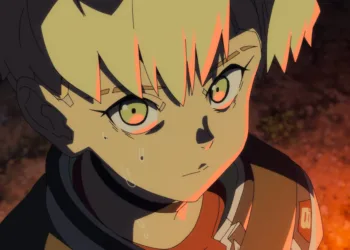








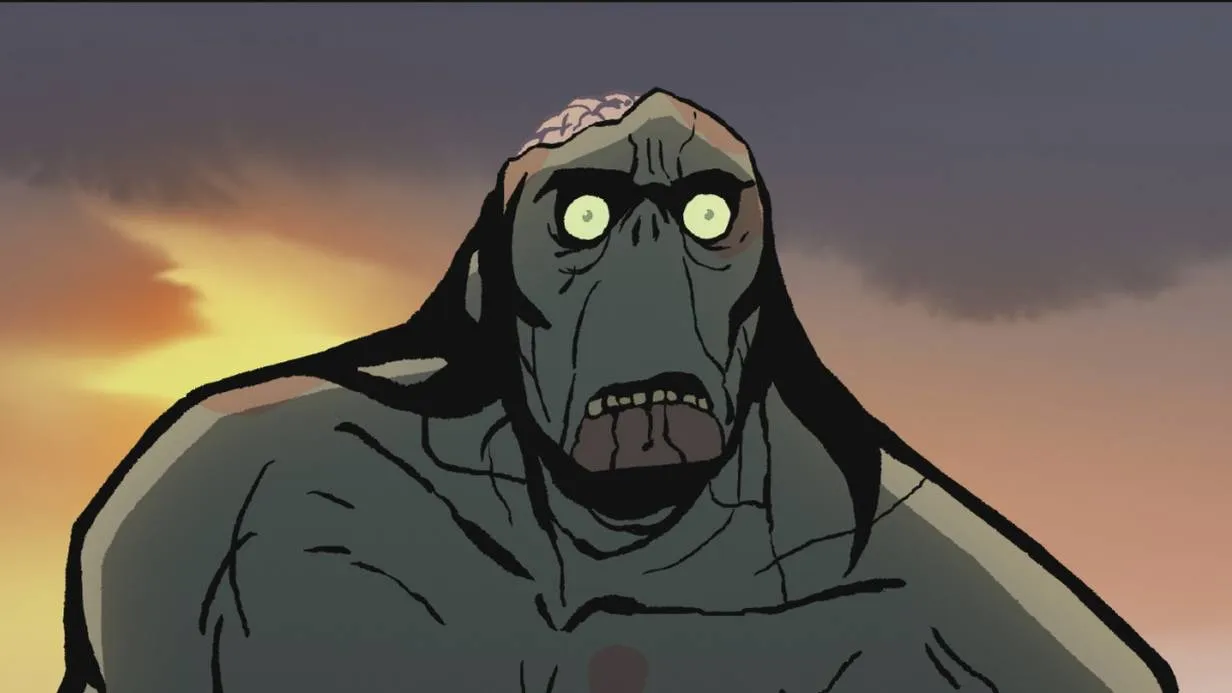

The crack of a dry twig beneath a heavy, charcoal-toned foot is the lone sound carrying across a scorched waste. Spear pauses at a pool of black water and meets a reflection that reads like damage inventory: jagged purple scarring, gaps where flesh should be, a body revised by violence.
Primal returns for a third season with a decisive turn away from the earlier emphasis on grounded survival. Genndy Tartakovsky steers the continuation into supernatural fantasy, keeping the series’ dialogue-free discipline intact. Meaning still travels through gesture, framing, and raw feeling, with images asked to do the work that spoken language usually does.
The story picks up in the wake of Spear’s sacrifice, tracking what remains for Fang and Mira in the world he left behind. The land stays hostile and unyielding, and danger keeps collecting in the corners of this ancient Earth as new threats press forward. The animation holds to its signature look while inviting darker material into the frame, and the season sets its sights on life and death in an era defined by brutality. The result carries forward the emotional weight already built, even as the series steps into territory that feels unfamiliar inside its own myth.
Physicality and the Burden of the Living Dead
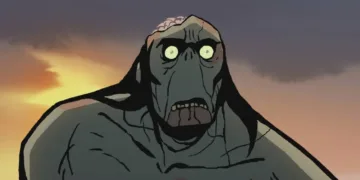
Spear now moves through the world as a hollow vessel, an undead automaton assembled from bone and scar tissue, stripped of the warmth that once made him feel like a living presence. His resurrection lends his motion a mechanical tension. Blades and flames lose their sting; sensation falls away, leaving a body that behaves like a tool. Combat changes shape under that condition.
He hurls himself into danger with reckless disregard for what remains of his structure, and his new form is marked by permanent damage and bouts of body horror that land with a sickening tactility. Humanity drains from the way he reads his surroundings. Instinctive passion gives way to cold function, a logic that seems to calculate survival without fully participating in it.
The cost of rebirth sits in every image: skin turned sallow and bruised, movement tightened into stiffness, as if unseen strings are pulling him through space. Freed from the limits of pain, he endures wounds that would have ended him in earlier seasons. Damaged limbs become weapons in their own right, turned outward with terrifying efficiency. Spear reads as a shell driven by lingering instinct, propelled forward without the comfort of conscious purpose.
Fang’s arc runs alongside that transformation through the daily labor of motherhood. She guards her young in a world growing sharper and more threatening toward her kind, and separation from Spear forces fresh strategies of survival.
The season shows her witnessing the hunting and mistreatment of other dinosaurs, an experience that tightens her defensive posture and sharpens her responses. Mira, by comparison, holds authority inside her village, emerging as a powerful leader carrying the memory of Spear’s sacrifice as a private mandate. Her connection with Fang rests on shared responsibility for the next generation.
They raise their children under the long shadow of violence, and grief becomes a language spoken without words between them. The series presses on questions of nature and nurture through these parallel lineages, human and dinosaur alike, with offspring trained by a landscape that offers no mercy. Parenthood becomes a heavy mantle in a time of constant peril.
The season frames an uncomfortable choice inside that duty: how much violence from the past becomes inheritance for the young. Protecting innocence in a world that demands brutality holds the tension in place, and Mira’s leadership carries both wisdom and steel as she works to keep her people safe from threats that gather in the shadows.
The Occult Shift and Primordial Terror
The season commits to ancient magic as a governing force, shifting the series into a space shaped by curses and mysterious powers that dictate how the world moves. Occult phenomena enter as part of the landscape, and the dead return under rules that feel written in something older than biology. That change brings a kind of cosmic dread, a sense that the universe itself has turned predatory.
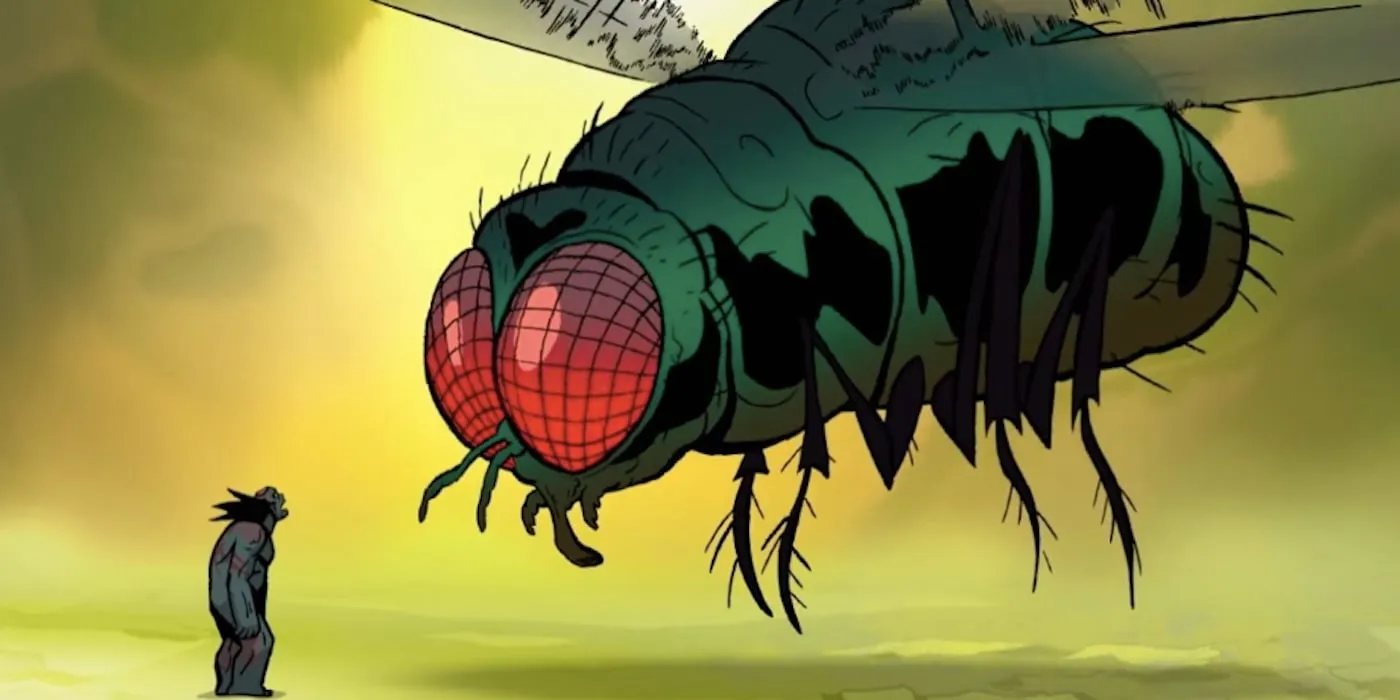
The creature designs carry echoes of horror creators such as Joe Dante and Guillermo del Toro, with forms that feel imagined from nightmares and given weight through texture and motion. “Feast of Flesh” stands as a concentrated display of that sensibility, staging visceral images that lean into body horror and refuse the comfort of restraint. The world grows harsher as the laws of the natural order loosen and the macabre takes their place.
Things that should never exist roam the plains, and every encounter inherits higher stakes under that logic. Survival remains tied to food and shelter, yet the danger expands into something spiritual, as if malevolent forces can consume the soul as readily as a predator consumes flesh.
Black goo seeps into this nightmare as an emblem of rot made physical, and grotesque transformations push the horror toward imagery reminiscent of Cenobites. Violence escalates in part because Spear can endure, and inflict, damage that would kill a living man. The fights arrive with choreographed brutality that treats the body as a medium for spectacle and suffering.
The enemies operate as participants in a lethal food chain, creatures for whom carnage functions as the basic currency of continuation. That environment invites comparison between humanity and monstrosity, and Spear’s condition makes the question feel personal even within an impersonal presentation. When he catches his reflection, existential weight settles over the moment. The fear registers plainly: he may have become indistinguishable from the horrors he once fought.
Autonomy twists under his undead state, leaving the sense of a will bent into unfamiliar shapes. The series uses these flashes to examine how thin the line can be between protector and beast, and the absence of a stable moral anchor in his adversaries sharpens the tragedy of his slide. He keeps fighting because necessity demands it, yet purpose slips away from his grasp. The primordial goo infects whatever it touches, warping natural creatures into parodies of life, and Spear moves through that corruption like a figure stranded from his own time, struggling against a nightmare that keeps advancing.
Rhythms of Survival and Memory
The season opens with a surge of high-action momentum. Early episodes arrive as self-contained chapters that establish the new status quo, introducing fresh antagonists whose anatomy and behavior challenge Spear at an intellectual level along with the usual physical threat. Midseason, the tempo shifts. Attention turns toward world-building and the mechanics of the supernatural rules now governing the story, and the narrative flow slows into something heavier.
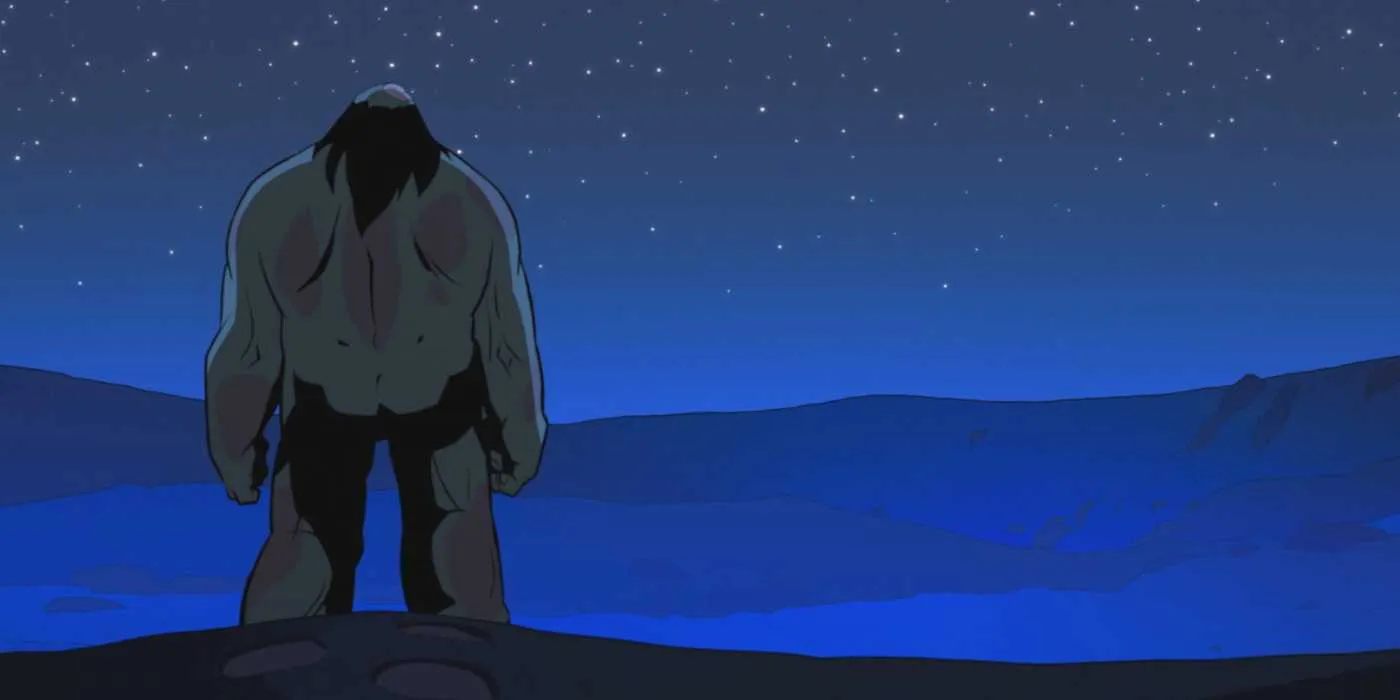
Spear’s mind clouds over with hazy memory, forcing him to repeat stages of development as if he is trapped in a loop of partial becoming. He wanders the wasteland searching for meaning that keeps hovering just beyond reach. The middle stretch asks for patience from the viewer, matching the confusion and stagnation of a consciousness suspended between worlds. Stillness becomes the canvas, and the sudden eruptions of violence hit harder when they arrive because silence has been allowed to settle.
Cyclical memory loss adds frustration to the hunt for meaning, turning progress into something that can be lost and reclaimed in the span of an episode. Over time, the separate chapters begin to lock into a more clearly serialized track. Spear moves through distinct phases on a path toward a specific destination, and the segments feel like a descent through layered states of existence. Biblical allusions to life and reincarnation surface across the season, threading the supernatural premise into older symbolic language.
The finale lands an ending that feels earned, resolving the immediate conflicts and gesturing toward a different era for the show. It offers a sense of finish while keeping space open for further exploration. The structure traces a shift from episodic adventure into a unified story about the price of returning from the grave, and the pacing follows the pulse of a dying world, sometimes frantic, sometimes close to silent. Each episode builds on what came before, tightening the momentum until the destination supplies the clarity that the earlier wandering withheld, anchoring the magic in a resolution that lands with a deeply human weight.
The Visual Language of Ancient High Fantasy
The animation keeps its hand-drawn texture, evoking the work of Frank Frazetta through muscular silhouettes and mythic staging. Color becomes a primary language in the absence of speech, carrying emotion through bold choices that read immediately. Bright, naturalistic flora and fauna sit beside the dark inventions of high fantasy, and the environment seems to respond to conflict like a living participant.
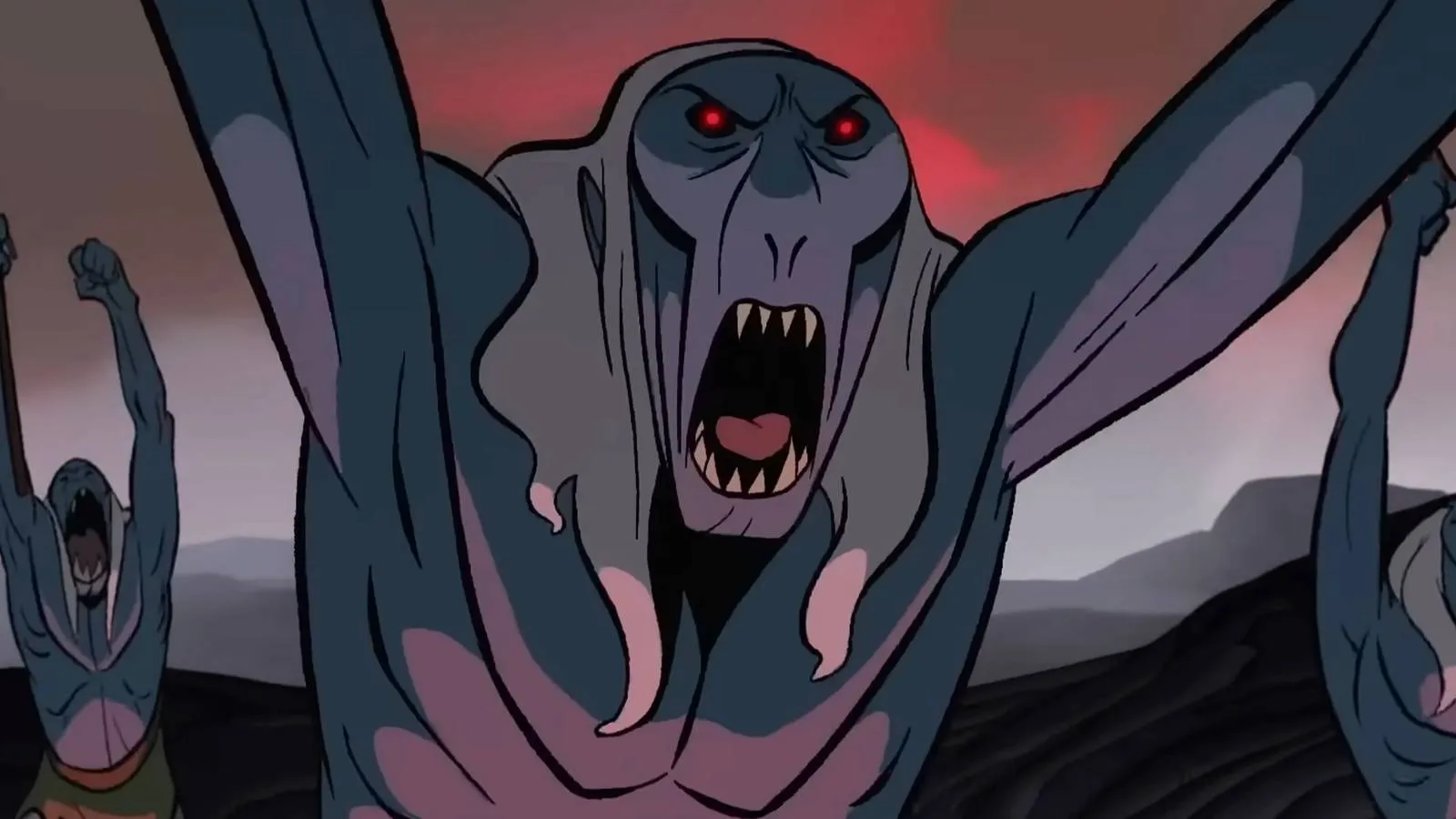
Tiny shifts in movement and subtle modulation in character acting suggest interior thought without a single spoken line. The visual control is strong enough that silence never blurs narrative clarity. A palette of deep reds and sickly greens helps the world feel ancient and alien at once, and the friction between natural beauty and supernatural ugliness keeps reminding the viewer that Spear’s condition is an unnatural state stamped onto the landscape.
Tyler Bates and Joanne Higginbottom’s score rises to operatic grandiosity, using ambient noise and wailing battle cries to build a dense atmosphere. Traditional orchestral passages take a different route than the more experimental sounds associated with prior seasons, and the music behaves like a guiding presence, shaping emotional response with steady force. Sword-and-sorcery elements arrive as a natural extension of the established world, reminiscent of high fantasy settings while remaining grounded in prehistoric context.
The world-building has grown dense enough to carry this genre turn without snapping, and each frame works as a vessel for themes communicated through pure imagery. Tranquil vistas can hide sudden violence, keeping tension alive between beauty and horror.
The move into high fantasy is handled with care, allowing the series to keep its primal identity intact. The score swells in moments of triumph and recedes into mournful hum in scenes of loss, adding sonic weight to the visual spectacle until the season plays like the sight and sound of a forgotten myth, recovered in fragments and stained with ash.
The third season of Genndy Tartakovsky’s Primal moves beyond the initial survival of Spear and Fang to explore a much darker, supernatural world. This installment is scheduled to premiere on January 11, 2026, on Adult Swim, with episodes available for streaming the next day on Max. In this chapter, the narrative continues the legacy of Spear following his sacrifice, introducing themes of resurrection and occult horror while maintaining the series’ signature wordless storytelling. Viewers can watch the premiere on Adult Swim and find the entire series on the Max streaming platform.
Full Credits
Title: Genndy Tartakovsky’s Primal Season 3
Distributor: Adult Swim, Warner Bros. Discovery, Max
Release date: January 11, 2026
Rating: TV-MA
Running time: 22–30 minutes
Director: Genndy Tartakovsky
Writers: Genndy Tartakovsky, Darrick Bachman, David Krentz, Bryan Andrews
Producers and Executive Producers: Genndy Tartakovsky, Mike Lazzo, Keith Crofford, Brian A. Miller, Jennifer Pelphrey, Sam Register, Oussama Bouacheria, Julien Chheng, Ulysse Malassagne
Cast: Aaron LaPlante, Laëtitia Eïdo, Joel Valentine, Fred Tatasciore, Jacob Dudman, Jeremy Crutchley
Director of Photography (Cinematographer): Scott Wills (Art Director)
Editors: Paul Douglas
Composer: Tyler Bates, Joanne Higginbottom
The Review
Primal Season 3
This season represents a daring evolution of the series. It shifts from prehistoric survival into a haunting supernatural myth. Spear acts as a tragic figure of bone and shadow. The animation remains a masterclass in visual storytelling. While the middle episodes slow down to explain the new magic, the finale delivers a heavy resolution. It stands as a peak of wordless emotion. The shift into dark fantasy feels earned through the sheer quality of the hand-drawn artistry. It is a grim, beautiful achievement in animation.
PROS
- Striking visual direction inspired by classic fantasy art.
- Visceral and creative combat choreography.
- Profound exploration of grief and parenthood.
- Operatic score that heightens every emotional beat.
- A definitive and satisfying season finale.
CONS
- Slower pacing in the middle episodes due to world-building.
- Supernatural shift may be jarring for those preferring grounded history.
- Repetitive nature of Spear's memory loss.