









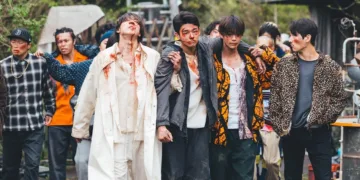















The Anatolian highlands in Emin Alper’s latest work read less like a map and more like a mood. In this semi-arid reach of rural Turkey, the land feels like a stern witness, staring down the friction between the Hazeron and Bezari clans. The film frames this as “territorial-dysmorphia,” a condition where the memory of ownership carries more weight than the ground itself. The Bezaris, once the affluent elite, fled the region during a period of civil strife. The Hazerons stayed behind, serving as government-armed guardians against local insurgency.
When the Bezari clan returns from exile to reclaim ancestral fields, the village’s thin peace starts to fray. Two brothers emerge as a split-screen of the community’s impulses. Sheikh Ferit, the younger, leans on inherited spiritual authority to preach coexistence, speaking as if a shared future can still be assembled from old grievances. Mesut, the older brother, treats reconciliation talk like surrender dressed up as virtue.
He carries the temperament of the parched earth: rigid, unforgiving, ready to crack. He watches the returning “outsiders” with a look that guards and hunts at once. A dispute over a few stony fields stops feeling like a civil quarrel and starts reading like an early warning system for tribal violence.
The Architecture of a Holy Mania
Mesut lives inside a permanent “shame-spiral,” a man building his identity on the unstable scaffolding of perceived inadequacy. He is the elder son passed over for leadership, stuck as a secondary character in his own family’s hagiography.
That sense of impotence finds its most dangerous outlet in the arrival of his wife’s pregnancy. When the village doctor announces that Gülsüm is carrying twins, Mesut reads it as an omen with teeth. He treats it as a curse, then seals himself inside a “superstition-fortress,” convinced twins serve as biological proof of the devil’s touch.
His domestic paranoia leaks into public life. Nightmares become divine directives in his hands, raw fear repackaged as destiny. He grows fluent in the “victim-aggressor” pivot, switching roles mid-sentence with the ease of someone who has practiced in the mirror. He invokes the “martyrs” of the past and frames the returning Bezari clan as an existential threat to their memory, and that story proves contagious.
Also Read






He leans on religious rhetoric to claim the state has abandoned the village, positioning himself as the remaining protector who still “gets it” (a familiar pitch, delivered with frightening confidence). The film captures how a marginalized figure can manufacture authority through fear, turning private collapse into a community instrument. He persuades his neighbors that salvation requires stained hands.
A Cartography of Oneiric Dread
Alper refuses the clean lines of traditional realism, choosing a visual mode of “claustro-spatial” unease. The village becomes a tangle of crumbling stone and flickering lamps that fail at the worst possible moments. Daylight gives the place a communal, near-pastoral surface. Night reshapes it into something predatory. The camera creeps through snaking alleys, then lurches toward sudden drops, tracking Mesut’s own loss of footing as if the environment has learned his rhythm.
The dream sequences follow a “blur-logic.” Monsters appear. Ghostly children drift through backstreets. The film declines the usual signposts that would neatly separate dream from waking life, so the viewer inherits Mesut’s confusion. Sound does the rest. Atonal strings and low-frequency drones hang in the air like a physical weight, turning simple conversations into something that feels like a prelude to execution.
The dreams can feel repetitive, and the repetition matters: it sketches a mind that no longer sorts shadow from threat with any reliability. Images of Chador-clad figures and symbolic animals bring a lyrical, near-gothic texture to what could have played as a straight social drama. The result lands as a sensory battering, a world where peace cannot take root because perception itself stays under siege.
The Anatomy of the Justified Atrocity
Salvation works like a biopsy of a radicalized mind, cutting into the “justification-engine” that lets ordinary people commit the unthinkable. Violence never arrives as a sudden lightning strike here. It accumulates through weaponized misconceptions and long-nursed lies, stacked carefully until the pile tips.
The film holds up a mirror to modern nationalist movements, showing leaders consolidating power by naming an “other” who can absorb blame for internal failures. What emerges is a study in “tribal-narcissism,” where the survival story of the group becomes permission to erase the person.
Patriarchal clan structures keep the voices of reason (often the women) pressed down to a murmur. Gülsüm stands as a tragic figure, her body turned into a battleground for her husband’s delusions. The men operate inside a “dialogue-vacuum,” refusing real speech with the opposing side until the language left is the pull of a trigger.
The film treats “salvation” as a word that can be bent into a warrant for total destruction, an easy halo for ugly impulses. The march toward the climax feels grim and prewritten. Once blood is shed, victory never enters the frame. The feud feeds a “savagery-loop,” and the next generation inherits ash, plus a list of names to avenge.
Salvation had its high-profile world premiere in the Official Competition of the 76th Berlin International Film Festival on February 15, 2026. Directed by the acclaimed Turkish filmmaker Emin Alper, the film is a gripping psychological drama inspired by true events, exploring the fallout of a decades-old land dispute in a remote mountain village. As of its premiere, the film is primarily available through the festival circuit, with domestic distribution in Turkey handled by Bir Film. International audiences can expect it to roll out in select theaters and streaming platforms following its festival run, with Lucky Number overseeing global sales.
Full Credits
Title: Salvation (Kurtuluş)
Distributor: Lucky Number (International Sales), Bir Film (Turkey), Meltem Films, TS Productions
Release date: February 15, 2026
Running time: 120 minutes
Director: Emin Alper
Writers: Emin Alper
Producers and Executive Producers: Nadir Öperli, Ersan Çongar, Laurent Lavolé, Miléna Poylo, Gilles Sacuto, Stienette Bosklopper, Maarten Swart, Yorgos Tsourgiannis, İrem Akbal
Cast: Caner Cindoruk, Berkay Ateş, Feyyaz Duman, Naz Göktan, Özlem Taş
Director of Photography (Cinematographer): Ahmet Sesigürgil, Barış Aygen
Editors: Özcan Vardar
Composer: Christiaan Verbeek
The Review
Salvation
Salvation is a harrowing examination of the psychological mechanics behind collective violence. Emin Alper crafts a world where religious hysteria and personal failure merge into a lethal ideology. The film demands a high level of patience from its audience because of its repetitive oneiric rhythms. The sheer intensity of the performances and the precision of the atmosphere make it a vital study of tribal radicalization. It remains a grim, necessary mirror to our contemporary political landscape.
PROS
- A commanding and visceral lead performance by Caner Cindoruk.
- Masterful use of lighting and sound to create a constant state of dread.
- An incisive, unflinching analysis of how nationalist rhetoric takes root.
CONS
- Occasional pacing issues that slow the narrative momentum.
- Dream sequences that occasionally repeat themes already established.