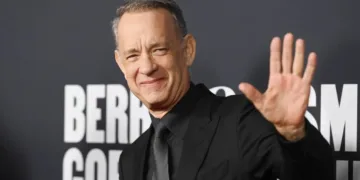


























Tom Hanks has been set to play Abraham Lincoln in a film adaptation of George Saunders’ Lincoln in the Bardo, a project that pairs a major star with one of the most formally daring American novels of the past decade and a filmmaker known for stop-motion work. Trade reports on Feb. 23-24 said Duke Johnson will direct, Saunders is adapting his own book, and Hanks will produce through Playtone with Gary Goetzman. Reports also said the film is planned as a live-action/stop-motion hybrid, with production expected in London.
The story shifts attention away from Lincoln’s public speeches and war-room image and toward private grief after the 1862 death of his son Willie. The novel centers on a cemetery setting and a chorus of voices, a structure that has long made it exciting for filmmakers and difficult to translate to screen. The Booker Prize site describes the book as being “narrated by a chorus of voices,” and Penguin Random House’s audio division previously mounted a 166-voice audiobook cast, a sign of how central multiplicity is to the material.
A notable wrinkle in the new casting is Hanks’ family connection: entertainment coverage has pointed to genealogy records describing him as a distant relative of Lincoln through Lincoln’s mother, Nancy Hanks. Hanks has built a long run of performances as real people, which gives the casting an immediate hook for studios and audiences alike.
Johnson’s involvement has drawn attention from film watchers because his co-directed Anomalisa earned an Academy Award nomination for animated feature, and the new project leans into a format that sits between performance drama and handcrafted animation.
The historical episode behind Saunders’ novel carries its own debate. Multiple accounts say Lincoln visited Willie’s temporary crypt at Oak Hill Cemetery after the funeral, and Library of Congress educational material notes Willie’s remains were temporarily interred in the Carroll vault in Georgetown. Some historians, cited in Smithsonian reporting, have said there is no firm evidence for the oft-repeated claim that Lincoln held the boy’s body, a distinction that may shape how viewers read the film’s emotional realism once more details emerge.