






















Dāvis Sīmanis’ The Year Before the War arrives like a fever dream scratched onto old nitrate, a black-and-white vision of Europe in 1913, one year before the continent begins tearing itself apart. It is strange, comic, ominous, and politically fevered, a film where history feels less like a chain of events than a sickness moving through rooms, train cars, forests, hotels, and lecture halls.
The film follows Hans, also called Peter or Petr, a Latvian hotel doorman in Riga whose life slips from its frame after he is mistaken for an anarchist. From there, identity becomes a loose garment. He crosses Europe through revolutionary circles, romantic delusion, psychoanalysis, and political violence, brushing against distorted versions of Freud, Lenin, Trotsky, Kafka, and a Mata Hari-like figure named Alma. Sīmanis treats 1913 as a haunted threshold. Everyone speaks, argues, desires, plots, and laughs, yet the dead future already stands in the doorway.
A Man Misnamed by History
The film moves as a picaresque, closer to a wandering nightmare than a conventional plot. Hans drifts through Riga, Switzerland, Vienna, Paris, Prague, London, and other spaces where Europe seems to be rehearsing its own collapse. The chaptered structure, divided by months, gives the film a quiet countdown. Time is not passing gently here. It is tightening.
Hans begins as a modest worker, nearly blank in his simplicity, then becomes a vessel for every violent idea that crosses his path. His changing name matters. Hans, Peter, Petr. Each version suggests another pressure placed upon him, another claim made by ideology, romance, class anger, or history itself. He is an everyman, yet that word feels almost too clean for him. He is a man emptied out until causes can enter him.
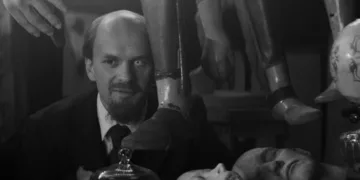
Sīmanis turns famous historical figures into grotesque apparitions. Freud is comic and faintly monstrous, reducing the mind to a maze of appetite and buried guilt. Lenin and Trotsky appear theatrical, feverish, almost demonic in their certainty. Early Hitler lingers like poison barely named. Realism is not the goal. These figures become symptoms of a diseased age, each carrying a theory, a grievance, a promise, or a gun.
Alma gives the film its thinnest thread of tenderness, though tenderness here is never safe. Her connection with Hans feels erotic, symbolic, and unstable. She is lover, spy, ghost, and warning sign, drawing him deeper into a world where desire and destruction keep speaking the same language.
Black-and-White Catastrophe
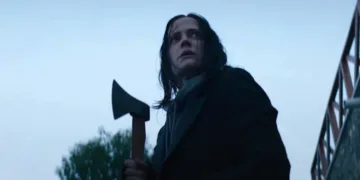
Visually, The Year Before the War is often astonishing. Andrejs Rudzāts’ black-and-white cinematography gives the film the texture of early cinema filtered through German Expressionism and surrealist dread. The opening image, with frozen fish, ice workers, and a man walking into a freezing lake, tells us how to watch the film. Life is trapped under ice. Death is already part of the landscape. Meaning will come in symbols, not explanations.
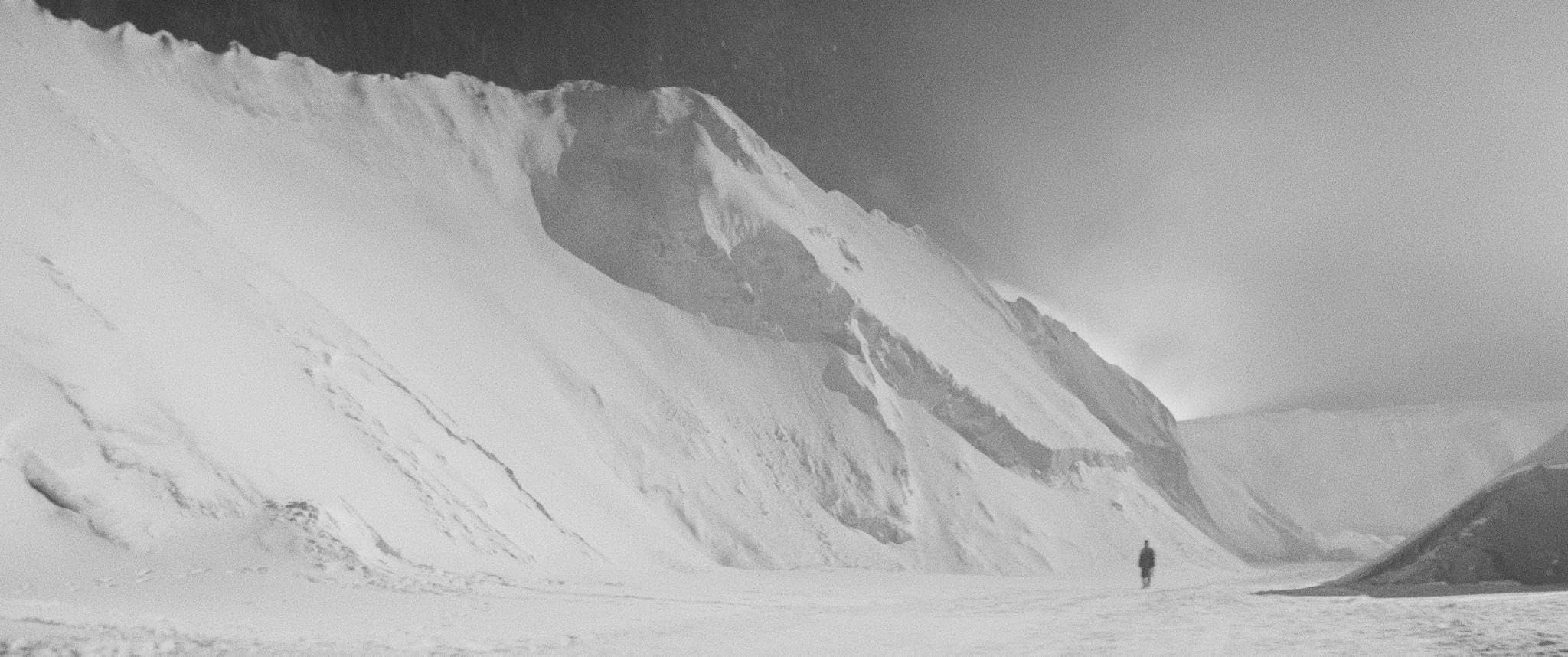
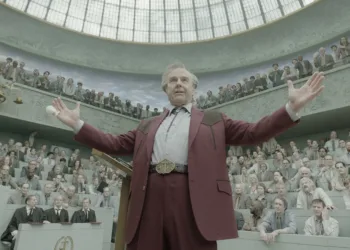
The camera finds beauty everywhere, then makes that beauty suffocating. Snow turns into a blank page waiting for blood. Architecture cages bodies. Political halls become ritual chambers. Forests and cities dwarf Hans, reducing him to a figure moved by forces he cannot name. The world looks grand and doomed, full of hard light, heavy shadow, and faces that seem carved out of old anxieties.
Anna Ryndová’s editing gives the film its nervous bloodstream. Months pass, places shift, moods fracture. One moment feels comic, the next grotesque, the next strangely mournful. This rhythm captures a Europe rushing toward disaster while still pretending it has time to debate, seduce, diagnose, and philosophize.
The silent-era touches deepen the film’s eerie playfulness: sped-up drunken motion, expressive gestures, theatrical compositions, faces held in stark contrast. Faustas Latenas’ score gives several passages a spectral charge, though there are moments where a stronger musical presence might have sharpened the film’s more disjointed episodes. Still, the soundscape leaves space for the images to breathe, or perhaps to rot.
Ideology, Hunger, and the Shape of Violence
The film’s darkest force is its vision of human beings searching for meaning inside systems that devour them. Political extremism, class rage, anti-Semitism, nationalism, revolution, masculinity, and war fever all pass through the film like infected air. Europe appears fluid on the surface, full of languages, border crossings, and cultural exchange. Underneath, violence waits with terrifying patience.

A train scene involving anti-Semitism carries particular weight because it shows horror before it has acquired its later machinery. The cruelty is casual. The humiliation is public. The future is already present in miniature, sitting in the carriage, accepted by those who look away. Sīmanis understands that catastrophe rarely arrives from nowhere. It practices first in gestures, jokes, rules, and permissions.
The tone is a dark tragicomedy, sometimes absurd enough to make the viewer laugh, then cold enough to make that laughter feel suspect. Intellectuals chatter. Radicals perform certainty. Men carry pistols as if murder might solve metaphysics. The comedy comes from the ridiculous vanity of people convinced they can master history. The horror comes from knowing history will use them instead.
Hans’s transformation is the film’s bleakest movement. He wants purpose, perhaps even love, yet he becomes useful to violence. By the later visions of war, revolution, and tribunal-like authority, Sīmanis suggests that liberation can curdle into punishment with frightening ease. The Year Before the War is dense, puzzling, and intentionally disorienting, yet its images stay lodged in the mind like frostbite. It watches a continent dream of remaking itself, then shows the dream sharpening into a blade.
The Year Before the War is a 2021 surrealist historical thriller directed by Dāvis Sīmanis. The film follows a Latvian man, Peter, also known as Hans, as he moves through Europe in 1913, encountering revolutionary politics, psychoanalysis, espionage, ideological extremism, and the shadow of the coming First World War. The film premiered at the International Film Festival Rotterdam on February 5, 2021, later screened in Lithuania on December 17, 2021, and received its Latvian theatrical release on April 15, 2022. As of May 30, 2026, viewing options vary by region, with listings showing availability through DAFilms and Klassiki in some territories.
Where to Watch The Year Before the War (2021) Online








Full Credits
- Title: The Year Before the War
- Distributor: Locomotive Productions
- Release date: February 5, 2021 at the International Film Festival Rotterdam, December 17, 2021 in Lithuania, April 15, 2022 in Latvian theaters
- Running time: 95 minutes
- Director: Dāvis Sīmanis
- Writers: Dāvis Sīmanis, Tabita Rudzāte, Uldis Tīrons
- Producers and Executive Producers: Roberts Vinovskis, Uljana Kim, Radim Procházka, Dominiks Jarmakovics
- Cast: Petr Buchta, Inga Siliņa, Ģirts Ķesteris, Lauris Dzelzītis, Gints Grāvelis, Juris Strenga, Jānis Putniņš, Eduards Johansons, Edgars Kaufelds, Daniel Sidon, Rūdolfs Apse, Igors Jakimenko
- Director of Photography: Andrejs Rudzāts
- Editors: Anna Ryndová
- Composer: Faustas Latenas
The Review
The Year Before the War
The Year Before the War is a strange, hypnotic, and demanding historical nightmare, rich with black-and-white beauty, absurd humor, and political dread. Its fractured structure may test some viewers, yet its vision of Europe drifting toward catastrophe has a chilling force. Dāvis Sīmanis turns history into a feverish moral landscape where identity, ideology, and violence dissolve into one another.
PROS
- Stunning black-and-white cinematography
- Bold surrealist tone
- Strong historical and philosophical weight
- Memorable use of absurd humor
- Striking silent-cinema influence
- Petr Buchta gives Hans a haunting instability
CONS
- Dense structure may feel alienating
- Some historical references can feel obscure
- Emotional thread with Alma remains intentionally distant
- Certain episodes feel sharper than others
- The score could have had a stronger presence