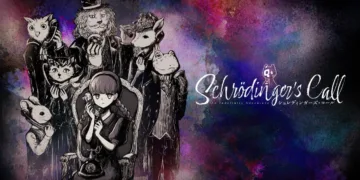




























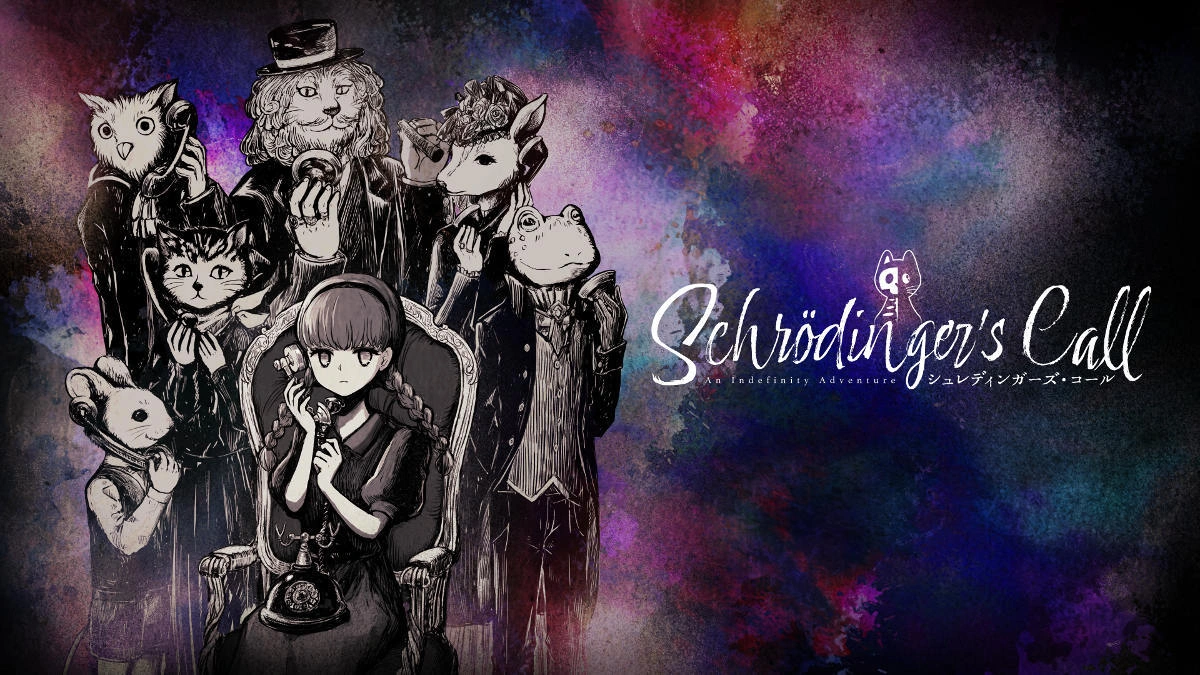

Schrödinger’s Call begins with a premise that feels intimate and cosmic at once. Mary wakes with no memory of who she is, where she is, or why the world around her seems frozen in catastrophe. Her only guide is Hamlet, a talking black cat with a theatrical name and a habit of explaining horror with unsettling calm. Her only tool is an antique telephone. Through it, she becomes the World’s Last Confidant, listening to spirits suspended near death and helping them face the regrets that keep them trapped.
Developed by Acrobatic Chirimenjako and published by Shueisha Games, the game sits close to the visual novel tradition, yet its tone reaches toward ghost stories, philosophical fiction, and experimental animation. The title’s connection to Schrödinger’s Cat is clear: these characters exist in a fragile state between life and death, memory and erasure, truth and emotional survival. What makes the game striking is how it turns that abstract idea into something painfully human. Every call is less a puzzle about facts than a wound asking to be understood.
Grief as a Shared Language
The story unfolds through separate cases, each built around a caller whose memories have collapsed into fragments. Mary listens, asks questions, gathers clues, and slowly reconstructs the pain that defines each person. These stories deal with guilt, love, self-hatred, fear, and emotional paralysis. The apocalypse gives the game scale, yet the writing keeps returning to private moments: a relationship that broke someone, a truth left unsaid, a decision that cannot be undone.
That focus gives Schrödinger’s Call a distinctly Japanese sensitivity toward liminal space. Its world feels shaped by ideas of unresolved spirits, cyclical suffering, and the need for emotional release before rest can arrive. The climactic confrontations carry traces of Buddhist imagery, particularly the sense of people caught inside loops of attachment and regret. Still, the game does not feel culturally sealed off. Its pain is specific enough to feel local, then direct enough to travel. Anyone who has avoided a truth for too long will understand the emotional grammar of these calls.
Mary’s own identity deepens that structure. At first, she seems like a listener, a vessel for other people’s stories. Gradually, each case starts reflecting something back at her. The callers’ regrets circle around her missing past, turning the game into a quiet study of how empathy can expose the self. Hamlet gives this darkness an odd rhythm. He can be cryptic, amusing, and faintly sinister, making the relationship between guide and captive feel unstable in a useful way.
The writing reaches its strongest moments when it resists easy catharsis. It understands that comfort and truth are rarely cleanly separated. Some scenes let characters face unbearable memories without reducing their pain to a moral lesson. The weakness is pace. A few conversations stretch too long, and certain chapters linger past their emotional peak. The game’s sadness works best when it is precise.
Listening as Gameplay
Mechanically, Schrödinger’s Call is simple. Most of the game involves answering calls, choosing dialogue responses, checking Mary’s notebook, and using gathered information to contact the right people. There are light point-and-click moments, though exploration stays limited. The notebook becomes the central bridge between story and play. It records names, memories, keywords, phone numbers, and sketches, giving the player a way to organize grief into something legible.

That design recalls mystery visual novels and courtroom adventure games such as Ace Attorney, where progress often depends on presenting the right clue at the right moment. Here, though, the purpose is emotional rather than legal. You are not exposing contradictions to win an argument. You are trying to understand what someone needs to hear while they are trapped inside their worst moment.
This is where the game’s choices become interesting, and sometimes frustrating. Schrödinger’s Call is mostly linear, so players expecting branching routes or radically different outcomes may feel confined. Dialogue choices shape the texture of conversations, yet they rarely reshape the story’s path. The game asks for empathy instead of strategy. It wants you to listen closely, read emotional context, and respond with care.
That can create powerful tension. A response that seems compassionate in theory may fail because the caller needs honesty rather than comfort. At times, the correct answer can feel unclear, which may come from the writing’s ambiguity or from translation friction. Still, the game usually lets you recover from mistakes, and that suits its design. Failure is treated less like defeat than a misunderstanding that must be repaired.
The chapter climaxes are the clearest fusion of narrative and mechanics. Mary uses the information she has gathered to guide each caller through a confrontation with regret. Animation intensifies, music swells, and the game turns conversation into an emotional struggle. It is limited as a system, yet meaningful as a ritual.
A Visual Novel That Thinks in Sound and Shadow
The presentation is where Schrödinger’s Call leaves its sharpest mark. Its black-and-white art style evokes picture books, manga, ink drawings, and theatrical shadow play. Characters are drawn with visible lines and fragile textures, while backgrounds slide between intimate spaces and abstract nightmare imagery. Faces distort. Shadows swallow edges. Some scenes feel unfinished by design, as if memory itself has refused to render cleanly.
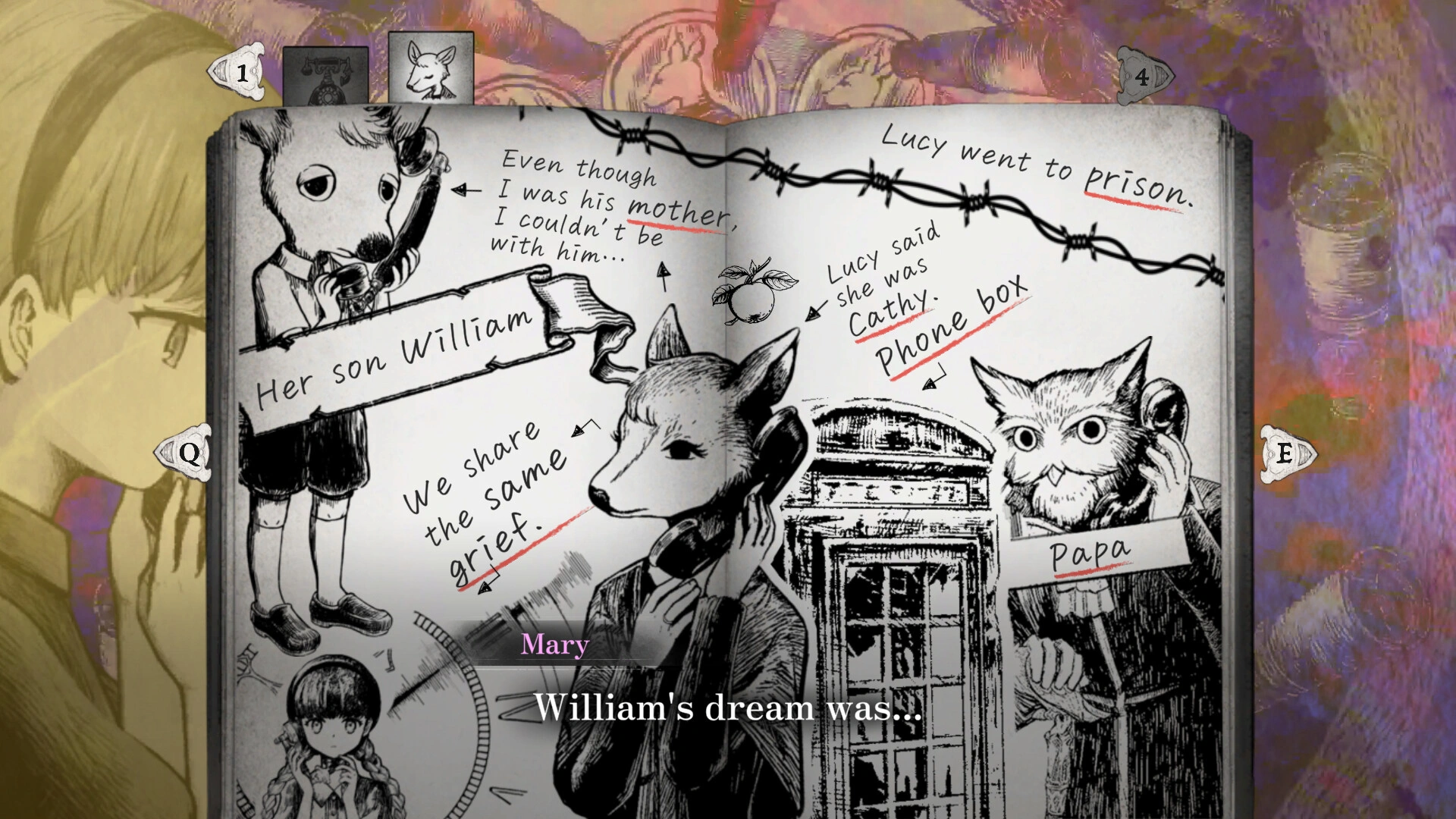
Selective color gives the monochrome world sudden force. Red, blue, and gold appear with precision, turning small visual details into emotional signals. The result recalls strands of Japanese experimental animation, especially works that use limited palettes and surreal framing to express mental collapse. The game also shares something with international art cinema: the confidence to let silence, framing, and visual repetition carry meaning before dialogue explains it.
Sound is just as important. Melancholic melodies drift through quieter scenes, then give way to orchestral swells, distorted voices, and dissonant effects. Headphones make a real difference because the audio often feels spatial and invasive, like the calls are entering Mary’s head rather than simply playing through speakers. The voice effects create distance between player and spirit, though they sometimes lack emotional variation. A character can sound similar in calm and distress, which briefly weakens the illusion.
The interface is restrained and effective. The phone, notebook, keywords, and visual cues are easy to read, and the game uses layout without breaking its somber tone. Accessibility options include text speed and vibration settings, with warnings for flashing images and intense effects. Those warnings matter, since some sequences can be visually aggressive.
Schrödinger’s Call will not suit every player. Its pace is slow, its structure repeats, and its narrative control is narrower than some may hope. Yet for players drawn to abstract storytelling, grief-centered fiction, and visual novels that treat listening as an act of play, it offers a haunting experience shaped by empathy, uncertainty, and the strange comfort of a voice on the other end of the line.
The Review
Schrödinger's Call
Schrödinger’s Call is a haunting visual novel with a powerful story, striking monochrome art, and sound design that turns every phone call into a fragile emotional encounter. Its gameplay is limited and its pacing can drag, yet the game’s empathy-driven choices, surreal atmosphere, and layered writing make it linger after the screen fades. For players open to slow, abstract, grief-centered storytelling, this is a memorable experience.
PROS
- Beautiful black-and-white art direction
- Strong emotional storytelling
- Excellent sound design and music
- Smart use of the notebook and clue system
- Memorable themes of grief, memory, and identity
CONS
- Slow pacing in some chapters
- Limited branching choices
- Repetitive structure
- Some dialogue feels drawn out
- Distorted voice effects can lack variation