























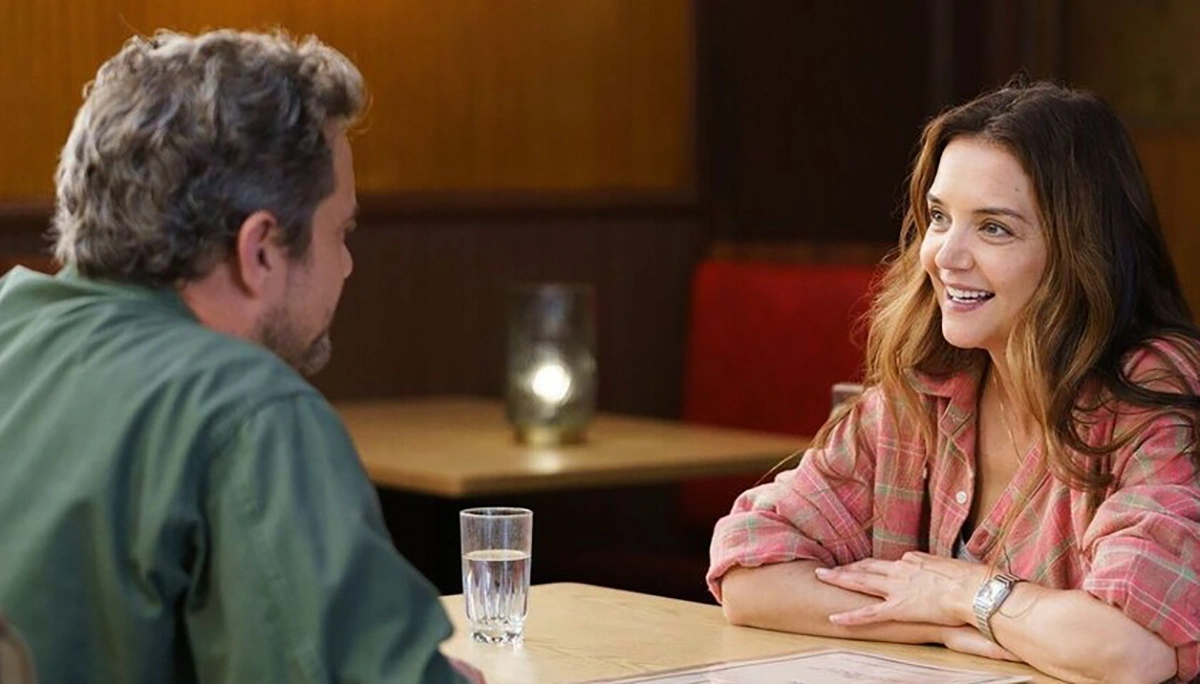

Happy Hours is a romantic dramedy built on a simple question: what happens when the person you once loved returns after life has had several decades to complicate the fantasy? Katie Holmes writes, directs, and stars as Liz, a newly divorced New York photographer trying to rebuild her sense of self after emotional upheaval. Joshua Jackson plays Andrew McCloud, a successful travel writer and Liz’s first great love, whose sudden reentry into her life turns a professional assignment into a reckoning with memory.
The film’s Alan Watts quotation about the past surviving through memory gives the story its clearest thematic frame. Liz and Andrew are not facing the past as it was. They are facing the edited version they have carried with them. That is a promising starting point for a midlife romance. Happy Hours has warmth, sincerity, and two appealing leads, yet it often trusts familiar romantic beats to do work that stronger character writing should have handled.
The Shape of a Second Chance
Liz is introduced at a point of personal reset. Her divorce has left her raw, and her photography career has become part of that recovery process. She wants to photograph “real people,” a phrase that signals both artistic frustration and emotional hunger. She is tired of surfaces, which makes Andrew’s arrival neatly ironic: he is both a real person from her past and a symbol she has spent years preserving in emotional amber.

The script moves between present-day New York and flashbacks of Liz and Andrew’s younger romance. Structurally, this should let the film examine how young love becomes adult mythology. The past scenes show the intensity of first attachment, while the present asks why two successful, attractive adults still seem trapped by a relationship that ended long ago. That tension has potential. The film understands that memory can soften old hurt, then turn it into something dangerously seductive.
The issue is that Liz and Andrew often feel sketched rather than fully built. Their reunion depends heavily on the actors’ natural rapport, which carries several scenes through thin writing. Liz’s grief and guardedness help explain her defensive edge, yet the film sometimes pushes her into reactions that feel arranged for conflict rather than rooted in emotional logic. Andrew, meanwhile, is charming by design, which makes him pleasant company but less dramatically textured than the story needs.
The obstacles in their path feel similarly engineered. Instead of conflict emerging from what they want, fear, or refuse to admit, the film often drops in tension to keep the romance from resolving too quickly. For an 80-minute film, it can still feel underwritten. That is a strange little magic trick.
Chemistry Does the Heavy Lifting
Holmes and Jackson remain the film’s best argument for itself. Their shared screen history gives Happy Hours an immediate charge, especially for viewers who arrive with affection for their earlier television pairing. The film is aware of that built-in nostalgia, perhaps too aware, yet the performers give it a softness that cannot be manufactured through casting alone.
Jackson brings an easy, almost frictionless charm to Andrew. He makes the character likable even when the script gives him little beyond thoughtful glances, literary success, and romantic patience. Holmes gives Liz a quieter ache. Her performance is strongest when Liz seems caught between wanting control and fearing what control has cost her. The character’s sharper moments can be frustrating, but Holmes finds the wound beneath them.
The supporting players bring welcome texture. Mary-Louise Parker, as Liz’s free-spirited aunt, injects a saltier comic rhythm whenever the film risks becoming too sweet. Andrew’s friends, played by Joe Tippett and John McGinty, provide some of the movie’s most relaxed and genuinely funny material. Their scenes have the looseness of actual friendship, with jokes landing because the characters seem comfortable around each other rather than because the screenplay has underlined the punchline.
McGinty’s presence also gives the film one of its more refreshing details. The ASL conversations are integrated naturally, without turning Deaf representation into a lesson plan. The friendship scenes have a lived-in quality that the central romance sometimes chases without fully catching.
A Gentle Film Caught Between Modes
Holmes directs Happy Hours with obvious affection for talk-driven romance, urban wandering, and the way a city can make coincidence feel almost reasonable. New York becomes a soft romantic field for photo shoots, chance meetings, bruised conversations, and late-in-life emotional testing. The film draws from the tradition of romances built around conversation, time, and unfinished feeling, though its dialogue rarely has the density or surprise required for that model.
This is where the film’s tonal uncertainty becomes visible. At times, it wants the clean machinery of a traditional romantic comedy: the reunion, the spark, the misunderstanding, the grand emotional pull. At other points, it aims for something looser and more reflective, a study of aging, regret, and the stories people tell themselves about lost love. Those two versions of the film are compatible in theory, but Happy Hours struggles to make them move at the same rhythm.
The visual approach is modest, sometimes too modest. The cinematography can feel flat, especially for a film about a photographer learning to see people honestly. The flashbacks and present-day scenes do not always build emotional momentum through editing, which weakens the intended dialogue between youth and middle age.
The music works better. Blondie gives the younger romance a shared pulse, while Norah Jones’ softer mood fits the adult timeline’s tenderness and fatigue. Those choices help express what the screenplay sometimes states too plainly.
Happy Hours is sincere, warm, and occasionally funny, with Holmes and Jackson giving it a romantic glow the writing only partly earns. It is a generous film about second chances, memory, and the stubborn appeal of old feelings. It is also predictable, thinly drawn, and overly dependent on nostalgia. Charming company, yes. A great love story, not quite.
Happy Hours is an American romantic comedy-drama film that celebrated its official world premiere at the Tribeca Festival on June 6, 2026. Written, directed by, and starring Katie Holmes, the production serves as a highly anticipated on-screen reunion with her former co-star Joshua Jackson. The narrative follows a newly divorced professional photographer and a successful travel writer who unexpectedly cross paths in New York City decades after their teenage romance ended, forcing them to navigate old wounds and assess whether they can build a new adult relationship together. Audiences interested in watching the independent feature can track its screening schedule across the festival circuit while the production companies finalize wider theatrical and digital streaming distribution rights.
Full Credits
Title: Happy Hours
Distributor: Maven Screen Media, Bond Street Station, STX Films
Release date: June 6, 2026
Running time: 90 minutes
Director: Katie Holmes
Writers: Katie Holmes
Producers and Executive Producers: Paula P. Manzanedo, Celine Rattray, Trudie Styler
Cast: Katie Holmes, Joshua Jackson, Mary-Louise Parker, Joe Tippett, Constance Wu, John McGinty, Jack Martin, Johnna Dias-Watson, Donald Webber Jr., Chloë Kerwin
Director of Photography (Cinematographer): Michael McDonough
Editors: Ian Blume
Composer: Norah Jones
The Review
Happy Hours
Happy Hours is a warm, sincere midlife romance carried by Katie Holmes and Joshua Jackson’s easy chemistry, even when the script gives them too little dramatic weight to carry. Holmes finds tenderness in memory, regret, and second chances, but the film often relies on nostalgia where sharper characterization should be. The supporting cast brings welcome humor and texture, while the central romance remains pleasant yet thinly developed. It is watchable, affectionate, and modestly charming, though rarely as emotionally rich as it wants to be.
PROS
- Katie Holmes and Joshua Jackson share natural chemistry
- Warm New York setting gives the film a pleasant romantic texture
- Mary-Louise Parker adds sharp comic energy
- John McGinty and Joe Tippett bring lively friendship scenes
- ASL representation feels casual and refreshing
- Sincere exploration of memory, old love, and emotional second chances
CONS
- The romance relies too heavily on nostalgia
- Flashbacks are underdeveloped
- Dialogue can feel too direct and overly tidy
- Some conflicts feel manufactured
- Flat cinematography limits the film’s visual personality
- The story lacks the depth needed for its larger trilogy ambitions





What a poetic, insightful and lovely review. I wanted to ‘underline’ so many sentences, as one used to do when reading books. I so appreciate the reviewer’s perspective.